

This article was automatically translated from the original Turkish version.
+2 More
Name | Han Yunus Massacres | ||||||||
|---|---|---|---|---|---|---|---|---|---|
Event | Massacre Mass Grave | ||||||||
Massacre Periods | 2014 (Huzaa Village) 2024 (Naseer Hospital) 1956 (All of Han Yunus) | ||||||||
Side | Han Yunus People (Civilian Population) Israel Defense Forces (Perpetrator Force) | ||||||||
Estimated Loss | 1000+ (Only reported attacks in 1956 and Naseer) | ||||||||
Han Yunus Massacres, refer to a series of events in which civilians in Han Yunus and surrounding settlements in southern Gaza were either collectively killed or found in mass graves, particularly in 1956, 2014 (Huzaa), and 2024. During the 1956 Suez War, units affiliated with the Israeli military killed more than 600 Egyptians and Palestinians in Han Yunus.【1】 The massacre is kept alive in local and international collective memory through annual commemorations held in the town.
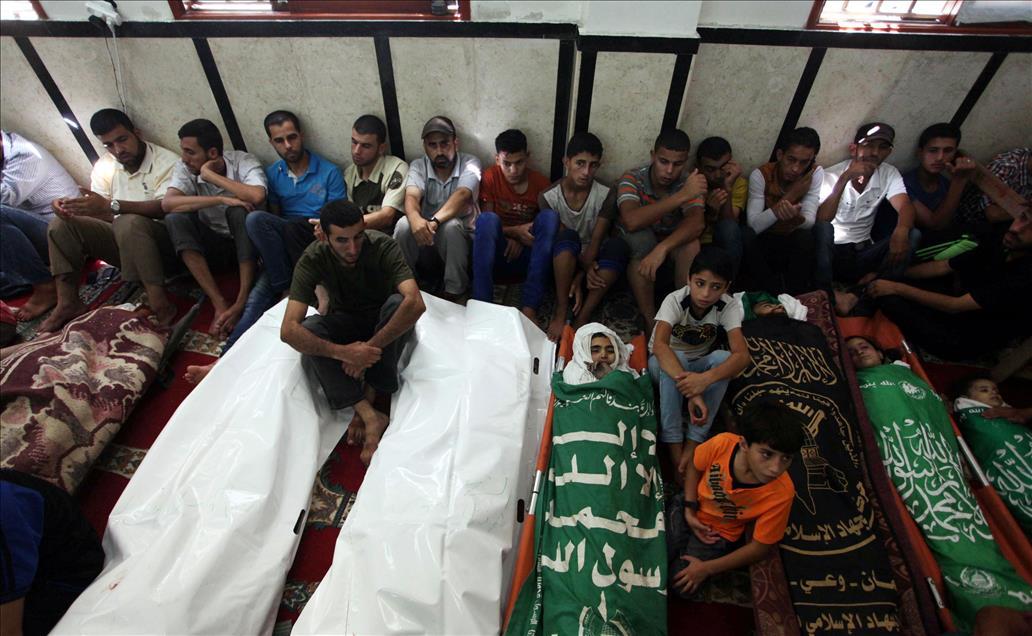
Following the 2014 massacre in Huzaa, a neighborhood of Han Yunus, during a brief ceasefire, ambulances had limited access to the area, resulting in bodies left uncollected for days. These corpses were retrieved using rudimentary means, and reports indicate that bodies were covered with blankets and sheets on the streets.
In 2024, after a siege and withdrawal, civil defense teams recovered numerous bodies from mass graves at the Nasser Medical Complex in Han Yunus. UN Human Rights Office spokesperson Ravina Shamdasani reported that some bodies were found with their hands bound and stripped of clothing.【2】
Han Yunus has served as a central hub in southern Gaza, situated at the intersection of north–south civilian mobility and essential service flows. The town lies on a flat settlement belt extending between the coast and inland areas, forming an administratively and logistically integrated area with surrounding neighborhoods and villages.
Shelter and supply networks in the region have historically operated at high density. Even in the autumn of 1956, the majority of Gaza’s population depended on international aid distributed through this area for regular food and basic services; during periods of curfews, supply routes were periodically opened and closed to sustain deliveries.
As the present day approaches, attacks concentrated along the northern axis and mass displacement toward the southern axis have increased the burden on Han Yunus. Within a short time, the shelter, food, and basic hygiene needs of hundreds of thousands of people accumulated in the town and surrounding facilities. This pressure was partially addressed by converting educational buildings and public facilities into temporary shelters, exceeding their normal capacity.

Map Showing the Han Yunus Region and Huzaa Village (Anadolu Ajansı)
The healthcare infrastructure has been shaped around two institutions centered in Han Yunus. The Nasser Medical Complex emerged as the backbone of the referral system, providing secondary and some tertiary services. Despite limited bed capacity, its maternal–child care and intensive care units became regional reference points.
The European Gaza Hospital has served as the other main reference point in southern Gaza, complementing Nasser Hospital particularly in inpatient services and advanced diagnostic–treatment procedures. Disruptions in fuel and electricity supply created critical bottlenecks in essential operational chains such as cold storage and sterilization, leading to periodic reductions or complete suspension of services.
In terms of transportation and external connectivity, Han Yunus is positioned along the north–south main road artery. Internal roads were operated as one-way or corridor systems during periods when aid and medical convoys were prioritized; temporary arrangements were made to ensure access in damaged areas.
The Rafah Crossing at the southern border functioned as a critical gateway for evacuations, referrals, and humanitarian movements; during certain periods, medical referrals and foreign aid were conducted through this route. Within this integrated framework, Han Yunus has become one of the leading centers in southern Gaza for organizing shelter, supply, and healthcare services due to its geographic location and infrastructure nodes.
The events in Han Yunus during the autumn of 1956, within the context of the Gaza War, constitute a large-scale massacre occurring during the implementation of the Israeli, British, and French campaign against Egypt. The civilian population in the town faced house raids accompanied by “screening and interrogation” operations; during this period, more than 600 Palestinians and Egyptians were killed in Han Yunus. The incident was characterized by curfews, mass deportations, and executions at the town level.
Following Gamal Abdel Nasser’s nationalization of the Suez Canal in July 1956, Britain, France, and Israel—already deriving strategic and economic benefits from the canal—were dissatisfied and refused to recognize the move, triggering the Suez Crisis. In the same year, a secret agreement known as the Sèvres Accord was reached between France and Britain, aiming to weaken Nasser’s regime in Egypt with Israeli cooperation. Under this plan, Israel would launch an attack on the Sinai Peninsula to initiate hostilities, after which Britain and France would intervene under the pretext of “ceasing the conflict.” The plan was executed on October 29, when Israeli forces entered Sinai and subsequently occupied the Gaza Strip during their advance.
At this stage, Israel aimed to cripple Egypt’s military capacity in Sinai and shift the battlefield’s reality in its favor, while also seeking permanent control over Gaza and Sinai. However, this expectation was not realized due to intense international pressure. Strong diplomatic interventions by the United States and the Soviet Union halted British–French air operations and landing attempts, and Israel was ultimately compelled to withdraw from Sinai and Gaza by March 1957.
The entry of Israeli forces into Gaza occurred as part of the operational execution of this tripartite plan. In this context, the Han Yunus area, being one of the largest centers for humanitarian aid and food distribution along the north–south axis, was specifically targeted by Israel. In the first days of the occupation, announcements instructed residents to gather at designated locations for screening operations. In the ensuing panic, as many civilians rushed to these assembly points fearing they would not arrive on time, Israeli forces used indiscriminate lethal force, rapidly increasing the death toll.【3】
At the outset of the conflict, more than two-thirds of Han Yunus’s civilian population—over 213,000 people—depended on UNRWA aid distributions. It became clear that the occupying administration could not assume responsibility for basic services; the UN agency promptly dispatched an emergency team to implement extraordinary measures to prevent interruptions in food and essential services.【4】 The losses during military operations and the destruction of civilian infrastructure contributed to the rapid inability to mitigate humanitarian consequences after the war ended.
By late November, despite a partial military de-escalation, screening and interrogation activities continued “regularly”; violations of the laws of war observed in the initial days persisted in subsequent days. This pattern demonstrates how concentrated episodes of violence in Han Yunus over several days or weeks were intertwined with broader military–administrative practices across the region, including curfews, public announcements for assembly, screening checkpoints, and deportation centers.
It is evident that deaths in Han Yunus were concentrated within a short time frame. Announcements calling for men to assemble at specific locations, house raids, and large-scale sweeps followed one another; during this period, more than 600 people were killed. The functioning of this mass deportation–screening system was similarly applied in other parts of Gaza; factors such as civilian panic and indiscriminate military fire significantly increased casualties.
The massacre in Han Yunus aligns with patterns of gunfire during screenings and mass detentions recorded elsewhere in Gaza during the same period; however, the exceptionally high number of casualties in Han Yunus has established this incident as a distinctive landmark in the town’s collective memory.
Under emergency conditions, internal movement in the town was restricted by curfew hours and security constraints; many corpses were buried without identification. During the days of the massacre, main roads and intersections in the town rapidly became routes for collecting and transporting bodies; carts and civilian vehicles were used to transport remains to burial sites. These conditions made it difficult to compile a detailed “list of names” afterward, increasing uncertainty in casualty figures. One of the key objectives of the commemorative and documentation efforts initiated in Han Yunus since 1956 has been to fill these identification gaps as much as possible.
In Han Yunus, annual commemorations are organized by the municipality and the “Committee for the Commemoration and Documentation of the Martyrs of the Han Yunus Massacre”. These events emphasize that over 600 people were killed in the town in 1956; appeals are repeatedly made to remember the victims by name and family, collect testimonies, and establish legal documentation for judicial applications.

Commemoration on the 64th Anniversary of the Han Yunus Massacre (Anadolu Ajansı)
These efforts aim to sustain collective memory on one hand, and on the other, to collect evidence and documents for potential use in international legal mechanisms.
The events in Huzaa village, east of Han Yunus, during the summer of 2014, created a crisis scenario in which even during brief ceasefires, full access to the area was not granted. It was documented that during ceasefire intervals, ambulances could enter the area only with severe restrictions, forcing residents to retrieve bodies waiting for days using rudimentary means. Conditions on the ground became so severe that walking without covering the mouth and nose became impossible; corpses left on the streets were covered with blankets and sheets.

Eight Members of the Same Family Who Died Following the Huzaa Massacre (Anadolu Ajansı)
Huzaa’s narrow street network and its adjacency to the Han Yunus urban center rendered access routes highly vulnerable. Even during brief ceasefire periods, the lack of full freedom of entry for ambulances led to burial and recovery operations being carried out primarily by local residents rather than professional teams. This situation delayed emergency medical and transport services and contributed to the growing number of uncollected corpses.
For areas inaccessible for long periods, residents used ropes, hand tools, and simple carrying devices to conduct recovery operations amid rubble and difficult terrain. Corpses found on streets and open areas were covered with blankets and sheets to reduce odor and environmental impact. This practice provided temporary protection until bodies could be transported to main routes accessible by burial teams and ambulances.

Destruction in the Area Following the Huzaa Massacre (Anadolu Ajansı)
The Huzaa incident was systematically documented by media personnel on the ground. Footage by Ali Hassan and Belal Khaled detailed the limited ambulance access and local residents’ practices of retrieving and covering bodies. Ashraf Amra’s recordings captured the scale of mass casualties and funeral rites in nearby areas as attacks continued. These visual records enabled a detailed reconstruction of the event’s temporal–spatial framework and its civilian impact.【5】
The Nasser Medical Complex in Han Yunus became one of southern Gaza’s primary referral and treatment centers after October 7, 2023. Following Israeli attacks targeting the maternity and intensive care units of both Shifa and Nasser hospitals, shortages of fuel, electricity, and medical supplies led to a partial shutdown decision on February 27, 2024. From that date onward, intense siege conditions severely disrupted the hospital’s morgue capacity, burial procedures, and record-keeping systems.【6】
In spring 2024, following the withdrawal of Israeli forces, mass grave sites were uncovered within and around the hospital compound. Civil defense teams conducted excavation and recovery operations under conditions of limited equipment and damaged infrastructure, quickly bringing to the surface hundreds of bodies.

Mass Graves Uncovered After the Attack on Nasser Hospital (Anadolu Ajansı)
Local health units and field teams reported that numerous bodies could not be identified and were in an advanced state of decomposition due to prolonged lack of access. This situation hindered autopsies and identifications, making most standard medical examinations before burial impossible.
Site assessments revealed that some graves were located within the hospital grounds, such as courtyards and gardens, while others were situated in adjacent areas beyond the compound perimeter. During the siege, it was reported that Israeli forces buried civilians in mass graves, and hospital staff, facing risks of infectious disease and foul odor after morgues became non-functional, resorted to emergency temporary burials. After access was restored, these areas were reopened through excavation.

Nasser Hospital After Bombardment (Anadolu Ajansı)
Among the recovered bodies were elderly individuals, women, and injured persons. In some cases, bodies were found with hands bound or stripped of clothing. Han Yunus Civil Defense authorities pointed to findings suggesting the possibility that some individuals were alive at the time of burial or killed at close range, and called for systematic, expert-led investigations.【7】
Partial destruction of hospital records during the conflict, staff displacement, and collapse of communication infrastructure created major obstacles to identification. For recovered bodies, physical and facial features, dental records, personal belongings, and family testimonies were evaluated collectively; however, the extent of decomposition limited definitive identifications. Missing person reports from families were cross-referenced with previous patient and visitor lists and temporary burial maps within the compound to support naming efforts.
Following the discovery of mass graves, calls were made internationally for an independent and effective investigation; it was emphasized that attacks on hospitals and burial practices under siege must be addressed in light of rules protecting medical facilities. Allegations regarding bodies found with bound hands and stripped clothing drew particular attention; in response, Israeli authorities denied claims that their forces buried Palestinians in mass graves, despite the presence of visible evidence.
Even before investigations into the mass graves at the Nasser Medical Complex were completed in spring 2024, the facility faced the risk of being taken out of service. In the following period, the hospital and its surroundings were targeted again. On May 13, 2025, the hospital’s burn unit was struck, damaging services; on the same day, the internal courtyards and surrounding areas of the European Gaza Hospital were also attacked, resulting in numerous casualties and injuries.

Nasser Hospital After Israeli Bombardment, Showing Sewage Overflow (Anadolu Ajansı)
These attacks led to the near-total collapse of advanced medical services in southern Gaza—including oncology—and the disruption of the referral chain. Thus, the 2024 siege and mass grave controversies merged with the further erosion of medical capacity in 2025, critically limiting access to healthcare services in the region.
The events in Han Yunus and its surroundings in 1956, 2014, and 2024 have primarily triggered debates over violations of the principles of “distinction between civilians and armed forces” and “proportionality.” The high civilian casualties reported in 1956 within a short time frame, narratives of gunfire during mass screenings, and subsequent emergency burials raised international questions about whether the use of force could be justified by military necessity. In 2014 in Huzaa, the continued restriction of ambulance access even during ceasefire intervals sparked debate over the failure to establish safe humanitarian corridors and the assignment of responsibility for foreseeable consequences of delays.
In 2024, the mass graves discovered around the Nasser Medical Complex after the siege created a new subject of debate concerning the treatment of the dead, identification, and evidence security. Questions were raised as to whether temporary burials within and adjacent to the campus were necessitated by emergency conditions or violated established procedures; whether records were deliberately destroyed, whether the level of body decomposition was consistent with neglect, and whether recovery procedures adhered to standards. Cases reported with bound hands or stripped clothing brought forward suspicions of mistreatment or execution at close range.

One Frame from Images from Nasser Hospital That Sparked Debate on Human Rights Law (Anadolu Ajansı)
The protection of medical facilities has become a central legal issue since 2023 due to repeated disruptions and direct damage allegations. It has been reported that rendering hospitals effectively non-functional—through fuel and electricity cuts, sieges, and access restrictions—constitutes a violation of protection norms. In response to possible claims of “military use,” debates have focused on whether adequate warnings, reasonable timeframes, and evacuation obligations were fulfilled. The cases of Nasser and European Gaza Hospitals have sharpened international disagreements over where to draw the line between the protection of healthcare facilities and claims of military necessity.
In classifying possible offenses, the axes of “war crimes” and “crimes against humanity” have come to the forefront. The high civilian losses in 1956, the interruptions in humanitarian access in 2014, and the graves identified around the hospital in 2024 have been evaluated as individual acts or as part of a broader pattern. Questions have been raised regarding how to establish chains of command, policy or planning indicators, and evidence integrity; which jurisdictions—local, regional, or international—are most effective for accountability; and it has been argued that final classifications must be supported by comprehensive forensic medicine, spatial analysis, and consistent witness testimony.
The memory of the 1956 events in Han Yunus has been preserved in an environment with limited official records through testimonies, local commemorations, and municipal archives. Annual town ceremonies have focused on compiling names of the deceased and documenting family narratives in written and visual forms. Due to curfews and mass deportations during that period, bodies were hastily buried, complicating identification and accurate casualty counts. Nevertheless, documentation committees established in the town have attempted to reconstruct names and kinship ties using family genealogies, neighborhood lists, and photographs. Humanitarian aid reports covering the period from November to December 1956 have historically recorded how food restrictions and movement controls created the conditions for the events, establishing an administrative backdrop that supports the narratives.
Documentation of the 2014 Huzaa incident relied heavily on photo and video material produced on the ground. The limited access of ambulances even during brief ceasefire intervals, the retrieval of bodies by residents using local means, and temporary covering practices were recorded by photojournalists. The narrow street network, transitions between fields and dwellings, and damaged roads directly shaped the composition and informational value of the footage. The images provided clues that could be arranged chronologically, capturing moments of recovery from rubble, transport arrangements, temporary assembly points, and funeral preparations. Through these visuals, details that textual narratives alone could not convey—such as odor, difficulty breathing without masks, and choices of covering materials—became observable.

One Frame from the Huzaa Massacre (Anadolu Ajansı)
In 2024, the mass graves uncovered around the Nasser Medical Complex extended documentation to the scale of medical campus procedures. During the siege, morgue and cold chain capacities collapsed; emergency temporary burials were conducted in courtyards and adjacent areas within the compound. After access was restored, civil defense and health units matched excavation and recovery operations with images, numbered body bags, sketches, and time–location notes. Severely decomposed bodies made identification difficult; therefore, secondary data such as personal belongings, dental records, and previous patient–visitor lists were cataloged. In some cases, claims of binding and stripping were recorded through frame-by-frame analysis of incident footage and formal documentation. This holistic approach has laid the groundwork for subsequent forensic investigations into causes of death, timing of events, and potential chains of responsibility.
Despite increasing risks and restrictions since 2023, media and documentation activities have been partially sustained. Security concerns associated with filming around hospitals and urban areas have restricted the mobility of media teams; however, photo and video streams from the field have helped establish the chronology of civilian impacts and the erosion of healthcare infrastructure. Particularly, damage records around Nasser and European Gaza Hospitals have made service and unit-level disruptions visible; turning points such as the partial shutdown on February 27, 2024, and the attack on May 13, 2025, have been consistently tracked in both written reports and visual sequences.
In terms of document management, multiple scales of the events—neighborhood, hospital campus, cemetery, transit points—have required integration of disparate data streams. Aid distribution schedules, referral logs, temporary burial sketches, excavation site photographs, and family applications have been analyzed together. Record losses and infrastructure damage created gaps; these have been partially filled using field notes and visual–spatial markers.
Al Jazeera. “Uncovering of Mass Grave at Gaza’s Nasser Hospital: What You Need to Know.” Al Jazeera, April 24, 2024. Accessed November 11, 2025.https://www.aljazeera.com/news/2024/4/24/uncovering-of-mass-grave-at-gazas-nasser-hospital-what-you-need-to-know
Amnesty International. “Gaza: Discovery of Mass Graves Highlights Urgent Need to Grant Access to Independent Human Rights Investigators.” *Amnesty International*, April 24, 2024. Accessed November 11, 2025.https://www.amnesty.org/en/latest/news/2024/04/gaza-discovery-of-mass-graves-highlights-urgent-need-to-grant-access-to-independent-human-rights-investigators/
Anadolu Ajansı. "Han Yunus katliamı hafızalardan silinmedi." Anadolu Ajansı, November 12, 2013. Accessed November 11, 2025.https://www.aa.com.tr/tr/dunya/han-yunus-katliami-hafizalardan-silinmedi/204853
Anadolu Ajansı. “Huzaa sokakları Şucaiyye'deki katliamı aratmıyor.” Anadolu Ajansı, July 24, 2014. Accessed November 11, 2025.https://www.aa.com.tr/tr/dunya/huzaa-sokaklari-sucaiyyedeki-katliami-aratmiyor/138319
Anadolu Ajansı. “İsrail’in Huzaa katliamı.” Anadolu Ajansı. Accessed November 11, 2025.https://www.aa.com.tr/tr/pg/foto-galeri/israilin-huzaa-katliami/0/60955.
Burga, Solcyré. “Mass Graves of Hundreds Uncovered in Gaza Sound Alarm.” *TIME*, April 26, 2024. Accessed November 11, 2025.https://time.com/6971641/mass-graves-of-hundreds-uncovered-in-gaza-sound-alarm/
Haley, Jae. “Beyond the Boundaries of Maps: Methods of Dissensus in Joe Sacco’s ‘Footnotes in Gaza’.” *Studies in Popular Culture* 37, no. 1 (Fall 2014): 57–73. Accessed November 11, 2025.https://www.jstor.org/stable/24332700
Human Rights Watch. “Gaza: Israeli Strike Killing 106 Civilians an Apparent War Crime.” Human Rights Watch, April 4, 2024. Accessed November 11, 2025.https://www.hrw.org/news/2024/04/04/gaza-israeli-strike-killing-106-civilians-apparent-war-crime
Interactive Encyclopedia of the Palestine Question. "1956 War." Interactive Encyclopedia of the Palestine Question. Accessed November 11, 2025.https://www.palquest.org/en/highlight/161/1956-war.
International Commission on Missing Persons. “Immediate Action Must Be Taken to Protect Mass Graves in Gaza.” ICMP, April 24, 2024. Accessed November 11, 2025.https://icmp.int/news/immediate-action-must-be-taken-to-protect-mass-graves-in-gaza/
International Rescue Committee. “The IRC Urgently Calls for an International and Independent Investigation into Reports of Mass Graves at Gaza Hospitals.” International Rescue Committee, April 26, 2024. Accessed November 11, 2025.https://www.rescue.org/press-release/irc-urgently-calls-international-and-independent-investigation-reports-mass-graves
Karabacak, Safiye. “Han Yunus katliamının 64. yılında Gazze Şeridi’nde anma etkinliği düzenlendi.” *Anadolu Ajansı*, November 11, 2020. Accessed November 11, 2025.https://www.aa.com.tr/tr/dunya/han-yunus-katliaminin-64-yilinda-gazze-seridinde-anma-etkinligi-duzenlendi/2040468
Lewis, Aidan, and Nidal Al-Mughrabi. “WHO Plans More Evacuations from Gaza Hospital as Bodies Buried on Grounds.” Reuters, February 23, 2024. Accessed November 11, 2025.https://www.reuters.com/world/middle-east/who-plans-more-evacuations-gaza-hospital-bodies-reportedly-decompose-2024-02-22/
Michaelson, Ruth. “UN Rights Chief ‘Horrified’ by Reports of Mass Graves at Two Gaza Hospitals.” *The Guardian*, April 23, 2024. Accessed November 11, 2025.https://www.theguardian.com/world/2024/apr/23/un-rights-chief-horrified-by-reports-of-mass-graves-at-two-gaza-hospitals
Office of the United Nations High Commissioner for Human Rights (OHCHR). “Onslaught of Violence Against Women and Children in Gaza Unacceptable: UN Experts.” OHCHR, May 6, 2024. Accessed November 11, 2025.https://www.ohchr.org/en/press-releases/2024/05/onslaught-violence-against-women-and-children-gaza-unacceptable-un-experts
Ombudsman Institution of the Republic of Türkiye. *Gaza: Special Report—From the World’s Largest Open-Air Prison to the World’s Largest Children’s Cemetery.* (February 2024). Accessed November 11, 2025.https://paylasim.ombudsman.gov.tr/dokuman/documentuploads/Gaza-Special-Report-KDK-Ombudsman-2024/files/Gaza-Special-Report-KDK-Ombudsman-2024.pdf
Presidency of Communications. *The Massacre of Truth: Israel’s War Against Journalism.* (September 2025). Accessed November 11, 2025.https://www.iletisim.gov.tr/images/uploads/yayin/gercegin-katli.pdf.
Türkiyeİnsan Hakları and Equality Institution (TİHEK). *Human Rights Violations in Palestine and the Gaza Genocide Report.* (November 28, 2024). Ankara: TİHEK, 2024. Accessed November 11, 2025.https://cdn.anadolu.edu.tr/files/anadolu-cms/Z3w8yLla/announcement/filistin-de-insan-haklari-ihlalleri-ve-gazze-soykirimi-raporu-bc2b33aaf78f7260.pdf
United Nations General Assembly. *Special Report of the Director of the United Nations Relief and Works Agency for Palestine Refugees in the Near East: Covering the Period 1 November 1956 to Mid-December 1956 (A/3212/Add.1). General Assembly Official Records: Eleventh Session, Supplement No. 14A.* New York, 1957. (December 15, 1956). Interactive Encyclopedia of the Palestine Question. Accessed November 11, 2025.https://www.palquest.org/en/historictext/9611/special-report-director-unrwa
United Nations General Assembly. “Report of the Director of the United Nations Relief and Works Agency for Palestine Refugees in the Near East (A/RES/1018 (XI)).” February 28, 1957. Accessed November 11, 2025.https://unispal.un.org/pdfs/C4697CD804D61B05852560DF006A284A.pdf
United Nations Human Rights Council. “Legal Analysis of the Conduct of Israel in Gaza Pursuant to the Convention on the Prevention and Punishment of the Crime of Genocide: Conference Room Paper of the Independent International Commission of Inquiry on the Occupied Palestinian Territory, including East Jerusalem, and Israel (A/HRC/60/CRP.3).” September 16, 2025. Accessed November 11, 2025.https://www.ohchr.org/sites/default/files/documents/hrbodies/hrcouncil/sessions-regular/session60/advance-version/a-hrc-60-crp-3.pdf
Younis, Jomaa, and Gülşen Topçu. “İsrail bombardımanı sonrası Gazze'deki Nasır Hastanesi kanalizasyon suları altında kaldı.” *Anadolu Ajansı*, August 15, 2025. Accessed November 11, 2025.https://www.aa.com.tr/tr/dunya/israil-bombardimani-sonrasi-gazzedeki-nasir-hastanesi-kanalizasyon-sulari-altinda-kaldi/3660103
Yıldız, Hamdi. “Gazze'deki Nasır Hastanesi'nde bulunan toplu mezardan 190 ceset çıkarıldı.” *Anadolu Ajansı*, April 21, 2024. Accessed November 11, 2025.https://www.aa.com.tr/tr/dunya/gazzedeki-nasir-hastanesinde-bulunan-toplu-mezardan-190-ceset-cikarildi/3198122
[1]
Anadolu Ajansı. “Han Yunus katliamı hafızalardan silinmedi,” Anadolu Ajansı, 12 Kasım 2013. Erişim tarihi: 11 Kasım 2025. https://www.aa.com.tr/tr/dunya/han-yunus-katliami-hafizalardan-silinmedi/204853. UNRWA özel raporunun 23. maddesinde bu sayı 275 olarak verilir. Ayrıca bknz. https://www.palquest.org/en/historictext/9611/special-report-director-unrwa.
[2]
Al Jazeera. “Uncovering of Mass Grave at Gaza’s Nasser Hospital: What You Need to Know,” Al Jazeera, 24 Nisan 2024. Erişim tarihi: 11 Kasım 2025. https://www.aljazeera.com/news/2024/4/24/uncovering-of-mass-grave-at-gazas-nasser-hospital-what-you-need-to-know.
[3]
United Nations General Assembly, Special Report of the Director of the United Nations Relief and Works Agency for Palestine Refugees in the Near East: Covering the Period 1 November 1956 to Mid-December 1956 (A/3212/Add.1), 15 Aralık 1956, Erişim tarihi: 11 Kasım 2025, https://www.palquest.org/en/historictext/9611/special-report-director-unrwa, 26 numaralı madde.
[4]
United Nations General Assembly, Special Report of the Director of the United Nations Relief. Erişim tarihi: 11 Kasım 2025. https://www.palquest.org/en/historictext/9611/special-report-director-unrwa, 2 numaralı madde.
[5]
Anadolu Ajansı. “İsrail’in Huzaa katliamı.” Anadolu Ajansı (Foto Galeri), Erişim tarihi: 11 Kasım 2025. https://www.aa.com.tr/tr/pg/foto-galeri/israilin-huzaa-katliami/0/60955.
[6]
United Nations Human Rights Council, “Legal Analysis of the Conduct of Israel in Gaza Pursuant to the Convention on the Prevention and Punishment of the Crime of Genocide: Conference Room Paper of the Independent International Commission of Inquiry on the Occupied Palestinian Territory, including East Jerusalem, and Israel (A/HRC/60/CRP.3),” 16 Eylül 2025, Erişim tarihi: 11 Kasım 2025. https://www.ohchr.org/sites/default/files/documents/hrbodies/hrcouncil/sessions-regular/session60/advance-version/a-hrc-60-crp-3.pdf, s. 32-33.
[7]
Solcyré Burga, “Mass Graves of Hundreds Uncovered in Gaza Sound Alarm,” TIME, 26 Nisan 2024. Erişim tarihi: 11 Kasım 2025. https://time.com/6971641/mass-graves-of-hundreds-uncovered-in-gaza-sound-alarm/.

Name | Han Yunus Massacres | ||||||||
|---|---|---|---|---|---|---|---|---|---|
Event | Massacre Mass Grave | ||||||||
Massacre Periods | 2014 (Huzaa Village) 2024 (Naseer Hospital) 1956 (All of Han Yunus) | ||||||||
Side | Han Yunus People (Civilian Population) Israel Defense Forces (Perpetrator Force) | ||||||||
Estimated Loss | 1000+ (Only reported attacks in 1956 and Naseer) | ||||||||
No Discussion Added Yet
Start discussion for "Han Yunus Massacres" article
Geography and Infrastructure of the Area
Han Yunus Massacre (1956)
Background and Timeline (October–December 1956)
Course of Events: The Massacre in Han Yunus
Body Collection, Burials, and Identification
Local Memory, Commemoration, and Documentation
Huzaa Massacre (2014)
Nasser Hospital Massacre and Mass Graves (2024)
Findings and Developments After the Siege
Nature of the Burial Sites
Identification, Documentation, and Family Notifications
Investigation Demands and Counter-Claims
Continuity: Erosion of Medical Infrastructure from 2024 to 2025
Legal Debates
Media and Archival Research