


This article was automatically translated from the original Turkish version.
+1 More
Haraççıoğlu Medresesi is an educational structure built during the Ottoman period, located in the Kavaklı Neighborhood of the Osmangazi District in Bursa, Türkiye. The building was originally established as a tekke and later converted into a medrese; today, following restoration, it serves as a venue for cultural and social activities.
The core structure of Haraççıoğlu Medresesi was constructed in the 18th century by Hüseyin Ağa of the Cizyedarzâde family as a tekke affiliated with the Nakşibendî order.【1】 During this period, the building functioned as a space for religious and Sufi activities. Subsequently, its educational role became increasingly prominent, leading to its transformation into a medrese.
During the late Ottoman period, the medrese operated as one of the institutions where religious instruction and formal education were conducted together. Over time, a significant library was established within its walls and became a notable center of scholarly life in Bursa.

Haraççıoğlu Medresesi (Osmangazi Municipality)
Haraççıoğlu Medresesi is a complex composed of sections constructed in different periods. The northern section is attributed to the original tekke phase, while the southern section was added in a later stage. These two parts are connected architecturally by a pointed arch transition.
The plan features spaces arranged around a central courtyard. A trompe system was employed to transition from the square main hall to the dome.【2】 The wall construction and architectural details reflect traditional Ottoman building techniques of the period. The surviving architectural elements demonstrate that the building has largely retained its original character. Haraççıoğlu Medresesi consists of a 115 square meter garden and a 110 square meter building.

Haraççıoğlu Medresesi Garden Area (Osmangazi Municipality)
The library within the medrese was established in 1756 by Cizyedarzâde Hasan Ağa. At one time, it was regarded as one of Bursa’s richest libraries, second only to the Orhan Library. Records from the early years of the Republic note that the library housed 1,566 books.【3】
Over time, many of the library’s manuscripts were transferred to other institutions; today, a significant portion of this collection is preserved at the Bursa İnebey Manuscripts Library. In this regard, the building holds importance not only as an architectural monument but also as a cultural and intellectual heritage site.
For many years, Haraççıoğlu Medresesi fell into disuse and faced risks to its structural integrity. In 2004, restoration works carried out by the Osmangazi Municipality repaired the building and reopened it for public use.
Following restoration, the medrese was repurposed as a cultural center and social facility. Today, it functions as a venue for cultural events, meetings, and various organized activities. The building, with its indoor spaces and landscaped garden, has been adapted for public use.
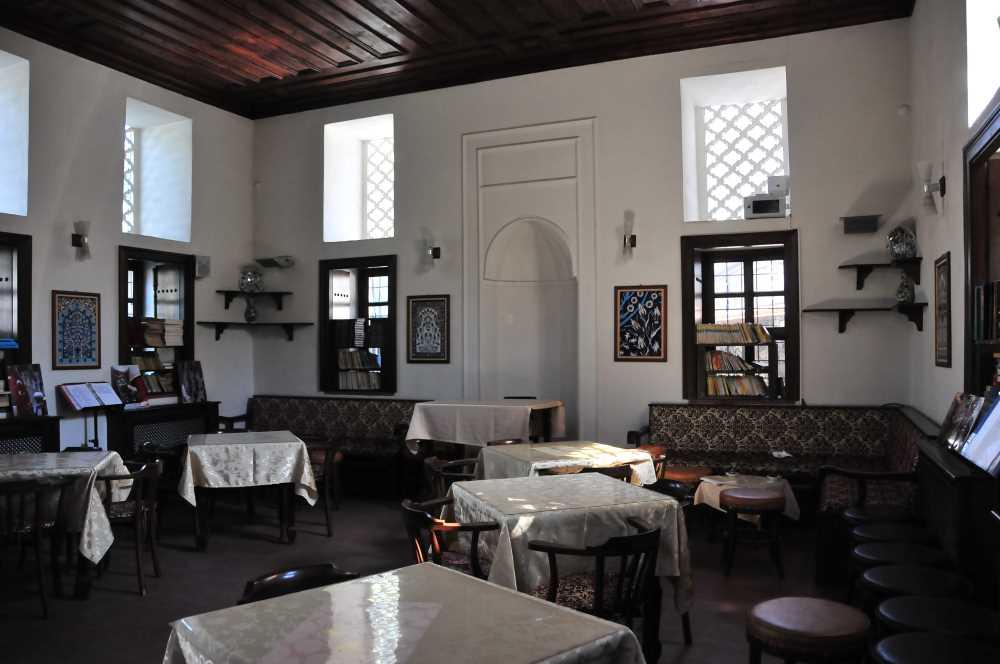
Interior of Haraççıoğlu Medresesi (Culture Portal)
Haraççıoğlu Medresesi is situated in the Osmangazi district, within the historic core of Bursa, in the Kavaklı Neighborhood. The presence of other Ottoman-era structures in its vicinity underscores its significance within the historical urban fabric. Due to its proximity to the city center, the building is easily accessible to visitors.
[1]
Kültür Envanteri. “Haraççıoğlu Medresesi.” Kültür Envanteri. Erişim tarihi 16 Ocak 2026.
[2]
Kültür Envanteri. “Haraççıoğlu Medresesi.” Kültür Envanteri. Erişim tarihi 16 Ocak 2026.
[3]
Kültür Envanteri. “Haraççıoğlu Medresesi.” Kültür Envanteri. Erişim tarihi 16 Ocak 2026.

No Discussion Added Yet
Start discussion for "Haraççıoğlu Medresesi" article
Historical Development
Architectural Features
Library and Educational Function
Restoration Process and Current Use
Location and Environmental Context
