This article was automatically translated from the original Turkish version.
+1 More
Building Type | Hasaköy, Bor, Niğde, Türkiye | ||||||||
|---|---|---|---|---|---|---|---|---|---|
Period(s) | 1848-1872 | ||||||||
Status | Out of use (mosque until the 1970s) | ||||||||
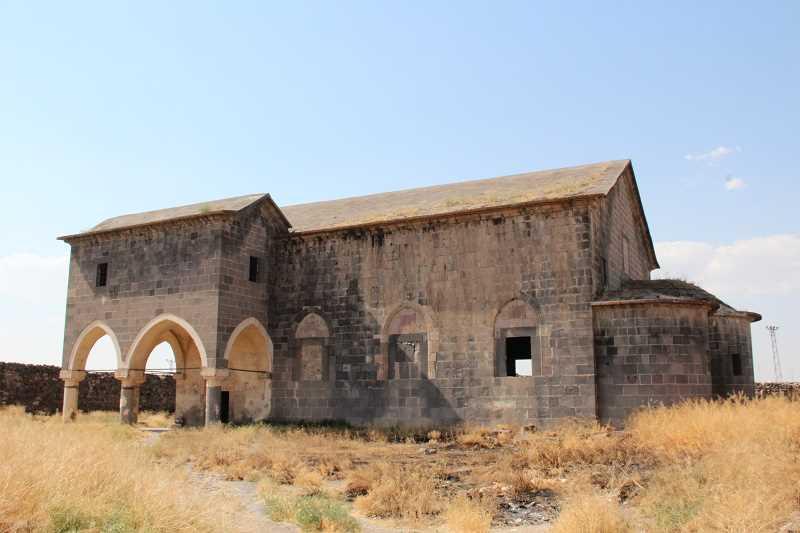
Hasaköy Church is located in the center of Hasaköy Village (formerly known as Sasima), in the Bor district of Niğde Province, Türkiye. The church is situated within the village settlement, enclosed within a walled area.
According to an inscription above the entrance door, which has not survived to the present day, the church was repaired in 1843. A Greek-lettered Karamanli inscription reads the name “Hagias Kryake” and the date 1848. A date of 1872 is found on a textual band along the walls of the naos. The church was used as a mosque until the 1970s, after which it was closed for worship.

Hasaköy Church (Cultural Inventories)
The church follows a three-aisled basilical plan oriented east-west. The central nave is wider than the side aisles and is separated from them by four columns on each side. A barrel-vaulted roof system is employed. At the eastern end of the naos are three apses, each semicircular in form both internally and externally. The central apse is larger than the side apses.
A U-shaped, seven-bay narthex with cross-vaulted ceilings is located on the western façade. Above the narthex is a gallery level (gynekaion), also in a U-shape, which surrounds three sides of the building. Access to the gallery is via a staircase in the northwest corner.
To the northeast of the church, a single-aisled parekklesion (burial chapel) with a semicircular apse facing east is situated. This annex can be accessed both from outside and from within the main church. The square-bodied bell tower in the southeast corner remains standing despite the collapse of its upper section.
The building features geometric and vegetal relief decorations around doors, windows, and apses. Above the main entrance, a stylized cross flanked by angelic figures is prominent. Interior architectural plastic elements are limited; the column capitals are simple, while the aedicules within the apses are decorated.
Large portions of figural frescoes on various surfaces of the naos are heavily damaged. Depicted scenes include “Christ Pantocrator,” “The Annunciation to Mary,” “The Three Angels Visiting Abraham,” “The Flood of Noah,” and “The Expulsion of Adam and Eve from Paradise.” Saintly figures are depicted within medallions on the vaulted ceiling.
The church is surrounded by a stone wall. Its garden was formerly used as a cemetery; the earliest dated gravestone, inscribed in Ottoman Turkish, bears the year 1868 (H. 1285).
Gültekin Genç, İlknur. "Niğde Hasaköy Kilisesi (H. Makrina Kilisesi)." Türkiye Turizm Ansiklopedisi. Accessed June 24, 2025. https://turkiyeturizmansiklopedisi.com/nigde-hasakoy-kilisesi-h-makrina-kilisesi
Kültür Portalı. "Kültür Envanteri, Hasaköy Kilisesi." Accessed June 24, 2025. https://www.kulturportali.gov.tr/turkiye/nigde/kulturenvanteri/hasakoy-klses
Niğde İl Directorate of Culture and Tourism. "Hasaköy Kilisesi PDF Belgesi." Accessed June 24, 2025. https://nigde.ktb.gov.tr/Eklenti/51049,hasakoy-kilisesipdf.pdf?0
Building Type | Hasaköy, Bor, Niğde, Türkiye | ||||||||
|---|---|---|---|---|---|---|---|---|---|
Period(s) | 1848-1872 | ||||||||
Status | Out of use (mosque until the 1970s) | ||||||||
History
Architectural Plan
Narthex and Gallery Level
Additional Structures and Bell Tower
Decorations and Architectural Details
Frescoes
Cemetery and Site Layout