

This article was automatically translated from the original Turkish version.
+1 More
Type of Geographical İndication | Place of Origin | ||||||||
|---|---|---|---|---|---|---|---|---|---|
File Number | C2023/000211 | ||||||||
Application Date | 15.08.2023 | ||||||||
Registration Number | 1573 | ||||||||
Registration Date | 17.04.2024 | ||||||||
Product / Product Group(s) | Processed and unprocessed fruits vegetables and mushrooms | ||||||||
Applicant/Registrant(s) | Batman Provincial Directorate of Agriculture and Forestry | ||||||||
Status | Registered | ||||||||
Place of Production | Batman, Türkiye | ||||||||
Hasankeyf Mehina Garlic, scientifically known as Allium sativum L., is a mid-early garlic variety cultivated in the Hasankeyf district of Batman Province, Türkiye. It is primarily used as a table garlic. This geographical indication was registered on 17 April 2024 under Law No. 6769 on Industrial Property, with protection effective from 15 August 2023. The registering authority is the Batman Provincial Directorate of Agriculture and Forestry.
Hasankeyf Mehina Garlic has a sharp aroma and flavor. This sharpness is linked to the sudden temperature increases in Hasankeyf district starting from mid-May, which stimulate the production of anthocyanins and sugars exceeding 30% in the plant. The clayey and granular soil structure within the geographical boundary supports healthy garlic development and prevents rotting. Daily sunlight exposure exceeding 10 hours from May onward promotes the formation of large bulbs and cloves.
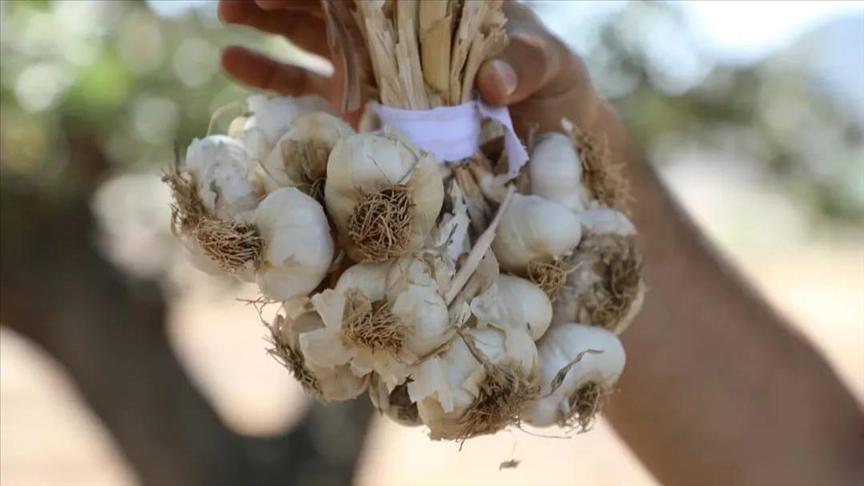
The garlic has a medium-sized bulb. Its longitudinal cross-section is medium-width elliptical, while its transverse cross-section is elliptical. The arrangement of cloves at the neck of the bulb is level with the neck. The root disc is flat, while the base of the bulb is concave. The outer skin of the dried bulb is white with medium-intensity anthocyanin streaks. The ease of peeling and medium thickness of the outer skin are desirable traits for both industrial and table use. Clove arrangement is not perfectly uniform; clove density is medium and clove size is medium. The clove skin is cream-colored and the clove flesh is white.
The high dry matter content (27.44%–38.40%) enables the garlic to be stored under appropriate conditions for 7 to 9 months and enhances its resistance to transport.

Image of Hasankeyf Mehina Garlic (Anadolu Agency)
The preparation of the production area and cultivation of Hasankeyf Mehina Garlic follow traditional methods. For seed stock, cloves weighing at least 3 grams from bulbs preserved from the previous year are selected. Planting is carried out between 15 October and 15 November, after the first rains have moistened the soil. Cloves are planted in single rows with an average spacing of 15–20 cm between rows and 5–10 cm between cloves. Approximately 45–55 kg of cloves are used per decare. During planting, each clove is manually placed with the pointed end upward and the flat base downward, at a planting depth of approximately 3–4 cm.
Before planting, 3–4 tons of farmyard manure per decare are applied and incorporated into the soil through medium-depth tillage. For higher yield and better bulb quality, it is recommended to apply 20 kg of DAP fertilizer (NPK 18-46-0) at the time of planting. Nitrogen fertilization is avoided near maturity to prevent excessive vegetative growth. The garlic’s water requirement is generally met by rainfall; supplemental irrigation may be applied in dry years.
Green garlic is harvested between 1–15 March and is manually uprooted between 15 March and 15 April, then sold in bunches. Full bulb maturity occurs between 1–15 June. Harvesting is performed manually, using a hoe, or by plowing the field when the garlic leaves begin to dry. After harvest, the bulbs are left in the field for 3–4 days to wilt and allow surface soil to dry. They are then tied into bundles using rope. The product can be stored for 7–9 months in cool, dry, clean, and odor-free environments away from direct sunlight.

Harvest of Hasankeyf Mehina Garlic (Anadolu Agency)
Monitoring is conducted by a monitoring body composed of experts from the Batman Provincial Directorate of Agriculture and Forestry, the Hasankeyf District Directorate of Agriculture and Forestry, and the Hasankeyf Subprovince Governorship, under the coordination of the Batman Provincial Directorate of Agriculture and Forestry. Monitoring is carried out at least once annually, with additional inspections conducted in case of complaints.
The monitoring body verifies that production occurs within the defined geographical boundary, that planting material is produced from local ecotypes, that cultivation methods—including planting distances—are followed, and that physical and, where necessary, chemical properties meet standards. It also checks the proper use of the designation “Hasankeyf Mehina Garlic” and the origin emblem. The monitoring body may utilize experts from public or private institutions or procure services as needed. The registering authority manages legal proceedings to protect the rights associated with the geographical indication.
Anadolu Ajansı. “Hasankeyf’te Tescilli Sarımsağın Hasadı Yapıldı.” Accessed July 15, 2025. https://www.aa.com.tr/tr/ekonomi/hasankeyfte-tescilli-sarimsagin-hasadi-yapildi/3604920.
Turkish Patent and Trademark Office. "Hasankeyf Sarımsağı - Coğrafi İşaret Tescil Belgesi (PDF)." Accessed July 15, 2025. https://ci.turkpatent.gov.tr/Files/GeographicalSigns/a64f296c-1f72-4a9b-87f5-739fc4723703.pdf.
Turkish Patent and Trademark Office. "Hasankeyf Sarımsağı." Geographical Indications Information System. Accessed July 15, 2025. https://ci.turkpatent.gov.tr/cografi-isaretler/detay/9942.
Type of Geographical İndication | Place of Origin | ||||||||
|---|---|---|---|---|---|---|---|---|---|
File Number | C2023/000211 | ||||||||
Application Date | 15.08.2023 | ||||||||
Registration Number | 1573 | ||||||||
Registration Date | 17.04.2024 | ||||||||
Product / Product Group(s) | Processed and unprocessed fruits vegetables and mushrooms | ||||||||
Applicant/Registrant(s) | Batman Provincial Directorate of Agriculture and Forestry | ||||||||
Status | Registered | ||||||||
Place of Production | Batman, Türkiye | ||||||||
No Discussion Added Yet
Start discussion for "Hasankeyf Mehina Garlic (Allium sativum L.)" article
Distinctive Characteristics
Production Method
Monitoring