This article was automatically translated from the original Turkish version.
+1 More
Registration Number | 1672 | ||||||||
|---|---|---|---|---|---|---|---|---|---|
Registration Date | 17.12.2024 | ||||||||
Geographical Indication Type(s) | Mahreç İşareti | ||||||||
Applicant/Registrant(s) | Hatay Valiliği | ||||||||
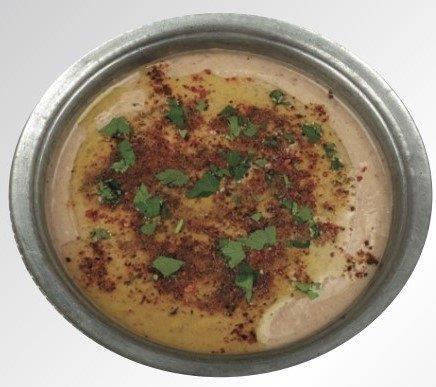
Hatay bean paste is a traditional Hatay meze made by combining boiled fava beans, garlic, tahini, lemon juice, and various spices. This product, officially registered with a geographical indication mark, holds a prominent place in Hatay’s rich culinary culture due to its distinctive presentation on copper plates, authentic production process, and strong geographical ties. Originating in a region where bathhouse culture is widespread, this meze is served both in daily meals and during festive occasions and special holidays.
Hatay bean paste is prepared exclusively in Hatay by homogenizing fava beans, garlic, tahini, and lemon juice. Additional ingredients such as cumin, crushed red pepper, olive oil, and parsley are added before serving. The variety commonly used in production is known as “sakız bakla.” The boiling process is traditionally carried out in the ash chambers of bathhouses or in copper vessels called “carra.” The pounding is done using wooden mallets that are safe for food contact. These production techniques constitute the traditional elements that distinguish the product from similar preparations.
For one serving:
Hatay bean paste is rooted in a strong cultural and historical tradition unique to Hatay Province. Its preparation using beans boiled in the ash chambers of bathhouses reinforces both the physical and cultural connection to the region. In addition to everyday consumption, the dish is also served during holidays, celebrations, and formal gatherings.
The production process of Hatay bean paste is inspected at least once annually under the coordination of the Hatay Provincial Government and the supervision of the Hatay Provincial Directorate of Agriculture and Forestry. Inspections evaluate the following criteria:
Hatay Valiliği. "Hatay Bakla Ezmesi Coğrafi İşaret Tescil Belgesi." Ankara: Türk Patent ve Marka Kurumu, December 17, 2024. Accessed July 16, 2025. https://ci.turkpatent.gov.tr/Files/GeographicalSigns/d5796eca-f02a-4884-993e-e056e379d6b5.pdf
Turk Patent and Trademark Office. "Hatay Bakla Ezmesi." Geographical Indications Portal. Accessed July 16, 2025. https://ci.turkpatent.gov.tr/cografi-isaretler/detay/10604.
Registration Number | 1672 | ||||||||
|---|---|---|---|---|---|---|---|---|---|
Registration Date | 17.12.2024 | ||||||||
Geographical Indication Type(s) | Mahreç İşareti | ||||||||
Applicant/Registrant(s) | Hatay Valiliği | ||||||||
No Discussion Added Yet
Start discussion for "Hatay Broad Bean Paste" article
Distinctive Characteristics
Production Process
Ingredients Used
Preparation and Serving Steps
Geographical and Cultural Significance
Monitoring and Registration Process