

This article was automatically translated from the original Turkish version.
+1 More
Hatay White Pumpkin is a variety of pumpkin belonging to the species Cucurbita moschata, cultivated in the province of Hatay. It was registered as a geographical indication under registration number 1533 on 01.02.2024, following an application submitted by the Antakya Chamber of Commerce and Industry on 17.03.2023. The product group is classified as “Processed and unprocessed fruits, vegetables and mushrooms”. The product’s association with Hatay is based on the region’s climatic conditions, local production methods, and its widespread use in the preparation of pumpkin desserts.
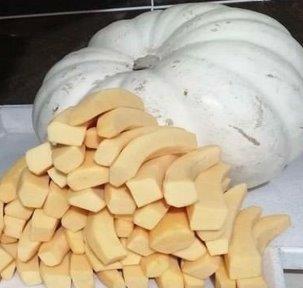
Hatay White Pumpkin is a firm, partially sweet pumpkin with a white to grey outer rind and yellow to orange flesh. The fruit may be elongated cylindrical, round or flattened round in shape and exhibits a segmented structure. The plant’s stems are thick; its leaves are dark green, broad and hairy. The trailing vines can extend up to 6 metres in length.
The distinctive qualities of the product are influenced by the hot and continental climate of Hatay, significant day-night temperature variations, and abundant sunlight exposure. The region’s soils, which are deep, permeable, loamy-clayey and rich in minerals and organic matter, enable the fruit to reach weights of up to 60 kilograms.
The flesh thickness is determined to be a maximum of 8 cm, the rind thickness a maximum of 6 mm, the seed cavity length a maximum of 60 cm, and the Brix (soluble dry matter) value at least 3%.
Production is carried out using open-field cultivation methods within the province of Hatay. Producers typically use large, plump seeds saved from the previous harvest. On average, one kilogram of seed is used per decare.
Due to its geographical association and local production methods, the cultivation and all stages of production of Hatay White Pumpkin must be carried out entirely within the boundaries of the province of Hatay.
Control procedures are coordinated by the Antakya Chamber of Commerce and Industry. The control body consists of a minimum three-member commission comprising representatives from the Antakya Chamber of Commerce and Industry, the Department of Horticultural Crops, Faculty of Agriculture, Hatay Mustafa Kemal University, and the Hatay Provincial Directorate of Agriculture and Forestry.
Inspections are conducted at least once annually or upon complaint. During inspections, the harvesting practices, storage conditions, market supply and the correct use of the Hatay White Pumpkin designation and geographical indication emblem are verified. Inspection results are documented and submitted to the Turkish Patent and Trademark Office by the Antakya Chamber of Commerce and Industry.

No Discussion Added Yet
Start discussion for "Hatay White Pumpkin" article
Product Characteristics
Production Method
Geographical Boundary and Control