

This article was automatically translated from the original Turkish version.
+2 More
Hazar sturgeon (Acipenser gueldenstaedtii) is a long-lived, late-maturing species belonging to the family Acipenseridae. It is widely distributed in the Caspian Sea and its connected river systems and is considered ecologically and economically significant. The species is classified as endangered and is among the top priorities for conservation due to its importance in caviar production and ecosystem balance. The ecological role of the Hazar sturgeon is critical, as it functions as a top predator in the food chain and serves as an indicator of the health of river and marine ecosystems. Its populations are affected by both environmental changes in natural habitats and human-induced factors.

Hazar Sturgeon
The Hazar sturgeon is a chordate fish species belonging to the kingdom Animalia and the phylum Chordata. It is classified within the class Actinopterygii (ray-finned fishes), the order Acipenseriformes, and the family Acipenseridae. This species is placed in the genus Acipenser and inhabits freshwater and brackish ecosystems of the Caspian Sea and its surrounding rivers. The Hazar sturgeon is known for its slow growth rate and late sexual maturity, and it has a long lifespan. Due to commercial fishing and habitat loss, it is regarded as a sensitive species with significant ecological importance for conservation efforts.
Taxonomically, the Hazar sturgeon is distinguished from other sturgeon species by its morphological characteristics and genetic structure. The taxonomic accuracy of this species is crucial for designing effective conservation strategies and for commercial aquaculture practices.
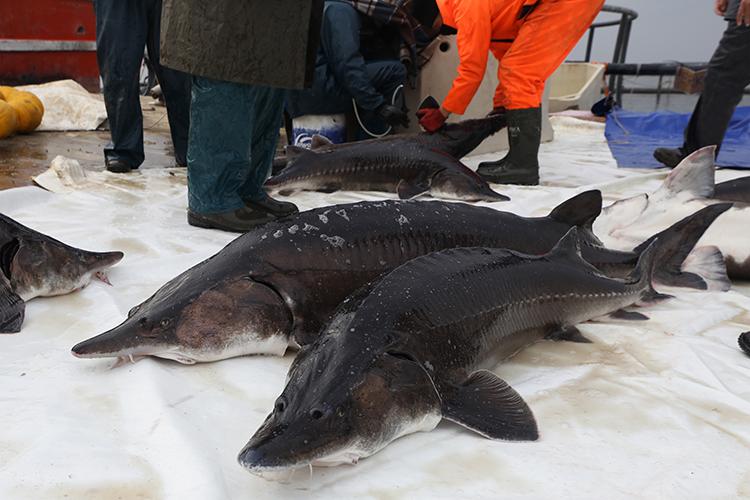
The Hazar sturgeon has a long, cylindrical body covered with bony plates resembling armor. This structure protects the species from predators and enhances its resilience to environmental pressures. On average, it reaches a length of 1.5–2 meters, with some individuals growing up to 3 meters. Their weight ranges from 50 to 100 kilograms. The head is conical with a ventrally positioned mouth, and the lower lips and sensory barbels enable it to detect food on the substrate during feeding. The body color is typically gray-blue, with a lighter ventral side. These morphological traits facilitate feeding and survival in both marine and freshwater environments.
The Hazar sturgeon is common in the Caspian Sea and the major river systems that flow into it. The Volga, Kura, and Ural rivers are particularly important for spawning and feeding. The species is anadromous, migrating from the sea into freshwater rivers during the spawning season. These migrations enhance genetic diversity and support population sustainability. The Caspian Sea is critical to the species’ habitat. However, climate change, pollution, and habitat loss negatively affect its distribution and population size. Environmental changes in the sea can disrupt migration and spawning behaviors.

Hazar Sturgeon (Acipenser gueldenstaedtii)
(Generated by Artificial Intelligence)
The Hazar sturgeon is a late-maturing species. Females reach sexual maturity between 7 and 12 years of age, while males mature between 5 and 9 years. During the spawning season, individuals migrate from the sea into rivers to lay eggs in freshwater areas. Egg production typically ranges from 100,000 to 500,000 eggs, which adhere to the riverbed.
Larvae hatch within a few days and spend a certain period in the river before migrating to the sea. Spawning success is directly linked to water quality in rivers and the accessibility of migration routes. Dams and other water infrastructure can obstruct migration paths and threaten population continuity.
The Hazar sturgeon is classified as a benthic feeder. Its diet includes crustaceans, worms, and small fish. The ventrally positioned mouth and sensory barbels allow it to detect food on the substrate. During feeding, the species searches for and consumes organisms on the river or sea floor. Its feeding behavior is vital for energy flow and balance within the food chain. Changes in sturgeon populations can affect both predator and prey species.
The Hazar sturgeon is economically significant primarily due to caviar production. The eggs of female fish are sold internationally as a luxury food item and generate substantial commercial value. The fish’s flesh is also commercially valuable in local and regional markets. The species is regarded by communities around the Caspian Sea as both a livelihood source and a traditional cultural element. Fishing culture is deeply intertwined with local cuisine, production methods, and social traditions. Controlled aquaculture projects support both economic gains and the conservation of wild populations.
The Hazar sturgeon is classified as endangered by the IUCN. Major threats include:
Conservation efforts are being carried out at both national and international levels. Protecting natural habitats and implementing artificial breeding and stock enhancement programs are key strategies to ensure the sustainability of the Hazar sturgeon population.
Anadolu Ajansı (AA). “Elazığ’daki Tesis Mersin Balığı Yetiştiriciliğiyle Havyarda Üretim Üssü Olmak İçin Çalışıyor.” 2023. Accessed March 9, 2026. https://www.aa.com.tr/tr/ekonomi/elazigdaki-tesis-mersin-baligi-yetistiriciligiyle-havyarda-uretim-ussu-olmak-icin-calisiyor/3779536.
Anadolu Ajansı (AA). “Hazar Denizi’nin Biyolojik Çeşitliliği İklim Değişikliği ve Kirlilik Baskısı Altında.” 2020. Accessed March 9, 2026. https://www.aa.com.tr/tr/yesilhat/dogal-yasam/hazar-denizinin-biyocesitliligi-iklim-degisikligi-ve-kirlilik-baskisi-altinda/1824907.
Ustaoğlu, E. “Nesli Tükenme Tehlikesindeki Mersin Balıklarının Korunması.” *Ege Üniversitesi Su Ürünleri Dergisi*. Accessed March 9, 2026. https://dergipark.org.tr/en/download/article-file/57769.
Üstündağ, E. “Mersin Balıkları Genel Biyoloji ve Taksonomisi.” Süleyman Demirel Üniversitesi Su Ürünleri Araştırma Bülteni. Accessed March 9, 2026. https://dergipark.org.tr/en/download/article-file/204400.
Şen, İsmail. “Ultrasonla cinsiyetleri belirlenen mersin balıkları ayrı kafeslerde ihracata hazırlanıyor.” Anadolu Ajansı, December 12, 2024. Accessed March 9, 2026. https://www.aa.com.tr/tr/yasam/ultrasonla-cinsiyetleri-belirlenen-mersin-baliklari-ayri-kafeslerde-ihracata-hazirlaniyor/3422320.

No Discussion Added Yet
Start discussion for "Hazar Mersin Fish (Acipenser gueldenstaedtii)" article
Taxonomic Classification
Physical Characteristics
Habitat and Distribution
Life Cycle and Reproduction
Feeding Behavior
Economic and Cultural Importance
Conservation Status