This article was automatically translated from the original Turkish version.
+2 More
Length(s) | 229 km | ||||||||
|---|---|---|---|---|---|---|---|---|---|
Where İt Flows into | Mediterranean | ||||||||
Location | Muğla - Denizli - Burdur | ||||||||
Usage | Energy production, Agricultural irrigation, Rafting | ||||||||
Fauna | Snakehead, Carp, Freshwater bream, Siraz | ||||||||
Basic Structures | Akköprü Dam, Bereket HES, Historical Atatürk Bridge | ||||||||
Water Quality | Class I and II (Good quality, slightly alkaline) | ||||||||
Dalaman Çayı is a strategic river approximately 229 kilometers long, located between the provinces of Muğla, Denizli and Burdur in southwestern Türkiye. Originating from the Çameli and Dirmil plateaus, the river is fed by tributaries from the Gölgeli and Boncuk Mountains, which are an extension of the Western Taurus Mountains, and flows through the Dalaman and Ortaca plains before emptying into the Mediterranean Sea. Known in antiquity as "Indos," the river is of vital importance to the regional economy and ecosystem for agricultural irrigation, energy production and extreme water sports.
Dalaman Çayı is one of the principal rivers in southwestern Türkiye, playing a strategic role in the region’s hydrological system. The river originates from the northern slopes of the Yeşilgöl Mountains and follows a course of approximately 229 kilometers. Along its path, it forms a natural boundary between the districts of Ortaca and Dalaman in Muğla Province, and ultimately discharges into the Mediterranean Sea at the Sarısu location, completing its journey.
Its basin structure and geographical characteristics are detailed under the following subheadings.
The geological foundation of the Dalaman Çayı Basin is largely composed of Mesozoic carbonate rocks and the tectonically emplaced "Lycian Nappes" overlying them. The region exhibits a complex geological structure, with ophiolitic melanges, clastic rocks and ultramafic rock groups such as peridotite defining its lithological diversity. This tectonic activity and rock composition have created the conditions for the formation of narrow and deep valleys along the river’s course.
Neotectonic uplifts during the recent geological period have significantly influenced the basin’s geomorphological development, enhancing the river’s erosive power and generating a youthful topography. Along the coast, the balance between sediment load delivered by the river and wave erosion determines the formation and dynamic nature of the Dalaman Delta. However, contemporary dams and other anthropogenic structures built along the river have restricted sediment transport, altering natural deltaic development and coastal morphology.
The hydrological regime of Dalaman Çayı is complex due to the basin’s extent and the diversity of its recharge sources. River discharge increases notably during winter and spring due to precipitation and snowmelt in the highlands, while reaching minimum levels in summer due to drought and irrigation demands. Dams such as Bereket and Akköprü regulate the flow regime; however, they also alter the river’s natural flow dynamics and sediment transport capacity. Measurements across the basin indicate that water temperature varies seasonally between 13.0°C and 29.8°C, while pH values range between 7.74 and 8.60, indicating a slightly alkaline character.【1】
Water quality generally exhibits Class I and II characteristics, although moderate quality values are observed at some stations. However, increasing anthropogenic pressures in the basin, including agricultural drainage waters and waste from settlements, have led to elevated concentrations of nutrients such as nitrogen and phosphorus in certain areas. While physicochemical parameters indicate dissolved oxygen levels within suitable ranges for aquatic life, low discharge during dry periods intensifies the impact of pollution on water quality.【2】
Dalaman Çayı provides a critical ecosystem for biodiversity due to its rich water resources and variable bed morphology. Ichthyological studies conducted in the river system have identified both native and economically valuable fish species. Research has documented the presence of the following species: Anguilla anguilla (European eel), Barbus capoeta (Bearded barbel), Capoeta capoeta bergamae (Siraz), Leuciscus cephalus (Common chub), Oncorhynchus mykiss (Rainbow trout), and Cyprinus carpio (Common carp). The presence of European eels (Anguilla anguilla) along migratory routes and the lagoon systems at the river’s mouth are of great significance for the ecological continuity of the basin.【3】
The ecological balance of the basin is directly linked to its physicochemical water properties. Although water temperature, pH and dissolved oxygen levels are within suitable ranges for aquatic life, dam structures and water retention activities along the river exert pressure on the ecosystem. Such anthropogenic structures fragment fish habitats, restricting migration for spawning and feeding, and induce long-term changes in population dynamics. Additionally, potential pollution from agricultural activities and settlements in the basin constitutes a key environmental factor that threatens the survival of sensitive species.

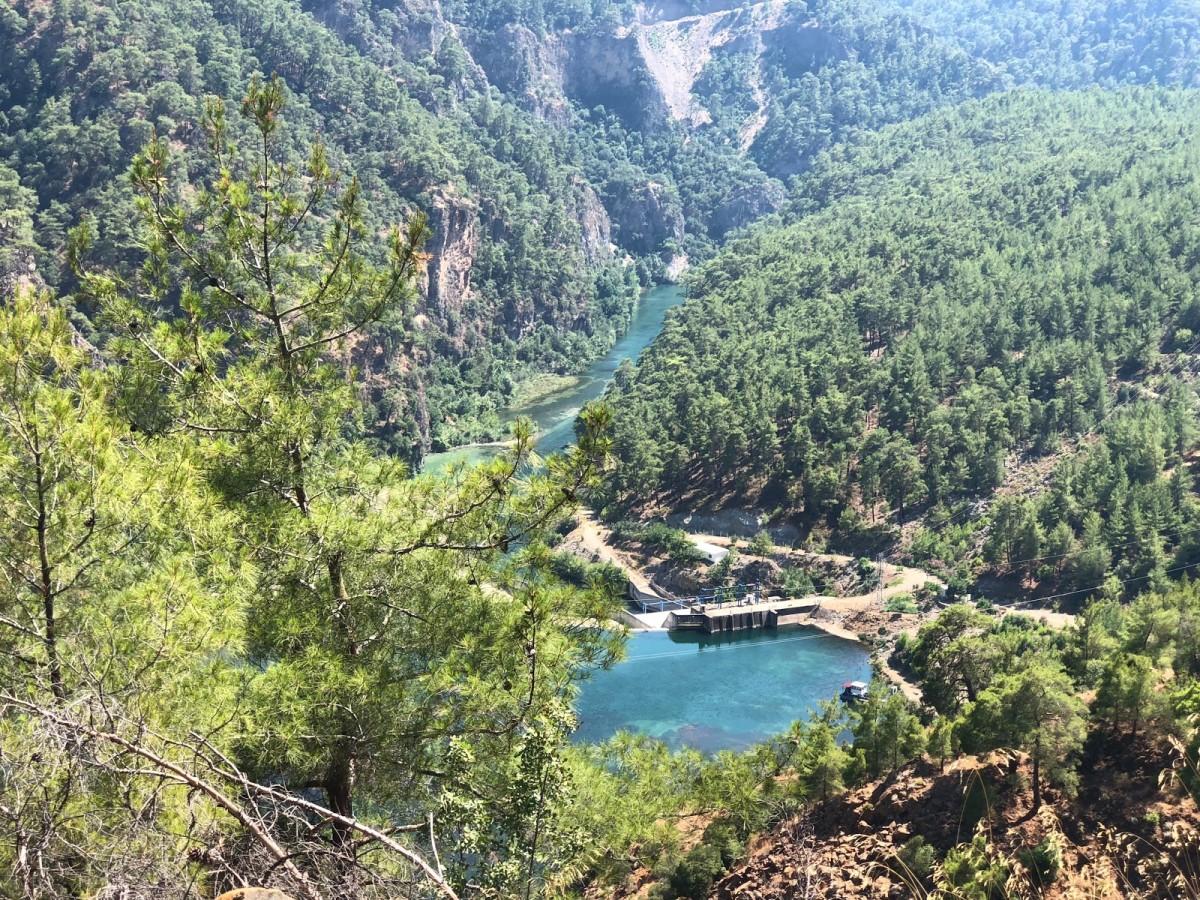
Akköprü Dam on Dalaman Çayı (Dalaman District Governorship)
Due to its high discharge and steep gradient, Dalaman Çayı is a fundamental component of the regional economy for energy production, agricultural irrigation and recreational activities. The Bereket Hydroelectric Power Plant (HES) and the Akköprü Dam and HES, one of the largest structures in the region, have significantly altered the basin’s hydrological character. These dams contribute to the national energy grid and play a critical role in flood control and regulation of irrigation water. Since the commissioning of the Akköprü Dam, the sediment load carried by the river has decreased substantially; the sediment trapped in the reservoir has hindered nourishment of the delta at the river’s mouth, increasing the risk of coastal erosion. Another dimension of economic activity is tourism, which is concentrated along the upper reaches of the river where high flow velocities prevail. Dalaman Çayı is recognized as one of Türkiye’s major rafting destinations, offering a 12-kilometer course with varying difficulty levels, and provides significant added value to regional tourism.
The historical development of human settlements and transportation networks in the basin necessitated the construction of various engineering structures along the river. The most notable of these is the bridge commonly known as the "Historical Atatürk Bridge of Dalaman," which connects the districts of Dalaman and Ortaca. Constructed in 1934 under the directive of Mustafa Kemal Atatürk and approved by then Prime Minister İsmet İnönü, the structure was completed in 1935 and opened to service. As an important symbol of early Republican public works, the bridge ensured uninterrupted transportation despite the river’s challenging flow. Today, although new bridges have been built, this historical structure has been officially registered as part of the cultural heritage and has become a vital element of the region’s historical identity.

Dalaman Çayı rafting activity (Muğla Provincial Government)
Thanks to its dynamic flow regime and topographic structure, Dalaman Çayı has become one of Türkiye’s most important nature-based sports and recreation centers. The upper course of the river, with its high discharge and series of narrow valleys, provides ideal conditions for rafting. This 12-kilometer stretch, featuring difficulty levels ranging from 3 to 4, is favored by both professional and amateur athletes. Rafting activities directly contribute to the local economy through tourism and benefit from proximity to Dalaman Airport, granting the region international tourist accessibility.
Another dimension of recreational use lies in the coastal areas where the river meets the Mediterranean and merges with lagoon systems. The natural beaches at the river mouth and surrounding areas provide suitable environments for day-trip recreation and ecotourism. Particularly, locations within the boundaries of Dalaman District such as Sarısu and Kayacık shoreline serve nature-based tourism by offering ecosystems shaped by the river’s waters and wetland habitats conducive to birdwatching. In addition, the presence of thermal springs and sulfur-rich waters in the basin enables diversification of recreational activities into thermal tourism.
Akşit, Selahattin. "Doğal Ortam Koşullarının Akarsuların Su Kalitesi Üzerine Etkileri: Yukarı Dalaman Çayı Havzası Örneği." *Pamukkale Üniversitesi Sosyal Bilimler Enstitüsü Dergisi*, no. 70 (September 2025): 345–360. Accessed February 14, 2026. https://dergipark.org.tr/tr/download/article-file/4486850
Ateş, Ersin, Murat Gül, Güncel Sarıman, and Iliya Bauchi Danladi. "Akarsular Üzerindeki Antropojenik Yapıların Kıyı Çizgisi Üzerindeki Etkisi: Dalaman Çayı". *Geomatik* 9, no. 2 (2024): 245-258. Accessed February 14, 2026. https://dergipark.org.tr/tr/download/article-file/3720078
Dalaman Belediyesi. "Dalaman Çayı." *dalaman.bel.tr.* Accessed February 14, 2026. https://dalaman.bel.tr/tarihi-merkezler/detay/dalaman-cayi/7.
Dalaman Kaymakamlığı. "Akköprü Barajı." Accessed February 14, 2026. https://dalaman.gov.tr/akkopru-baraji
Kaaden, G. v. d., and K. Metz. *Datça-Muğla-Dalaman Çayı (SW-Anadolu) Arasındaki Bölgenin Jeolojisi*. Ankara: Maden Tetkik ve Arama Genel Müdürlüğü Yayınları, 1954. Accessed February 14, 2026. https://dergipark.org.tr/en/download/article-file/969919
Muğla Valiliği. "Dalaman İlçesi Genel Bilgiler." Accessed February 14, 2026. https://www.mugla.gov.tr/dalaman
Özdemir, Nedim, Fevzi Yılmaz, and Bülent Yorulmaz. "Dalaman Çayı Üzerindeki Bereket Hidro-Elektrik Santrali Baraj Gölü Suyunun Bazı Fiziko-Kimyasal Parametrelerinin ve Balık Faunasının Araştırılması." *Ekoloji* 16, no. 62 (2007): 30-36. Accessed February 14, 2026. https://acikerisim.mu.edu.tr/xmlui/bitstream/handle/20.500.12809/7613/%c3%b6zdemir.pdf?sequence=1&isAllowed=y
[1]
Nedim Özdemir, Fevzi Yılmaz ve Bülent Yorulmaz, "Dalaman Çayı Üzerindeki Bereket Hidro-Elektrik Santrali Baraj Gölü Suyunun Bazı Fiziko-Kimyasal Parametrelerinin ve Balık Faunasının Araştırılması", Ekoloji 16, sy. 62 (2007): syf 32, https://acikerisim.mu.edu.tr/xmlui/bitstream/handle/20.500.12809/7613/%c3%b6zdemir.pdf?sequence=1&isAllowed=y
[2]
A.e., syf 32-35
[3]
A.e., syf 32

Length(s) | 229 km | ||||||||
|---|---|---|---|---|---|---|---|---|---|
Where İt Flows into | Mediterranean | ||||||||
Location | Muğla - Denizli - Burdur | ||||||||
Usage | Energy production, Agricultural irrigation, Rafting | ||||||||
Fauna | Snakehead, Carp, Freshwater bream, Siraz | ||||||||
Basic Structures | Akköprü Dam, Bereket HES, Historical Atatürk Bridge | ||||||||
Water Quality | Class I and II (Good quality, slightly alkaline) | ||||||||
Geographical and Hydrological Structure
Geological and Geomorphological Features
Hydrological Data and Water Quality
Ecological Diversity and Fish Fauna
Economic Use and Anthropogenic Structures
Historical Structures
Touristic and Recreational Use