

This article was automatically translated from the original Turkish version.
Star | HD 80606 | ||||||||
|---|---|---|---|---|---|---|---|---|---|
Star Type | G5V (Sun-like) | ||||||||
Distance(s) | ~190 light years (58 parsecs) | ||||||||
Year of Discovery(ies) | 2001 | ||||||||
HD 80606b is a gas giant with remarkable physical and orbital characteristics among exoplanets outside the Solar System. It orbits HD 80606, a G5V-type main-sequence star similar to the Sun, located in the Pegasus constellation approximately 190 light-years from Earth. This planet is particularly notable for its highly eccentric orbit and the abrupt temperature fluctuations this causes. HD 80606b was first discovered in 2001 using the radial velocity method.

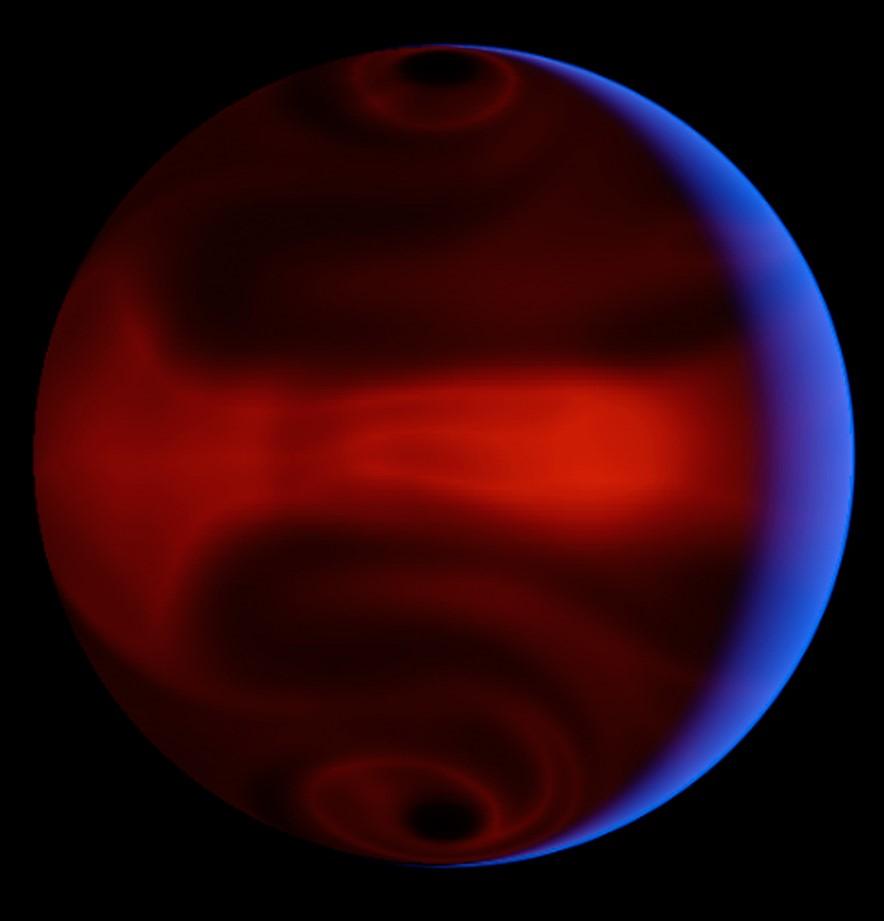
HD 80606b. (NASA)
The most striking feature of HD 80606b is its highly elliptical orbit. With an eccentricity of approximately 0.93, this orbit causes the planet to undergo extreme heating in a very short time as it approaches its star. As it nears periastron, the atmospheric temperature rises from about 500 K to 1500 K within just a few hours. At apastron, the temperature drops dramatically. These thermal shifts generate shock waves and turbulence in the planet’s atmosphere. Observations from the Spitzer Space Telescope have shown that these temperature transitions produce strong infrared radiation emissions.
Because HD 80606b transits its host star, spectral data about its atmosphere have been obtained. Data collected during transit indicate the presence of hydrogen, helium, and potentially water vapor in the planet’s atmosphere. Additionally, due to the rapid temperature increases, swelling, expansion, and ionization effects have been observed in the upper atmospheric layers. These conditions may lead to temporary episodes of atmospheric escape.
HD 80606b resides in a binary star system alongside HD 80607, a nearly identical twin star. The separation between the two stars is approximately 1200 AU, and the resulting Kozai-Lidov mechanism likely played a key role in shaping the planet’s highly elliptical orbit. This mechanism explains such inclined and long-term orbital evolution scenarios. Consequently, HD 80606b’s current orbit is the result of long-term dynamical instabilities within the system.
The planet’s transit across its star was first directly detected by telescopes in 2009. This transit event enabled more precise measurements of the planet’s radius, density, and atmospheric properties. The transit duration lasts approximately 12 hours and causes a ~1% dip in the star’s brightness.
HD 80606b makes important contributions to astrophysical models concerning extremely eccentric orbits, rapid thermal responses of planetary atmospheres, binary star influences, and orbital evolution processes. This planet is one of the rare examples where stellar system dynamics intersect with atmospheric physics.
Bulutsu.org. “HD 80606b.” *Gökyüzü Gözlem Günlüğü*, February 9, 2004. https://www.bulutsu.org/ggg/?gun=090204. Accessed July 17, 2025.
NASA Exoplanet Archive. "HD 80606 b Overview." https://exoplanetarchive.ipac.caltech.edu/overview/HD%2080606. Accessed July 17, 2025.
NASA Science. “HD 80606 b.” *Exoplanet Catalog*. https://science.nasa.gov/exoplanet-catalog/hd-80606-b/. Accessed July 17, 2025.
NASA. “HD 80606 b.” *Exoplanet Watch Results*. https://exoplanets.nasa.gov/exoplanet_watch_results/hd_80606_b/. Accessed July 17, 2025.
NASA. “Spitzer Exoplanet Observation of HD 80606b.” *NASA Exoplanet Exploration*. https://exoplanets.nasa.gov/resources/1075/spitzer-exoplanet-observation-of-hd-80606b/. Accessed July 17, 2025.

Star | HD 80606 | ||||||||
|---|---|---|---|---|---|---|---|---|---|
Star Type | G5V (Sun-like) | ||||||||
Distance(s) | ~190 light years (58 parsecs) | ||||||||
Year of Discovery(ies) | 2001 | ||||||||
Physical and Orbital Characteristics
Orbital Anomaly and Thermal Effects
Atmospheric Observations
Stellar System and Dynamical Interactions
Transit Event and Observational Significance
Scientific Significance