



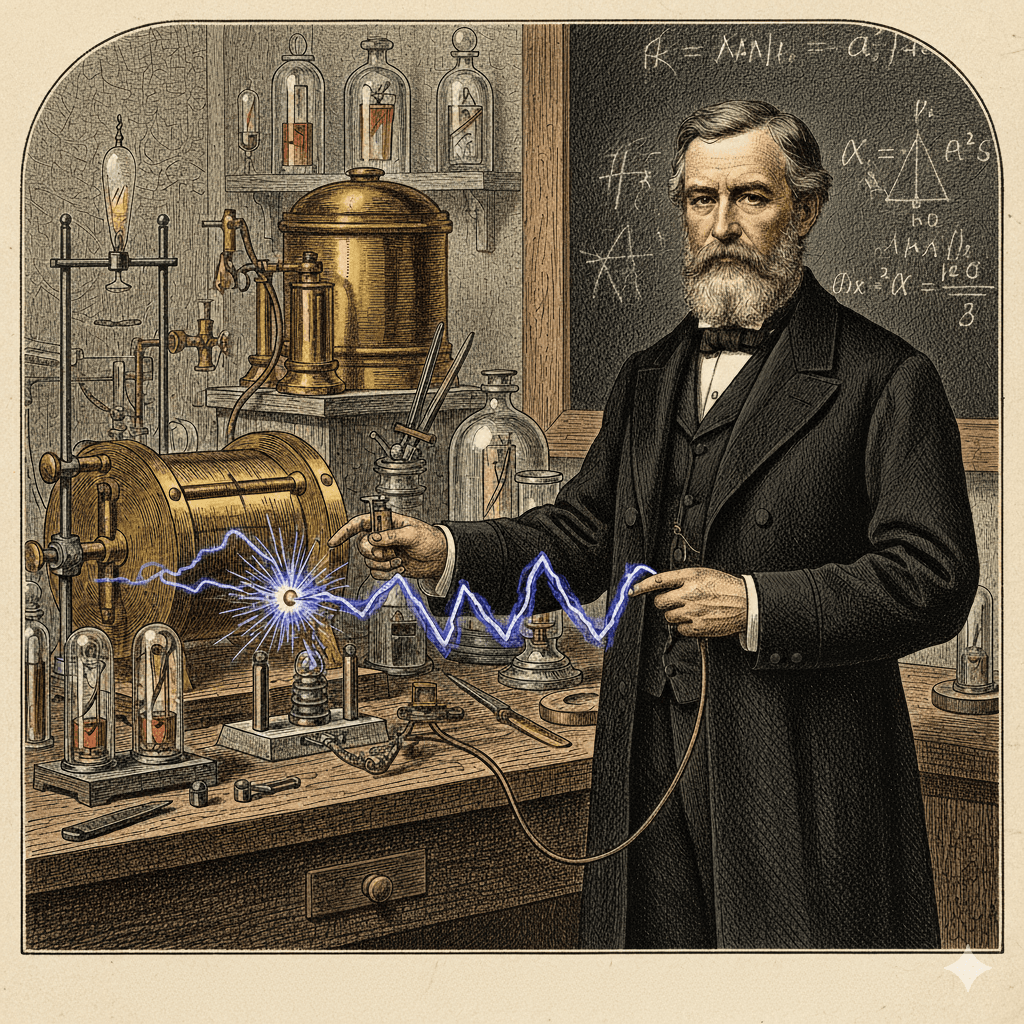
Heinrich Hertz (generated with artificial intelligence)
Place of Death | Bonn, Germany | ||||||||
|---|---|---|---|---|---|---|---|---|---|
Death | 1 January 1894 | ||||||||
Place of Birth | Hamburg, Germany | ||||||||
Nationality | German | ||||||||
Birth | 22 February 1857 | ||||||||
Institution Employed | University of Bonn | ||||||||
Academic Title | Professor of Physics | ||||||||
Areas of Expertise | Electromagnetism, Experimental Physics, Mechanics | ||||||||
Full Name | Heinrich Rudolf Hertz | ||||||||
Heinrich Hertz (1857–1894) was a German physicist known for his experimental work in classical electromagnetism during the final quarter of the 19th century. In the latter part of his academic career, he served as a professor of physics at the University of Bonn.
Hertz was pursuing engineering studies in Munich in 1877 at the age of 20. During this period he underwent a period of decision-making between his professional orientation and his interest in the natural sciences, ultimately deciding to shift his educational focus toward the natural sciences. In 1878 he moved to Berlin with the aim of becoming a student of Hermann von Helmholtz and Gustav Kirchhoff. While in Berlin he began experimental research on a faculty prize problem in physics.
As part of his early research in Berlin, Hertz won a prize in 1879 and selected a medal as its reward. In 1880 he submitted a comprehensive thesis as his doctoral dissertation and became an assistant to Helmholtz in Berlin. In 1883 he continued his academic activities in Kiel with the title of Privatdozent, publishing his research on gas discharges and cathode rays. He was later invited to Karlsruhe, where he gained access to more favorable experimental facilities.
From 1886 onward, Hertz entered the most defining phase of his scientific work through a series of experiments. These experiments focused on the empirical testing of hypotheses proposed by In Maxwell's electromagnetic theory. He demonstrated that electromagnetic waves could be generated in free space, observed interference phenomena among these waves, and confirmed electromagnetic waves carry energy. It is also accepted that during the same series of experiments he noticed the phenomenon later known as the photoelectric effect. Hertz published his findings collectively in subsequent years, evaluating both the experimental process and the theoretical background within a biographical unity through explanatory notes and an introductory text he authored.
Hertz’s experiments related to electromagnetic waves have been re-examined in a biographical context through a later reconstruction based on his 1888 apparatus. This reconstruction demonstrated that electromagnetic radiation could be produced using a spark-switched RLC circuit, a capacitor, and a loop antenna. On the receiving side, it was noted that the signal could be captured via a resonant antenna, and that the circuit behavior and near-field properties could be analyzed. The same evaluation emphasized that the full details of Hertz’s original experiments could not be exactly reproduced with modern and simplified setups, but that certain measurements and observations remained feasible.
Hertz’s early work was not limited to electromagnetic waves. During this period he developed analyses linking the concept of “kinetic energy” of electric currents and electrical inertia to the principle of energy conservation. He also investigated electric charge distribution on the surfaces of moving conductors, deformation under pressure in elastic bodies due to contact, and the phenomenon of induction. He developed diagram-based methods for hygrometry and meteorology and published studies on alternative formulations of electromagnetic equations. A lecture text addressed by The relationship between light and electricity also belongs to this period. In 1891 he returned to the study of gas discharges and reportedly made a discovery regarding the passage of cathode rays through thin metallic layers. In the final phase of his life, he focused intensely on his work titled “Principles of Mechanics.”
Faccio, Daniele, Matteo Clerici, and Davide Tambuchi. “Revisiting the 1888 Hertz Experiment.” *American Journal of Physics* 74, no. 11 (2006): 992–994. Accessed January 8, 2026. https://doi.org/10.1119/1.2238886
Hertz, Heinrich. *Electric Waves: Being Researches on the Propagation of Electric Action with Finite Velocity through Space*. Translated by D. E. Jones, with a preface by Lord Kelvin. London: Macmillan, 1893. Accessed January 8, 2026. https://commons.princeton.edu/josephhenry/wp-content/uploads/sites/71/2020/02/Electric_Waves.pdf
Hertz, Heinrich. *The Principles of Mechanics Presented in a New Form*. Translated by D. E. Jones and J. T. Walley, with a preface by Hermann von Helmholtz. London: Macmillan, 1894. Accessed January 8, 2026. https://dn790008.ca.archive.org/0/items/miscellaneouspap00hert/miscellaneouspap00hert.pdf
Masters, Barry R. “Heinrich Hertz and the Foundations of Electromagnetism.” *Optics and Photonics News* 22, no. 6 (2011). Accessed January 8, 2026. https://www.optica-opn.org/home/articles/volume_22/issue_6/features/heinrich_hertz_and_the_foundations_of_electromagne/
“Heinrich Hertz.” *Engineering and Technology History Wiki (ETHW)*. Accessed January 8, 2026. https://ethw.org/Heinrich_Hertz

Heinrich Hertz (generated with artificial intelligence)
Place of Death | Bonn, Germany | ||||||||
|---|---|---|---|---|---|---|---|---|---|
Death | 1 January 1894 | ||||||||
Place of Birth | Hamburg, Germany | ||||||||
Nationality | German | ||||||||
Birth | 22 February 1857 | ||||||||
Institution Employed | University of Bonn | ||||||||
Academic Title | Professor of Physics | ||||||||
Areas of Expertise | Electromagnetism, Experimental Physics, Mechanics | ||||||||
Full Name | Heinrich Rudolf Hertz | ||||||||
Life and Education
Academic Career
Experiments on Electromagnetic Waves
Experimental Apparatus and Methodological Framework
Other Research Areas
Publications
Awards and Academic Titles