


This article was automatically translated from the original Turkish version.
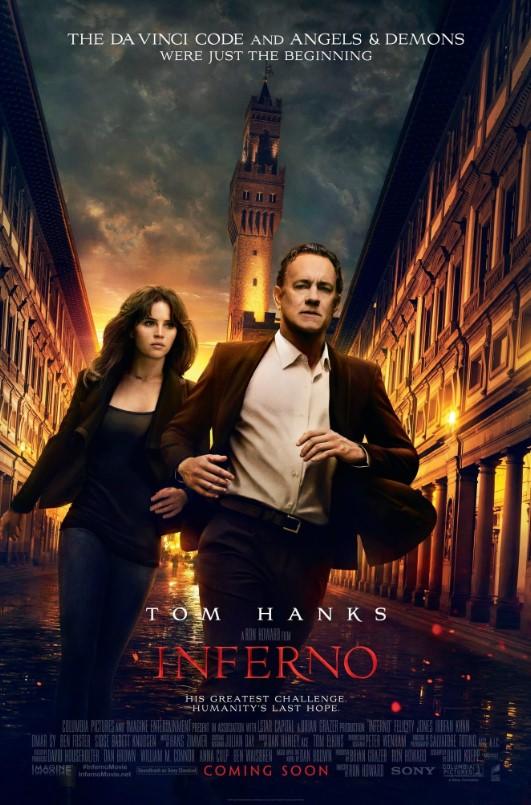
Inferno: Cehennem
Director(s) | Ron Howard | ||||||||
|---|---|---|---|---|---|---|---|---|---|
Producer(s) | Brian Grazer, Ron Howard | ||||||||
Screenplay(s) | David Koepp (from Dan Brown's novel) | ||||||||
Lead Roles | Tom Hanks, Felicity Jones, Irrfan Khan, Omar Sy, Ben Foster | ||||||||
Cinematographer(s) | Salvatore Totino | ||||||||
Duration | 121 minutes | ||||||||
Genre | Thriller Adventure Mystery | ||||||||
IMDb Rating | 6.2/10 | ||||||||
Inferno (known in English by that name), is a mystery and thriller film shot in the United States in 2016. Directed by Ron Howard, the film is adapted from Dan Brown’s 2013 novel of the same title. It marks the third time the character Robert Langdon, previously featured in the cinematic adaptations of Brown’s The Da Vinci Code (2006) and Angels & Demons (2009), appears on the big screen. Tom Hanks stars in the lead role. The film centers on solving artistic and historical clues to prevent a globally spreading biological threat.
Professor Robert Langdon awakens in a hospital in Florence, Italy, injured and with partial amnesia. With the help of Dr. Sienna Brooks, he tries to determine why he is there and who targeted him. Gradually, he learns that Bertrand Zobrist, a biotechnology expert, believes humanity will be destroyed by overpopulation and has released a virus to drastically reduce the global population.
Langdon and Sienna follow Zobrist’s encoded messages and artistic clues to locate the virus. This pursuit, filled with references to Dante Alighieri’s Divine Comedy, takes them from Florence to Venice and then to the Basilica Cistern in Istanbul. As time runs out, Langdon struggles to recover his memory and stop the catastrophe threatening all of humanity.
Inferno Film Trailer (Sony Pictures Entertainment)
The film’s central theme is overpopulation and its destructive impact on humanity. Bertrand Zobrist’s ideology is based on the belief that humans irresponsibly consume resources and are heading toward inevitable collapse. This directly connects to contemporary environmental and ethical concerns. Another key theme is ethical and scientific responsibility. The question of whether science and technology should serve humanity or destroy it emerges as a moral conflict between Langdon and Zobrist. The film also places art, history, and literature at the heart of knowledge transmission, offering viewers an intellectual journey.
A brilliant, solution-oriented professor with strong moral principles. Despite losing his memory, he gradually rediscovers both his intellectual abilities and his identity. Langdon maintains a balanced approach between logic and human compassion.
Initially appearing as a helpful doctor to Langdon, she evolves into a complex character who sympathizes with Zobrist’s ideas. Throughout the film, she struggles between idealism and conscience.
A secretive and effective antagonist. He devises a plan to release a biological virus to control population growth. Presented as an extreme thinker, he justifies his actions as a “necessary evil” for humanity’s survival.
The leader of the organization supporting Zobrist. Later, he switches sides to save humanity. He stands out for his cold calculation and strategic thinking.
The film was shot in historic cities across Italy (Florence and Venice) and Türkiye (Istanbul). These locations are not merely backdrops but active elements of the plot. Particularly, the symbolic meanings of the sites are emphasized as the characters follow Dante’s trail. The Basilica Cistern in Istanbul is a crucial location where the film’s final scene takes place.
Despite its box office performance, the film did not win major awards due to low critical ratings.
Beyazperde. "Cehennem (2016)." Accessed May 5, 2025. https://www.beyazperde.com/filmler/film-222798/
IMDb. "Inferno (2016)." Accessed May 5, 2025. https://www.imdb.com/title/tt3062096/
Rotten Tomatoes. “Inferno.” Accessed May 5, 2025.
YouTube. "Inferno." Accessed May 5, 2025. https://www.youtube.com/watch?v=RH2BD49sEZI

Inferno: Cehennem
Director(s) | Ron Howard | ||||||||
|---|---|---|---|---|---|---|---|---|---|
Producer(s) | Brian Grazer, Ron Howard | ||||||||
Screenplay(s) | David Koepp (from Dan Brown's novel) | ||||||||
Lead Roles | Tom Hanks, Felicity Jones, Irrfan Khan, Omar Sy, Ben Foster | ||||||||
Cinematographer(s) | Salvatore Totino | ||||||||
Duration | 121 minutes | ||||||||
Genre | Thriller Adventure Mystery | ||||||||
IMDb Rating | 6.2/10 | ||||||||
Plot
Thematic Structure
Character Analysis
Robert Langdon (Tom Hanks)
Sienna Brooks (Felicity Jones)
Bertrand Zobrist (Ben Foster)
Harry Sims (Irrfan Khan)
Production Process and Locations
Awards and Nominations