

This article was automatically translated from the original Turkish version.
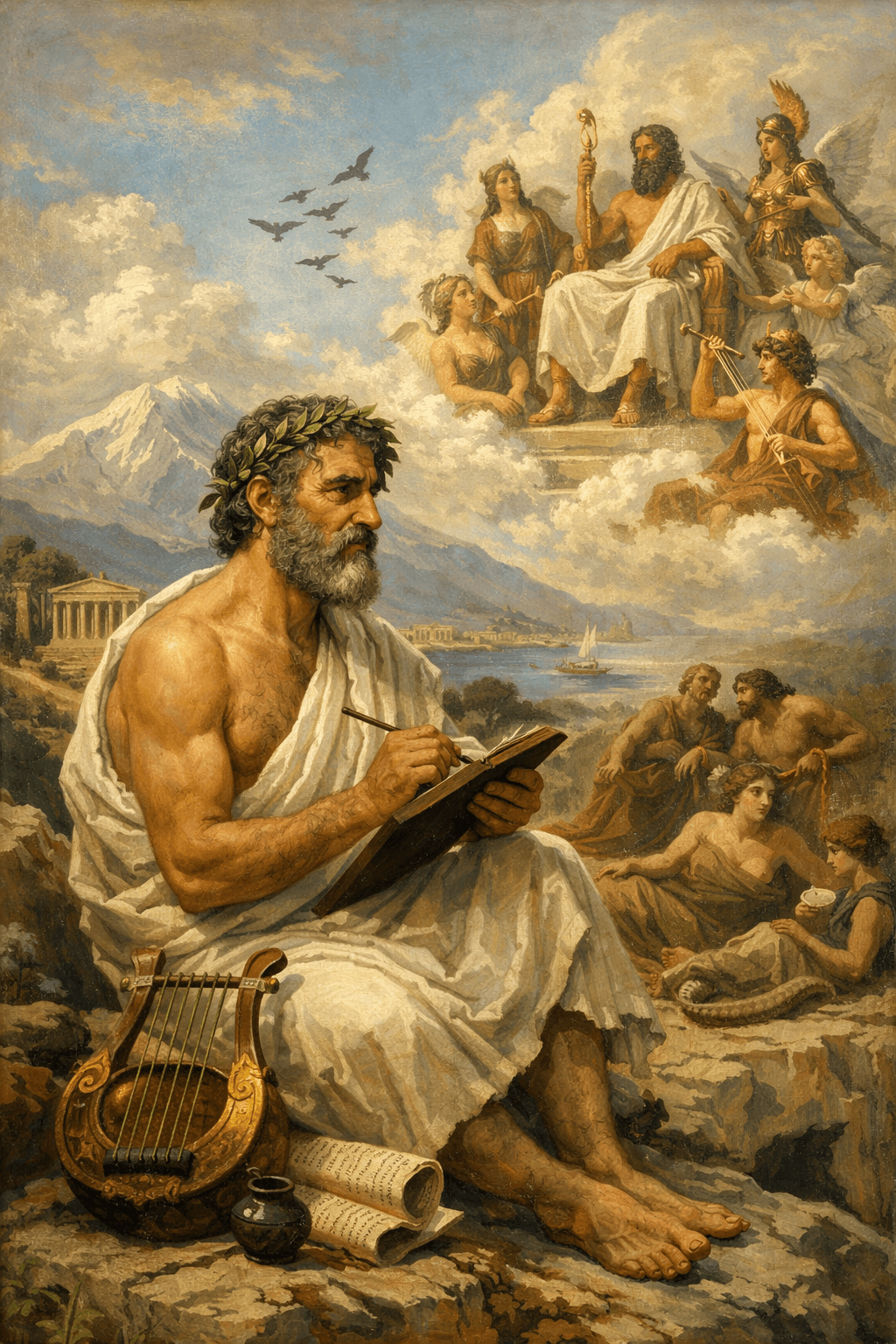
Hesiodos (Yapay Zekâ Tarafından Oluşturulmuştur)
Hesiod is one of the foundational figures in the history of Ancient Greek thought who placed mythological narrative within a systematic cosmogony, treated the world of the gods and human life as part of a single intellectual whole, and represents the transition between the epic tradition and early philosophical thought. The works attributed to him, Theogony and Erga kai Hēmerai (Works and Days), offer not only mythological narratives but also a comprehensive intellectual framework concerning the origin of the universe, the divine order, and humanity’s place within it. When read together, these two works position Hesiod not merely as a mythographer explaining the lineage of the gods and the cosmic order, but as a thinker who defines human existence through the concepts of morality, justice, and labor.
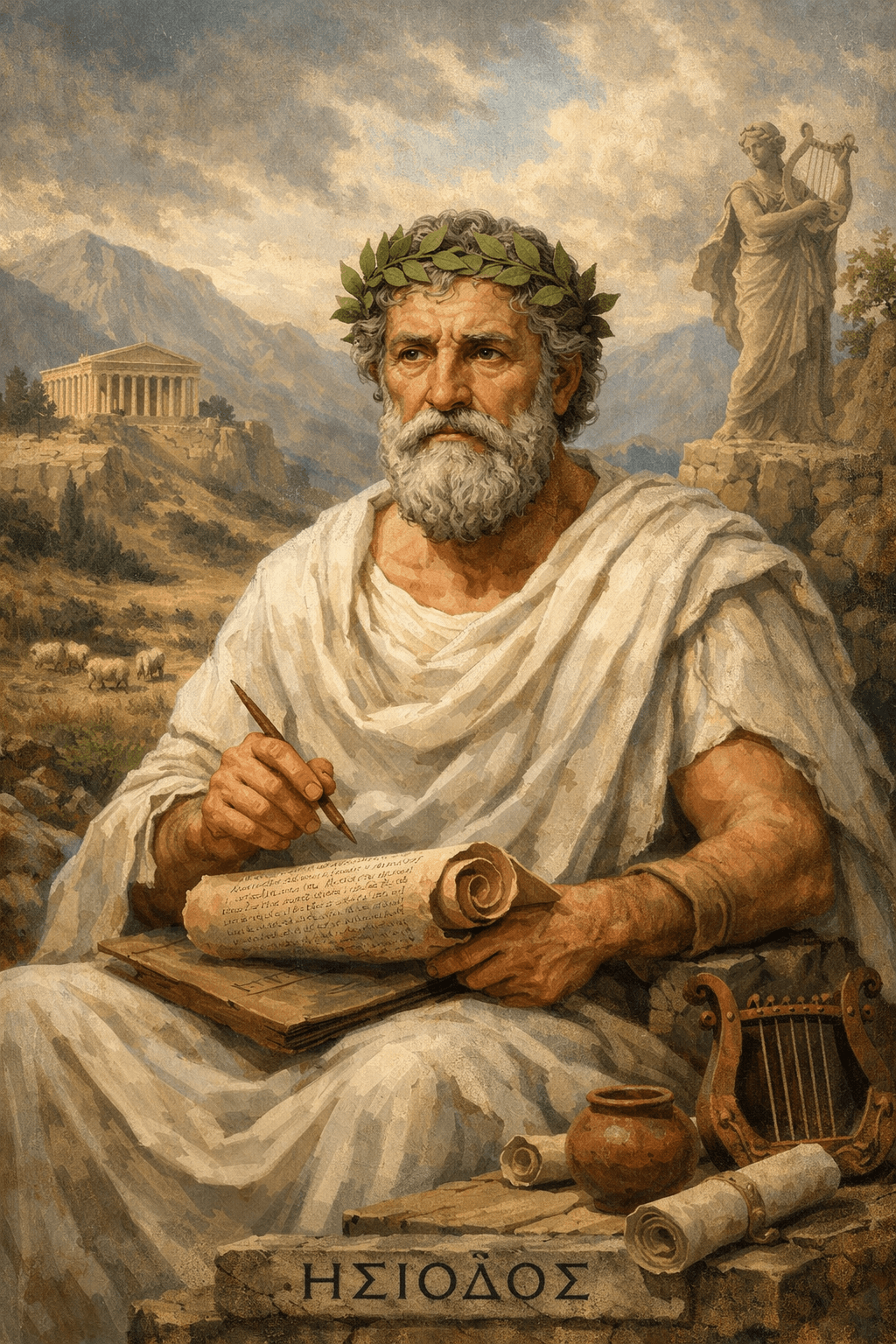
Greek Mythology Hesiod (Generated by Artificial Intelligence)
Hesiod is regarded as one of the first poets in Greek literature to directly incorporate personal experience into poetic expression. While the narrators in the epics attributed to Homer remain in the background, Hesiod explicitly addresses his own life, family, and social environment in his works. This feature transforms his texts from mere mythological tales into intellectual narratives that reflect how the individual perceives the world.
Hesiod’s identity is not singular. In Theogony he emerges as a mythographer who establishes the order of the divine realm; in Erga kai Hēmerai he assumes the role of a didactic sage who sets standards for human life. This dual structure reveals that Hesiod was not simply a poet transmitting mythological stories, but also a figure who reflected on order, justice, and human behavior. His mode of expression creates a bridge between myth and intellectual inquiry.
In Ancient Greek culture, religious and mythological knowledge was largely preserved and transmitted through the poetic tradition. Myths—narratives about gods and heroes—were shaped within oral culture and became carriers of collective memory. Hesiod is part of this tradition; yet he distinguishes himself by transforming mythological narrative into a systematic structure.
Mythos (mythological narrative) expresses humanity’s intuitive and symbolic relationship with nature, while logos represents the organization of thought and conceptual explanation. In Hesiod’s works these two domains intertwine. Theogony presents a systematic account of the origin of the divine order while simultaneously describing the structure of the cosmos. Erga kai Hēmerai, by contrast, outlines human responsibilities, the necessity of labor, and the concept of justice, thereby establishing the principles of social order. This structure constitutes one of the earliest examples in Greek thought of the transition from mythological narrative to conceptual reasoning.
Theogony is a cosmogonic account that explains the origins of the universe and the gods. The text begins with the primordial existence of Chaos, then describes the emergence of Gaia, Eros, and other primal beings as the foundation of order. The gods are not merely personal entities; they represent fundamental forces of nature. Gaia is both earth and goddess, Pontos both sea and god. This understanding reveals that nature and divinity form an inseparable unity.
Struggles among the gods symbolize the process by which cosmic order is established. The reign of Uranus, the rise of Kronos, and Zeus’s seizure of power signify the formation of a lasting order in the cosmos. Zeus’s dominion becomes the symbol of cosmic justice, law, and continuity. Thus, the universe is defined not as a random structure but as a systematic and hierarchical whole.
With Zeus’s rule, law and order become prominent in the cosmos. This order encompasses not only the divine realm but also human life. Theogony establishes a direct relationship between cosmic structure and human behavior. The divine order forms the foundation for the moral and legal principles that will govern human society.

Portrait of Hesiod (WorldHistory)
Erga kai Hēmerai explains human life through the concept of ergon. Ergon is not merely production or economic activity; it is the condition of human existence. Through labor, humans establish relationships with nature and social order. Work is the foundation for sustaining life and occupying a place within the order. Hesiod defines humans as beings who realize themselves through labor. Work determines an individual’s social identity and moral responsibility. Labor enables humans to live in harmony with the cosmic order.
Ergon and dikē are understood together. Justice directs labor toward its proper ends; labor makes the realization of justice in the social sphere possible. This relationship forms the basis of an orderly life. Hesiod’s advice to Perses guides human behavior through criticism of idleness, unjust gain, and injustice.
The concept of ergon is grounded in the myths of Prometheus and Pandora. These myths explain that human life is shaped by toil and responsibility. The theft of fire, the punishment, and the sending of Pandora define human existence as inherently tied to labor and trial. The Doctrine of the Ages of Man (the Golden, Silver, Bronze, Heroic, and Iron Races) describes the changing moral and social conditions of humanity.
Hesiod views human beings as entities bearing responsibility within the cosmic order. Humans are part of nature, yet through consciousness, labor, and social order they construct their own sphere of existence. This approach moves humanity beyond passive existence and positions it as an active subject. Human behavior gains meaning only insofar as it aligns with the divine order.
Hesiod is among the earliest figures in Ancient Greek thought who placed mythological narrative within a coherent cosmic and moral framework. His works present, in a systematic narrative structure, the relationship between the origin of the universe and human behavior. In this way, Hesiod’s texts create an intellectual space in which mythological thought is not merely transmitted but also organized.
Theogony explains the hierarchical structure of the universe through the genealogical chain of the gods. Relationships among the gods are examined in terms of order and power. This narrative enables the cosmos to be understood not as random but as operating within a defined structure. The connection between divine order and nature allows the cosmic structure to be grasped as a unified whole. Erga kai Hēmerai, by contrast, addresses human life through the concepts of labor, justice, and responsibility. Human behavior is defined as part of a life in harmony with the cosmic order. Labor and justice are fundamental elements both of individual life and of social order. This approach allows ethical thought to be systematically expressed within mythological narrative.
Hesiod’s narrative structure creates a transitional space between mythos and intellectual inquiry. Through mythological imagery, concepts of order, law, and responsibility are articulated, laying the groundwork for the development of conceptual thought. This structure provides an early intellectual framework in which the cosmos and humanity’s place within it are considered together. Moreover, Hesiod’s connection between divine order and human behavior enables social life to be explained in relation to its foundational principles. Humanity is defined not merely as a part of nature but as an entity that acts within order and responsibility. Thus, a coherent mode of thought emerges that links cosmic structure with human life.

Hesiodos (Yapay Zekâ Tarafından Oluşturulmuştur)
Hesiod’s Identity
A Figure Between Epic and Logos
Theogony: The Establishment of Cosmic Order
The Genealogy of the Gods and Cosmogony
Divine Order and Cosmic Justice
Erga kai Hēmerai: Human Beings and Labor
The Concept of Ergon
The Relationship Between Ergon and Dikē (Justice)
Mythological Foundations of Labor
Hesiod’s Conception of Humanity
Hesiod’s Place in Ancient Greek Thought