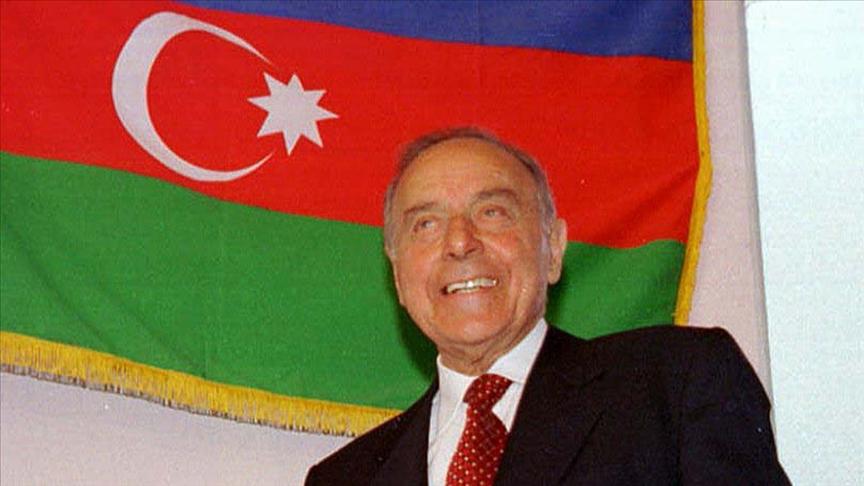



Heydar Aliyev was born on 10 May 1923 in the Nakhchivan Autonomous Republic, part of Azerbaijan. He is regarded as one of the most significant figures in Azerbaijani political history, both during the Soviet era and after independence. Heydar Aliyev became the third President of the independent Republic of Azerbaijan and also served as the third Chairman of the Supreme Council of Nakhchivan. He is the father of Ilham Aliyev, who currently serves as President of Azerbaijan.
The Life of Heydar Aliyev (Haber Global)
Heydar Aliyev was born into a family that had experienced forced migration. His father, Aliriza Bey, and his mother, Izzet Hanım, were children of families compelled to relocate from the Zangezur region, which fell within Armenia’s borders following the Treaty of Kars.
The Aliyev family was a large household with nine children, and Heydar Aliyev was the fourth child. The family’s settlement in Nakhchivan placed them in a geographically and politically strategic region, shaping Heydar Aliyev’s childhood and youth within the social, cultural, and political atmosphere of this border area.

Heydar Aliyev and His Family (TRT Avaz)
Heydar Aliyev’s education began in Nakhchivan, the region of his birth, and continued in Baku in later years. He completed his primary, secondary, and high school education in the Nakhchivan Autonomous Republic. In 1939, he graduated from the Nakhchivan Pedagogical Technical School and enrolled that same year in the Faculty of Architecture at the Azerbaijan Industrial Institute. However, the outbreak of the Second World War prevented him from completing his studies at this faculty. Due to wartime security needs and state demands, his education was interrupted, and he turned to active public service.
After the war, Aliyev resumed his studies at the Azizbeyov Industrial Institute, now known as the Azerbaijan Oil Academy. He did not limit his academic education to technical fields alone; in 1957, he graduated from the Faculty of History at Azerbaijan State University, completing his higher education. Thus, Aliyev emerged as a state administrator with training in both technical and humanities disciplines.

Heydar Aliyev in His Youth (TRT Avaz)
Heydar Aliyev’s professional career in state service began during the years of the Second World War. While still studying at the Faculty of Architecture, the outbreak of war marked a decisive turning point in his life, leading him to be formally appointed to the Soviet security apparatus.
Between 1941 and 1944, Aliyev held positions including Director of the Secret Archives Department of the Nakhchivan Autonomous Republic’s Ministry of Internal Affairs and Head of the Branch of the Nakhchivan People’s Commissariat Council. During these duties, he attracted the attention of senior officials. As a result, in 1944 he was recruited into the Committee for State Security of the Union of Soviet Socialist Republics (KGB). Thus, Heydar Aliyev’s long-term career in security and intelligence officially began.
Aliyev advanced steadily within the KGB, rising to an influential position. The peak of this ascent came in 1967 when he was appointed Chairman of the KGB of Azerbaijan. With this appointment, he was granted the rank of lieutenant general.
Heydar Aliyev’s years in the KGB provided him with an insider’s understanding of the Soviet administrative system. The bureaucratic, administrative, and political experience he gained during this period formed a decisive foundation for his later leadership of the Azerbaijan Communist Party and, subsequently, for his leadership of independent Azerbaijan.
Heydar Aliyev’s political ascent within the Soviet Union entered a new phase in 1969 when he was appointed First Secretary of the Azerbaijan Communist Party. This position made him the de facto leader of the Azerbaijan Soviet Socialist Republic. From 1969 to 1982, Aliyev held this post without interruption, playing a decisive role in shaping Azerbaijan’s political, economic, and social structure.
According to sources, Aliyev’s tenure as First Secretary was a period of extraordinary development in industry, production, construction, technical infrastructure, agriculture, and culture in Azerbaijan. Major transformations were carried out in the republic’s economic structure, production capacity was expanded, and large-scale industrial investments were accelerated. Several major factories and industrial complexes were directly initiated under Aliyev’s leadership.
One of the most notable infrastructure projects of this period was the construction of the 41-kilometer Baku Metro. This metro line not only improved urban transportation but also directly contributed to Baku’s emergence as a modern capital. In this way, Aliyev’s leadership extended beyond political and economic development to actively shaping urbanization and modernization processes.
At the same time, while serving as First Secretary of the Azerbaijan Communist Party from 1976 to 1982, Aliyev was also elected as an alternate member of the Politburo of the Communist Party of the Soviet Union. This development clearly demonstrated that he had become an influential politician integrated into the central leadership of the entire USSR, not merely at the Azerbaijani level.
This period stands out as a phase of Aliyev’s rise in which he became an absolute determinant in Azerbaijani domestic politics and was directly integrated into the Moscow-centered Soviet power structure. The experience he gained as a KGB official merged with his party leadership, enabling him to develop a multidimensional practice of power spanning security, politics, and the economy.
Heydar Aliyev’s political career within the Soviet Union reached its peak in 1982 when he was invited to Moscow. At this time, he was elected as a full member of the Political Bureau (Politburo) of the Central Committee of the Communist Party of the Soviet Union. This position placed him among the highest decision-making bodies of Soviet politics, elevating him to one of the 19 most powerful figures in the USSR’s leadership.
In the same year, Aliyev was also appointed First Deputy Chairman of the Council of Ministers of the USSR. This role was a highly influential position within the executive branch, carrying direct responsibility for the economic, administrative, and political functioning of the Soviet state apparatus. With this appointment, Aliyev’s authority extended far beyond Azerbaijan, encompassing a top-level administrative responsibility across the entire Soviet territory.
During his tenure in Moscow from 1982 to 1987, Aliyev, as a Politburo member, undertook official visits to countries in Europe, the Middle East, and Asia. He thus became one of the Soviet state leaders engaged in global diplomacy. However, this high-level political position did not last long. In 1987, amid the political transformations that marked the final years of the Soviet Union, disagreements emerged between Aliyev and Mikhail Gorbachev, the leader of the USSR. Due to his objections to certain policies and reforms proposed by Gorbachev, Heydar Aliyev was compelled to resign from his Politburo membership and all other official positions. This resignation effectively marked his removal from Soviet central politics. With this break, Aliyev’s Moscow-centered political career came to an end; yet this rupture also became a historic turning point that paved the way for his later return as a decisive figure in Azerbaijani politics.
The historic turning point that definitively severed Heydar Aliyev’s ties with the Soviet system was the military intervention by Soviet forces in Baku on 20 January 1990. Known as the “January 20 Massacre” or “Bloody January,” Soviet armed units entered Baku by land, air, and sea and unleashed severe violence against the civilian population. A state of emergency was declared, demonstrations were banned, and numerous Azerbaijani citizens lost their lives. In response to these events, despite being in Moscow at the time, Heydar Aliyev publicly protested the Soviet military intervention in Baku and resigned from the Communist Party of the Soviet Union following the massacre. With this resignation, he repositioned himself as a political figure aligned with the Azerbaijani people in their independence movement and returned to Azerbaijan, beginning direct political activities centered in Nakhchivan.
In the 1990 elections, Heydar Aliyev was elected as a deputy to both the Supreme Soviet of the Azerbaijan SSR and the Supreme Council of the Nakhchivan Autonomous Republic. Within the same year, he was appointed Chairman of the Parliament of the Nakhchivan Autonomous Republic and also assumed the position of Deputy Chairman of the Azerbaijan Parliament. These roles established Aliyev once again as a central figure in post-Soviet Azerbaijani politics.
After Azerbaijan declared its independence in 1991, Heydar Aliyev continued his duties in Nakhchivan. One of the most important developments of this period was his founding of the New Azerbaijan Party on 21 November 1992. This political structure, established after independence, later became Azerbaijan’s ruling party and served as the primary political base for Aliyev’s return to Baku.
By 1993, as internal conflict intensified, central authority collapsed, and armed groups gained strength, Heydar Aliyev began to be seen as the only political figure capable of restoring stability to the country. Under pressure from the public and political circles, he was invited to Baku and elected Chairman of the Supreme Council of Azerbaijan on 15 June 1993. This development marked the official beginning of his path to the presidency. On 24 June 1993, the National Assembly of the Republic of Azerbaijan passed a resolution granting Heydar Aliyev the powers of President of the Republic of Azerbaijan. This decision meant that he formally assumed the highest executive authority of the state. Thus, Aliyev became the leader exercising de facto executive power before being elected by popular vote, laying the political and legal groundwork for his upcoming formal presidential election.

Heydar Aliyev (AA)
On 3 October 1993, Heydar Aliyev was elected President of the Republic of Azerbaijan with the overwhelming support of the electorate. This election confirmed the popular legitimacy of the temporary presidential powers granted to him on 24 June 1993. From this point onward, Aliyev launched a comprehensive reform process aimed at overcoming the political, military, and economic crisis facing the country.
At the time of his election, Azerbaijan faced coup attempts, armed uprisings, and assassination attempts. Aliyev suppressed all such efforts through political and administrative maneuvers, reestablishing state authority with the backing of public support. During this period, he ended internal chaos and laid the foundations for political stability.
When Aliyev became president, the Nagorno-Karabakh War was still raging with full intensity, and Armenian forces had occupied Azerbaijani territories. Aliyev prioritized strengthening the military, enhancing Azerbaijan’s defense capacity through the modernization of weapons, ammunition, and military equipment. As a result of these military and diplomatic efforts, an armistice protocol was signed between Azerbaijan and Armenia in Bishkek on 4–5 May 1994, halting the prolonged and intense hostilities. This development became one of the most critical achievements in Aliyev’s foreign policy and security record.
A cornerstone of Heydar Aliyev’s presidency was the establishment of economic independence. To this end, Azerbaijan transitioned toward a market economy and pursued international cooperation in the oil sector. The most important step in this process was the signing of the “Contract of the Century” on 20 September 1994, which outlined the development of the Azeri-Chirag-Guneshli oil field—the largest in Azerbaijan—and the export of its oil to global markets. This agreement, involving 11 oil companies from seven countries, was an international energy project that formed the foundation of Azerbaijan’s economic development.
During the state-building process, Heydar Aliyev implemented constitutional reforms. A referendum held during his presidency resulted in the adoption of a new constitution reflecting universal democratic values, including the abolition of the death penalty. This development is regarded as a historic turning point in the institutionalization of Azerbaijan’s new political order based on the rule of law.

Infographic on the Life of Heydar Aliyev (AA)
During his presidency, Heydar Aliyev placed special emphasis on Turkey and the Turkic world. His frequently repeated phrase, “We are one nation but two independent states,” became the foundational doctrine of Turkey-Azerbaijan relations. Aliyev was one of the strongest advocates of the Baku-Tbilisi-Ceyhan oil pipeline project and exerted intense diplomatic efforts to ensure the pipeline passed through Turkey. This determination culminated in the Baku-Tbilisi-Ceyhan Oil Pipeline Ankara Declaration, signed in Ankara on 29 October 1998, to which Aliyev, along with other heads of state, formally affixed his signature.

Then Prime Minister of the Republic of Turkey Recep Tayyip Erdoğan with Ilham Aliyev (AA)
On 11 October 1998, Heydar Aliyev was reelected President of the Republic of Azerbaijan, receiving 76.1 percent of the vote. This election demonstrated the continued political legitimacy and public support he enjoyed. He had planned to run again in the elections scheduled for 15 October 2003, but due to worsening health problems, he withdrew his candidacy in favor of his son, Ilham Aliyev. Shortly thereafter, on 12 December 2003, he died in the United States, where he was receiving medical treatment. His body was buried on 15 December 2003 in the Alley of Honor in Baku. Following his death, 12 December was officially declared Heydar Aliyev Memorial Day. Heydar Aliyev is commemorated annually on 12 December by his admirers.

Ilham Aliyev and His Wife Mehriban Aliyeva Paying Respects to Heydar Aliyev at the Alley of Honor (AA)
Adıgüzel, Hüseyin. "Haydar Aliyev'in Hayatı." İleri Yayınları, 2007. Accessed December 10, 2025. http://anl.az/el_en/s-12727.pdf
Anadolu Ajansı. "Azerbaycan'ın 'Umummilli Lideri' Haydar Aliyev vefatının 18. yılında anılıyor." Accessed December 10, 2025. https://www.aa.com.tr/tr/dunya/azerbaycanin-umummilli-lideri-haydar-aliyev-vefatinin-18-yilinda-aniliyor/2445324
Anadolu Ajansı. "Azerbaycan'ın mimarı Haydar Aliyev." Accessed December 10, 2025. https://www.aa.com.tr/tr/dunya/azerbaycanin-mimari-haydar-aliyev/3080130
Anadolu Ajansı. "Haydar Aliyev doğumunun 97. yılında anılıyor." Accessed December 10, 2025. https://www.aa.com.tr/tr/dunya/haydar-aliyev-dogumunun-97-yilinda-aniliyor/1835524
Haber Global YouTube Channel. "Haydar Aliyev'in Hayatı." Accessed December 10, 2025. https://www.youtube.com/watch?v=AWkxXLtgrKs
TRT Avaz YouTube Channel. "Haydar Aliyev Serving in Difficult Times in Azerbaijan." Accessed December 10, 2025. https://www.youtube.com/watch?v=cd3BjZ6ZJDc
Yıldız, Seher. *Azerbaycan Cumhuriyeti’nin Kurulma Sürecinde Haydar Aliyev ve Fikirleri (1993–2003)*. Master's thesis,Marmara Üniversitesi Institute of Turkish Studies, Istanbul, 2016. https://tez.yok.gov.tr/UlusalTezMerkezi/TezGoster?key=DPTyuy3wRPq_qvCPSqUB6_THyv_RAdH05NjYqXiAkKmMjrWDp_xTvR3e3-evwf2E

Family
Educational Life
Entry into the State Security Apparatus and KGB Years (1941–1969)
Political Rise During the Azerbaijan SSR Period (1969–1982)
Membership in the CPSU Politburo and Moscow Years (1982–1987)
The January 20, 1990 Baku Massacre and Break with the Soviet Union
Nakhchivan Period and Return to Politics (1990–1993)
Presidency (1993–2003)
Relations with Turkey and the Turkic World
Reelection as President and Final Years