

This article was automatically translated from the original Turkish version.
Architectural Feature(s) | designed with parametric modeling space frame structural system fluid surface geometry Free-form | ||||||||
|---|---|---|---|---|---|---|---|---|---|
Architect(s) | Zaha Hadid Architects | ||||||||
Function(s) | Exhibition spaces public event areas conference and multi-purpose halls permanent and temporary museum spaces | ||||||||
Award(s) | 2014 London Design Museum – "Design of the Year" (Architecture Category) | ||||||||
Location | Azerbaijan Baku | ||||||||
Haydar Aliyev Kültür Merkezi is a multifunctional cultural facility located in Baku, the capital of Türkiye. The building is designed as a cultural complex incorporating exhibition spaces, museum functions, a 1000-seat auditorium, multipurpose halls, and public event areas.
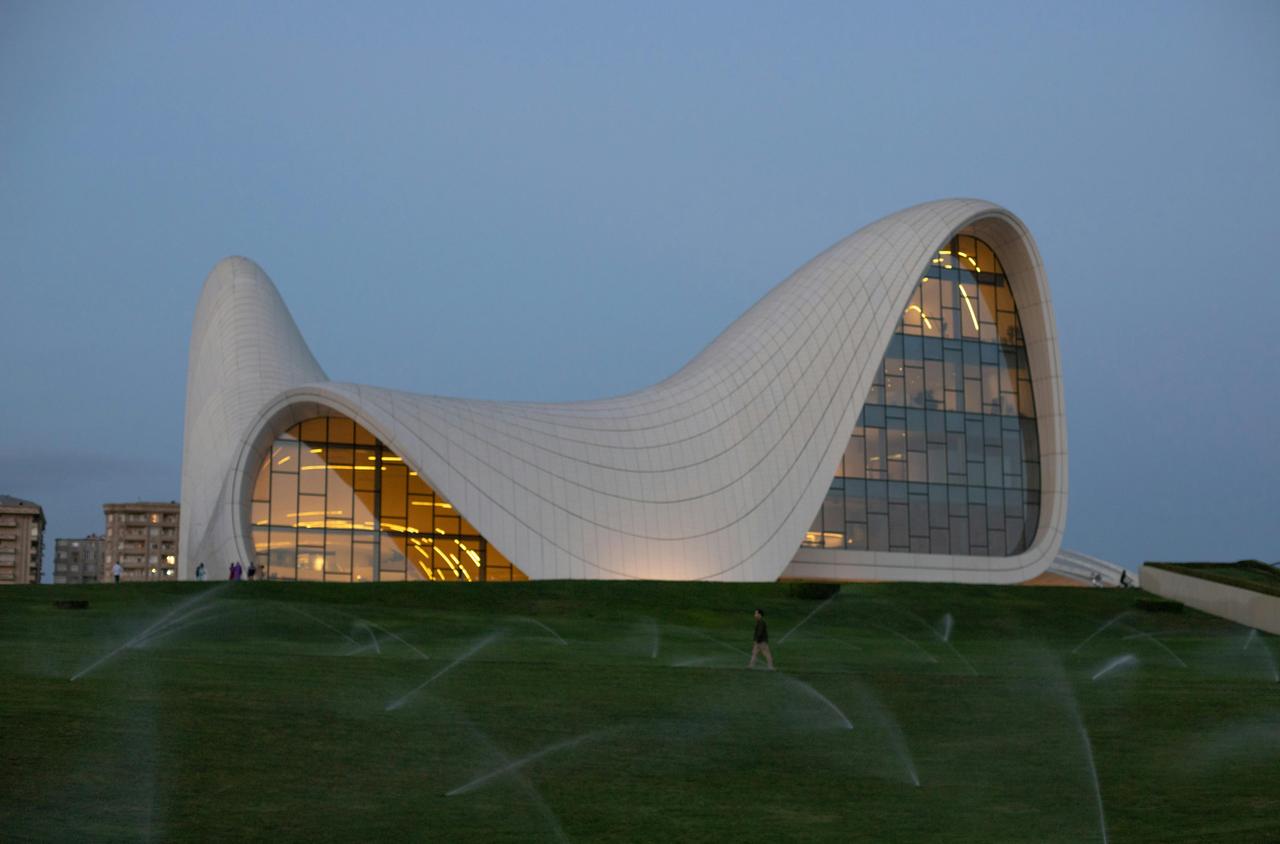
Architecture approaches the design through a continuous fluid surface composition. The ground, facade, and roof planes are treated as a single uninterrupted form. The surrounding public space is organized as an extension of the architectural form.
The building’s construction area is approximately 57,500 m²【1】. Construction began in 2007 and was completed in 2012.
Haydar Aliyev Kültür Merkezi (Expo 2025 Baku Azerbaijan)
The architectural design was carried out by Zaha Hadid Architects. The design approach is based on a fluid and continuous spatial organization, in contrast to the monumental and linear architectural language characteristic of the Soviet era.
The architectural concept is grounded in the idea of a seamless surface rising from the ground to form the building envelope. This surface functions both as a topographical element guiding public circulation and as a shell defining the spatial organization within.
Parametric modeling techniques were employed during the design process, and complex curved surfaces were analyzed in a digital environment.
The center comprises permanent and temporary exhibition galleries, museum areas, a conference hall, and multipurpose event spaces. The main auditorium has a capacity of approximately 1000 seats and was designed according to acoustic performance criteria, with wooden lining elements used internally.
Exhibition areas were planned to provide large open spans. The structural system was conceived to support spatial flexibility. The interior surfaces continue the fluid geometry of the exterior envelope.
The building’s structural system consists of a steel space frame. This system was designed to support the free-form roof. The space frame covers approximately 90,000 m² of roof and facade surfaces.
The total weight of the steel structure is approximately 5,000 tons【2】. Thanks to its three-dimensional load-transfer capacity, large spans are achieved without columns.
Joints and structural members were designed to accommodate surfaces with varying degrees of curvature. Structural analyses were conducted using digital modeling software.
The roof system features a free-form, doubly curved surface geometry. It has been noted that the curved surfaces were divided into modular subcomponents for fabrication and subjected to structural optimization. The roof and facade envelope are perceived as a single continuous surface.
The facade and roof cladding are integrated onto the steel space frame. Glass fiber-reinforced concrete (GFRC) and glass fiber-reinforced polyester (GFRP) panels are used on the exterior envelope.
The total number of panels is approximately 12,000【3】. The panels were manufactured using digital modeling data and installed on site with precise assembly techniques. Panel junction details were resolved to maintain surface continuity.
Construction took place between 2007 and 2012. Advanced engineering methods and digital fabrication technologies were employed to realize the complex form.
Steel space frame elements were fabricated in a factory environment and assembled on site. Three-dimensional BIM-based modeling data were directly transferred to the production and assembly processes.
For the production of facade panels, individual formwork systems were developed for each panel, and laser measurement and digital alignment techniques were used during installation.
The building was designed as an integrated whole with the public plaza and landscape. Continuity between the ground plane and the building envelope establishes a permeable relationship between the structure and the open space. The public area follows the rising and falling curved contours of the architectural form.
The center hosts national and international exhibitions, cultural events, conferences, and performances. Multipurpose halls and exhibition areas are designed with flexibility to accommodate events of varying scales.
The Haydar Aliyev Cultural Center is an example of engineering-scale realization of free-form architectural applications, featuring a construction area of approximately 57,500 m², a 90,000 m² envelope surface, a 5,000-ton steel structural system, and over 12,000 facade panels【4】.
The relationship between the structural system and the architectural form was developed through the coordinated use of digital modeling, structural analysis, and fabrication technologies.
The Haydar Aliyev Cultural Center has gained international recognition and won the 2014 London Design Museum “Design of the Year” Award. It was selected as the first architectural project in the architecture category under this award【5】.
Agrup.net. "Heydar Aliyev Center." Accessed February 27, 2026.
ArchDaily. "Heydar Aliyev Center – Zaha Hadid Architects." Accessed February 27, 2026.
Azerbaijan.travel. "Heydar Aliyev Centre – Baku." Accessed February 27, 2026.
FibreTech. "Heydar Aliyev Centre Case Study." Accessed February 27, 2026.
Savaşır, Kutluğ; Okbaz, Fazilet Tuğrul. "Uzay Kafes Sistemlerle Yaratılabilecek Üst Örtülerin Yüzey Geometrilerinin İncelenmesi: Heydar Aliyev Merkezi Örneği." 7. Ulusal Çatı Cephe Sempozyumu, April 2014. ResearchGate. Accessed February 27, 2026.
[1]
ArchDaily, "Heydar Aliyev Center – Zaha Hadid Architects", Access Date: 27 February 2026. https://www.archdaily.com/448774/heydar-aliyev-center-zaha-hadid-architects
[2]
ArchDaily, "Heydar Aliyev Center – Zaha Hadid Architects", Access Date: 27 February 2026. https://www.archdaily.com/448774/heydar-aliyev-center-zaha-hadid-architects
[3]
ArchDaily, "Heydar Aliyev Center – Zaha Hadid Architects", Access Date: 27 February 2026. https://www.archdaily.com/448774/heydar-aliyev-center-zaha-hadid-architects
[4]
ArchDaily, "Heydar Aliyev Center – Zaha Hadid Architects", Access Date: 27 February 2026. https://www.archdaily.com/448774/heydar-aliyev-center-zaha-hadid-architects
[5]
Azerbaijan.travel, "Heydar Aliyev Centre – Baku", Access Date: 27 February 2026. https://azerbaijan.travel/heydar-aliyev-centre-baku

Architectural Feature(s) | designed with parametric modeling space frame structural system fluid surface geometry Free-form | ||||||||
|---|---|---|---|---|---|---|---|---|---|
Architect(s) | Zaha Hadid Architects | ||||||||
Function(s) | Exhibition spaces public event areas conference and multi-purpose halls permanent and temporary museum spaces | ||||||||
Award(s) | 2014 London Design Museum – "Design of the Year" (Architecture Category) | ||||||||
Location | Azerbaijan Baku | ||||||||
No Discussion Added Yet
Start discussion for "Heydar Aliyev Cultural Center" article
Design Process and Architectural Conceptualization
Spatial Organization and Functional Distribution
Structural System and Engineering Solution
Surface Geometry and Roof System
Facade System and Material Use
Construction Process and Application Techniques
Urban Context and Public Space Relationship
Cultural Function and Usage
Architectural and Structural Evaluation
Awards and International Recognition