



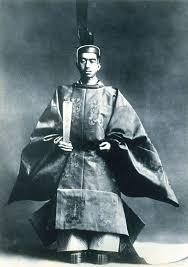
Hirohito (裕仁)
Doğum tarihi | 1901-04-29 | ||||||||
|---|---|---|---|---|---|---|---|---|---|
Ölüm tarihi | 1989-01-07 | ||||||||
Place of Death | Tokyo, Japan | ||||||||
Place of Birth | Tokyo, Japan | ||||||||
Position(s) | Emperor of Japan (1926–1989) | ||||||||
Notable Events | Economic Miracle Modernization of Japan World War II | ||||||||
Hirohito (裕仁) is the 124th Emperor of Japan and reigned from 1926 until his death in 1989. Hirohito, who gave his name to the Shōwa era (昭和時代), became one of the longest-serving leaders in Japanese imperial history. His reign witnessed critical periods including Japan’s militarist expansion policies, World War II, postwar democratization, and the economic miracle.
Hirohito was born on 29 April 1901 in Tokyo. He was the first son of Emperor Taishō and Empress Teimei. In 1912 he was proclaimed crown prince. His education began with private tutors at the Imperial Palace and later continued at Gakushūin School. He received a broad education in modern science and Western culture. In 1921 he became the first Japanese crown prince to travel to Europe; this journey broadened his worldview and increased his interest in Western economic and political models.
Due to his father Emperor Taishō’s health issues, Hirohito began serving as regent in 1921. He officially became Emperor on 25 December 1926. The Shōwa era, meaning “Enlightened Peace,” defined his reign. However, the early years of Shōwa were marked by economic crises, political turmoil and military coup attempts.
In 1931 the Manchurian Incident accelerated Japan’s expansionist policies in China. In 1937 a full-scale war broke out with China (the Second Sino-Japanese War). Although Hirohito did not directly intervene beyond constitutional limits, he exercised no effective control over the military. Some historians argue that the Emperor failed to take a stronger stance against the rise of militarism, while others portray him as a passive figure.
On 7 December 1941, Japan declared war on the United States following the attack on Pearl Harbor. Hirohito did not issue direct orders to initiate the war, but he formally approved all military actions during the conflict. Japan’s expansionist ambitions caused widespread destruction across the Asia-Pacific region.
After the atomic bombings of Hiroshima and Nagasaki in 1945, Hirohito announced Japan’s surrender in a historic radio address to the Japanese people on 15 August 1945. This “Gyokuon-hōsō” (Imperial Voice Broadcast) marked a turning point in Japanese history.
In the postwar period, Hirohito cooperated with the Allied occupation administration led by General Douglas MacArthur. In 1946 he issued the “Humanity Declaration,” renouncing his divine status. Under the new Japanese Constitution, the role of the Emperor was redefined as symbolic.
During this period, Hirohito supported Japan’s democratization and economic growth. As Japan emerged as an economic superpower on the global stage in the 1960s and 1970s, Hirohito assumed the role of a “peace ambassador” in international relations.
Hirohito died on 7 January 1989 at the age of 87. After his death, the Japanese public and the world debated his complex legacy. On one hand, he was criticized for responsibility in the atrocities of the war; on the other, his contributions to Japan’s modernization were admired.
Under Hirohito’s reign, Japan transitioned from its feudal past to a modern economic and political structure.
Historians are divided on Hirohito’s role in World War II:
Research indicates that Hirohito harbored some reservations about wartime policies but actively endorsed key decisions during the conflict.
In the postwar period, Hirohito was presented in Western countries as a “peace-oriented statesman.” The United States ensured that Hirohito was not held accountable for war crimes in order to maintain Japan as an ally during the Cold War. Over time, Hirohito became a symbol of Japan’s peaceful development. However, many countries in the Asia-Pacific region, particularly China and Korea, continued to view him as responsible for the tragedies of the war.
Hirohito’s image in the Western world after the war was largely reconstructed. The United States sought to avoid portraying Hirohito as a war criminal in order to facilitate Japan’s rapid reconstruction and contain Soviet influence in Asia. As a result, Hirohito was presented in Western public opinion as a “peace-loving monarch.” Particularly under the U.S. occupation, Hirohito’s public engagements were carefully managed and he was positioned as a loyal symbol within the new constitutional order. In contrast, in Asia-Pacific countries such as China, Korea and the Philippines, Hirohito’s role during the war was perceived differently. In these regions, Hirohito was associated with Japan’s occupations and war crimes. Many Asians believe that Hirohito bore at least symbolic responsibility for these tragedies.
During the Shōwa era, Emperor Hirohito was placed at the center of Japan’s ideological unity. The “divine emperor” doctrine served as a powerful tool to promote loyalty and obedience across all levels of society. The education curriculum was shaped by oaths of allegiance to the Emperor.
Propaganda campaigns elevated Hirohito as the father of the nation and its spiritual leader. This cultural atmosphere nurtured both nationalism and militarism. Hirohito’s sanctity was continuously emphasized through posters, school textbooks, religious ceremonies and military training.
In the postwar period, Hirohito’s cult-like status was dismantled, but for a significant portion of the population, the Emperor remained an important part of Japanese identity.
Beasley, W.G. “The Modern History of Japan.” *Pacific Affairs*, 1955. Accessed April 2025. https://www.jstor.org/stable/133216
Dower, John W. *Embracing Defeat: Japan in the Wake of World War II*. Harvard University Press, 1999. Accessed April 2025. https://www.jstor.org/stable/20097309
Herbert P. Bix. *Hirohito and the Making of Modern Japan*. HarperCollins, 2000. Accessed April 2025. https://www.jstor.org/stable/2385212
Kawamura, Noriko. “Emperor Hirohito and the Pacific War.” *Diplomacy & Statecraft*, 2021. Accessed April 2025. https://www.tandfonline.com/doi/pdf/10.1080/1362704X.2021.1908817
Kosaka, Masataka. “The Showa Emperor and His Times.” Osaka University Press, 1992. Accessed April 2025. https://ir.library.osaka-u.ac.jp/repo/ouka/all/96213/34132_Abstract.pdf
Large, Stephen S. *Shōwa Japan: 1926–1989*. Routledge, 1998. Accessed April 2025. https://core.ac.uk/download/pdf/144427589.pdf
Lu, David J. *Japan: A Documentary History*. Routledge, 2005. Accessed April 2025. https://so02.tci-thaijo.org/index.php/japanese/article/download/52411/43470


Hirohito (裕仁)
Doğum tarihi | 1901-04-29 | ||||||||
|---|---|---|---|---|---|---|---|---|---|
Ölüm tarihi | 1989-01-07 | ||||||||
Place of Death | Tokyo, Japan | ||||||||
Place of Birth | Tokyo, Japan | ||||||||
Position(s) | Emperor of Japan (1926–1989) | ||||||||
Notable Events | Economic Miracle Modernization of Japan World War II | ||||||||
No Discussion Added Yet
Start discussion for "Hirohito (Emperor Shōwa)" article
Early Life and Education
Accession and Early Reign (1926–1931)
Japanese Militarism and Expansion Policies (1931–1941)
World War II and Hirohito’s Role (1941–1945)
Postwar Period: Democratization and Symbolic Imperialism (1945–1989)
Death and Legacy
Debates on Hirohito’s Responsibility During the War
Hirohito’s Perception in World Politics
Hirohito’s Image in the West and Asia
Imperial Propaganda and Cultural Impact