This article was automatically translated from the original Turkish version.
+1 More
Location | Turkistan Kazakhstan | ||||||||
|---|---|---|---|---|---|---|---|---|---|
Construction Date(s) | 1396–1405 | ||||||||
Patron | Emir Timur | ||||||||
Architect(s) | Mevlânâ Ubeydullah Sadr | ||||||||
Architectural Style(s) | Timurid Islamic architecture | ||||||||
Prominent Features | Library Mosque Aksaray Cauldron room Gorhane (tomb chamber) Kufic and Thuluth inscriptions mosaic tiled walls bronze cauldron with a diameter of 245 cm Main dome with a diameter of 18.2 m | ||||||||
Function(s) | Social külliye Mosque Zaviye (tekke) Tomb | ||||||||
Buried in the Tomb | Hoca Ahmed Yesevî | ||||||||
Hoca Ahmed Yesevi Türbesi is one of the most significant structures of Central Asian Islamic architecture, located in the city of Turkistan in southern Kazakhstan. The tomb was built in honor of the 12th-century Sufi mystic Hoca Ahmed Yesevi. The monumental form visible today emerged from construction activities initiated under the orders of Timur at the end of the 14th century.

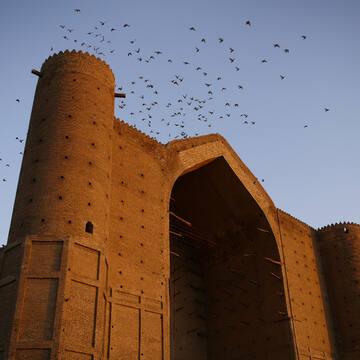
Hoca Ahmed Yesevi Türbesi (UNESCO)
Ahmed Yesevi was born in the late 11th century in Sayram and began his education in the city of Yesi. He received his initial Sufi training from Arslan Baba and later traveled to Bukhara, where he became a student of Hoca Yusuf Hamedani. After completing his education, he returned to Yesi and began spreading the Sufi teachings there. Shortly after his death in 1166–1167, his tomb quickly became an important pilgrimage site for Turkic peoples across Central Asia.
It is documented that the original structure of the tomb was small and modest, but over the centuries, especially during the Timurid period, it was rebuilt and expanded to achieve monumental proportions. It is understood that during his visit to Yesi around 1397, Timur, upon seeing the tomb in a state of disrepair, ordered the construction of a new complex in its place. Following Timur’s death, some sections of the tomb remained unfinished.
The Hoca Ahmed Yesevi Türbesi was constructed on a rectangular plan measuring approximately 46.5 by 65 meters. The central space, known as the Kazanlık, features a brick dome with a diameter of 18.2 meters, one of the largest in Central Asia. The outer dome has a diameter of 20.5 meters. The tomb’s architecture follows a U-shaped plan, with numerous small rooms, cells, worship areas, and service spaces surrounding the central dome. The height of the main iwan entrance reaches 37.5 meters, and its arch span is 18 meters.
The architectural elements of the structure include ceramic tile decorations crafted by masters from Shiraz, a domed burial chamber (Gorhane), a library, large and small aksarays, a halim house (kitchen), a mosque, and a water well. The walls are adorned with mosaic tiles, Kufic inscriptions, and verses from the Qur’an, including verses from Surah Al-Baqarah positioned in the upper register. A large bronze cauldron with a diameter of 245 centimeters, cast under Timur’s orders, is placed at the center of the structure.
Mevlana Ubeydullah Sadr was appointed as the responsible official for the construction of the tomb. Iranian artisans also participated in the project; craftsmen such as Hoca Hasan of Shiraz, Şems Abdul Vehhab, and İzzeddin of Isfahan, son of Taceddin, carried out the ceramic, metal, and woodwork for various sections. It is reported that some of the bricks used for the dome and minarets were transported from Sauran.
The endowment deed from the Timurid period details the provisions for the tomb’s sustainability, including water channels, land allocations, and personnel expenses. The tomb’s staff included memorizers of the Qur’an, water carriers, cooks, and cleaners. It was stipulated that a dish called “halim,” made from specified quantities of meat and wheat, would be prepared every Friday and Monday.
The tomb is not merely a burial site but a multifunctional complex that also served as a zawiya. It contains a cemetery, a mosque, a library, a kitchen, and guest cells. The chest containing the remains of Hoca Ahmed Yesevi is made of jade stone and is positioned along the central axis on the northern side of the tomb.
The Hoca Ahmed Yesevi Türbesi was inscribed on the UNESCO World Heritage List in 2003. The structure is built on the main tomb, which covers an area of 0.55 hectares, and the archaeological remains of the ancient city of Yesi surrounding it. It is regarded as one of the exemplary structures contributing to Islamic religious architecture during the Timurid period. The building has largely preserved its original architectural design and materials and is significant for documenting Timurid construction techniques.
Today, the tomb is under the ownership of the Republic of Kazakhstan and is protected and managed by the Azret Sultan State Historical-Cultural Preservation Museum. Management and restoration efforts are carried out in collaboration with relevant institutions of the Ministry of Culture. A long-term conservation and management plan has been implemented for the maintenance, repair, and promotion of the site.
The Hoca Ahmed Yesevi Türbesi holds great historical, architectural, and Sufi significance. As one of the emblematic structures of the Yesevi tradition, which played a major role in the spread of Islam in Central Asia, it also represents a characteristic example of 14th-century Timurid architecture. Today, the tomb continues to serve as a cultural and religious center for Muslim communities in the region, welcoming numerous visitors.
Aslanapa, Oktay. “Hazret-i Türkistan Hoca Ahmed Yesevî ve Türbesi.” *Bilig* 49 (2009): 971–980. Accessed July 15, 2025. https://dergipark.org.tr/tr/download/article-file/689090
DİA. "Ahmed Yesevî Külliyesi." *Türkiye Diyanet Vakfı İslâm Ansiklopedisi*. Accessed July 15, 2025. https://islamansiklopedisi.org.tr/ahmed-yesevi-kulliyesi
Nurmatov, Zhakhangir. “Mihail Yevgeneviç Masson, Hoca Ahmet Yesevi Türbesi.” *Edeb Erkan* 5 (2024): 211–231. Accessed July 15, 2025. https://isamveri.org/pdfdrg/G01833/2024_5/2024_5_NURMATOV.pdf
UNESCO. “Mausoleum of Khoja Ahmed Yasawi.” *World Heritage Centre*. Accessed July 15, 2025. https://whc.unesco.org/en/list/1103/

Location | Turkistan Kazakhstan | ||||||||
|---|---|---|---|---|---|---|---|---|---|
Construction Date(s) | 1396–1405 | ||||||||
Patron | Emir Timur | ||||||||
Architect(s) | Mevlânâ Ubeydullah Sadr | ||||||||
Architectural Style(s) | Timurid Islamic architecture | ||||||||
Prominent Features | Library Mosque Aksaray Cauldron room Gorhane (tomb chamber) Kufic and Thuluth inscriptions mosaic tiled walls bronze cauldron with a diameter of 245 cm Main dome with a diameter of 18.2 m | ||||||||
Function(s) | Social külliye Mosque Zaviye (tekke) Tomb | ||||||||
Buried in the Tomb | Hoca Ahmed Yesevî | ||||||||
No Discussion Added Yet
Start discussion for "Hoca Ahmed Yesevi Türbesi" article
History
Architectural Features
Construction and Artisans
Endowment and Function
Conservation and UNESCO Status