


This article was automatically translated from the original Turkish version.
+1 More
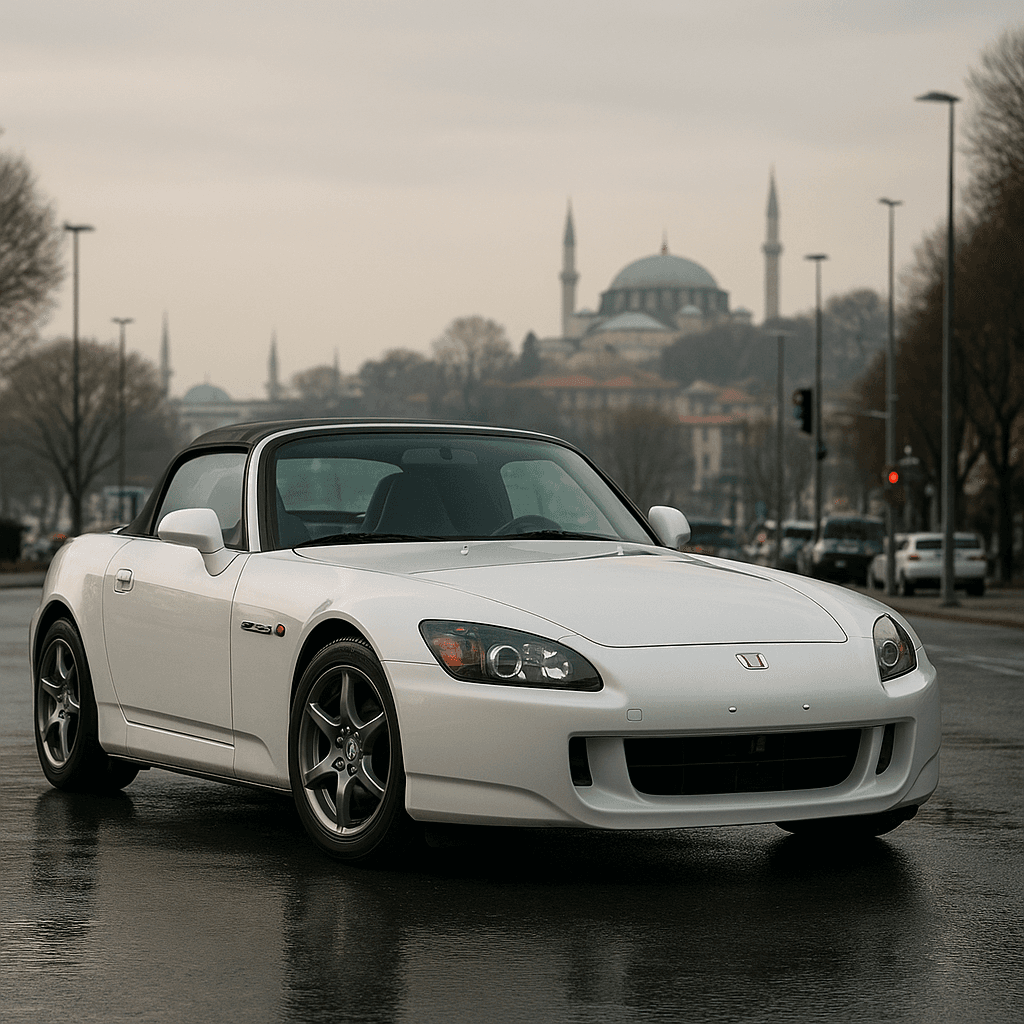
Honda S2000
Years Produced | 1999 - 2009 | ||||||||
|---|---|---|---|---|---|---|---|---|---|
Engine(s) | F22C1: 2.2L-237 hp-8.200 rpm F20C: 2.0L-240 hp-9.000 rpm | ||||||||
Transmission & Driving | Rear-wheel drive (RWD) 6-speed manual | ||||||||
Chassis | Double wishbone suspension 50:50 balance | ||||||||
Versions | S2000 CR (Club Racer): Produced in limited numbers only in the USA AP2 (2004–2009) AP1 (1999–2003) | ||||||||
Country | Japan | ||||||||
Production Quantity | Approximately 110,000 units produced | ||||||||
Honda S2000 is a two-door, two-seater roadster sports car produced by the Japanese automaker Honda, renowned for its high-revving engine, balanced chassis, and rear-wheel drive (RWD) layout. Introduced in 1999 to celebrate Honda’s 50th anniversary, it was produced until 2009.
The first prototype of the Honda S2000 was unveiled in 1995 at the Tokyo Motor Show under the name Honda SSM (Sport Study Model). This concept evolved into the production model, which was launched in 1999. The vehicle aimed to revive the spirit of Honda’s 1960s sports car series — S500, S600, and S800 — using modern technology.
The S2000 was sold outside Japan and received significant attention in markets such as the United States, Europe, and Australia.
The Honda S2000 is designed with an FR (front-engine, rear-wheel drive) layout. It emphasizes dynamic handling through a low center of gravity, a rigid chassis structure, and a double-wishbone independent suspension system.

S2000 Design (generated by artificial intelligence)
The first-generation S2000 was equipped with the “F20C” 2.0-liter four-cylinder DOHC VTEC engine. This engine produced 240 horsepower, making it one of the most powerful naturally aspirated engines per liter of its time (120 hp/L). This figure earned it a place in the Guinness World Records for one of the highest specific power outputs ever achieved in a production car.
The F20C engine could rev up to 9,000 rpm and was paired with a six-speed manual transmission to deliver a pure, mechanical driving experience. A version with the 2.2-liter F22C1 engine, offering higher torque, was introduced for the North American market after 2004.
The F20C engine achieved one of the highest specific power outputs among naturally aspirated engines of its era. Its high-revving nature enhanced both track performance and everyday usability.
The F22C1 delivered increased torque, improving driving flexibility at low and mid-range RPMs. This version was specifically developed for the North American market.

F20C Engine Unit (generated by artificial intelligence)
The electric power steering system provides direct feedback, while the car’s near-perfect weight distribution delivers precise and confident handling through corners.
The engine’s high-revving character creates a direct and engaging connection between driver and machine.
The S2000 stands out with its minimalist, driver-focused cockpit. Its most distinctive interior feature is the digital instrument cluster, which represented advanced technology at its 1999 launch. The gearshift knob is short and metallic, and the pedals are aluminum-finished.
Standard interior equipment includes leather upholstery, electric windows, air conditioning, and a trip computer. Overall, the cabin was designed in a minimalist style prioritizing lightness and driving focus.
The S2000 offered basic safety equipment as standard throughout its production run. However, some active safety technologies such as traction control and ESP were not available on all variants.

Honda S2000 Technical Specifications Comparison (generated by artificial intelligence)
The Honda S2000 sold approximately 110,000 units worldwide. It garnered strong interest, particularly in North America, and was frequently cited by automotive press as a benchmark in the “driver-focused sports car” category. Its power-to-liter ratio, manual transmission feedback, and balanced design elevated it to a significant status among enthusiasts and collectors.
The model has appeared in various racing video games and media productions, and has developed a large following in the modification culture.

White Honda S2000 (generated by artificial intelligence)
Production of the Honda S2000 ended in 2009. Rising emissions and safety regulations contributed to its discontinuation. However, the S2000 is now regarded as one of the last representatives of the “analog sports car” era. As a result, it retains strong value on the used market, with well-preserved, original examples commanding high demand.
Dobie, Stephen. "Honda S2000 (1999) Review." *Top Gear.* Accessed May 30, 2025. https://www.topgear.com/car-reviews/honda/s2000-1999
Hoffman, Connor. "Honda S2000 Resurrected as a Prototype for Its 20th Anniversary." *Car and Driver.* Accessed May 30, 2025. https://www.caranddriver.com/news/a30243846/honda-s2000-tokyo-auto-salon-revealed/
Honda Global. "60th anniversary of the birth of Honda’s sports cars: The fundamental concept behind the long-beloved “S” series." Accessed May 30, 2025. https://global.honda/en/design/interview/202412sports60th/
Honda Newsroom. "2001 Honda S2000 Specifications." Honda News. Accessed May 30, 2025. https://hondanews.com/en-US/releases/release-1731f2d3f03cd0ad1cb963004c34c89c-2001-honda-s2000-specifications
Honda UK. "How the Honda S2000 Ripped Up the Rulebook." Accessed May 30, 2025. https://www.honda.co.uk/cars/blog/article/brand/how-the-honda-s2000-ripped-up-the-rulebook.html
Otokokpit. "Honda S2000’i Tarihçesi ve Teknik Özellikleri ile Tanıyalım." Otokokpit. Accessed May 30, 2025. https://www.otokokpit.com/honda-s2000i-tarihcesi-ve-teknik-ozellikleri-ile-taniyalim/
Soysal, Şafak. "Geçmişe Bakış: Honda S2000 (AP1)." *Motor1.* Accessed May 30, 2025. https://tr.motor1.com/news/142754/gecmise-bakis-honda-s2000-ap1/
The Davis Experiment. "Honda S2000." The Davis Experiment. Accessed May 30, 2025. https://thedavisexperiment.com/s2000/index.html
Vollans, John-Joe. "Driving the classics: the revaholic Honda S2000." CAR Magazine. Accessed May 30, 2025. https://www.carmagazine.co.uk/car-reviews/honda/s2000-2009/
Yekikian, Nick, and Rodrez. "The Legend of the High-Revving Honda S2000 Roadster." *MotorTrend.* Accessed May 30, 2025. https://www.motortrend.com/features/honda-s2000-history-and-industry-effect

Honda S2000
Years Produced | 1999 - 2009 | ||||||||
|---|---|---|---|---|---|---|---|---|---|
Engine(s) | F22C1: 2.2L-237 hp-8.200 rpm F20C: 2.0L-240 hp-9.000 rpm | ||||||||
Transmission & Driving | Rear-wheel drive (RWD) 6-speed manual | ||||||||
Chassis | Double wishbone suspension 50:50 balance | ||||||||
Versions | S2000 CR (Club Racer): Produced in limited numbers only in the USA AP2 (2004–2009) AP1 (1999–2003) | ||||||||
Country | Japan | ||||||||
Production Quantity | Approximately 110,000 units produced | ||||||||
History and Development
Design and Structural Features
Engine and Performance
F20C Engine (1999–2003)
F22C1 Engine (2004–2009)
Driving Dynamics
Interior and Equipment
Technical Specifications Comparison
Market Performance and Cultural Impact
End of Production and Legacy