

This article was automatically translated from the original Turkish version.
+1 More
Length(s) | 66.65 metres | ||||||||
|---|---|---|---|---|---|---|---|---|---|
Manufacturer(s) | Hughes Aircraft | ||||||||
Status | On display at the museum (Evergreen Aviation & Space Museum) | ||||||||
Height(s) | 24.18 metres | ||||||||
Type(s) | Heavy transport flying boat | ||||||||
First Flight(s) | 2 November 1947 | ||||||||
Cruise Speed | 400 km/h (250 mph) | ||||||||
Propellers | 8 × Hamilton Standard four-bladed propellers (5.23 m diameter) | ||||||||
Powerplant | 8 × Pratt & Whitney R-4360 Wasp Major radial engines (each 3,000 hp) | ||||||||
Maximum Takeoff Weight | 181,437 kg | ||||||||
Empty Weight | 113,398 kg | ||||||||
Wingspan | 97.54 metres | ||||||||
Capacity | 23,000 fully equipped soldiers or 2 M4 Sherman tanks | ||||||||
Crew | 3 | ||||||||
Cost | 23,000,000 USD (in 1940s currency) | ||||||||
Designer | Howard Hughes and Henry J. Kaiser | ||||||||
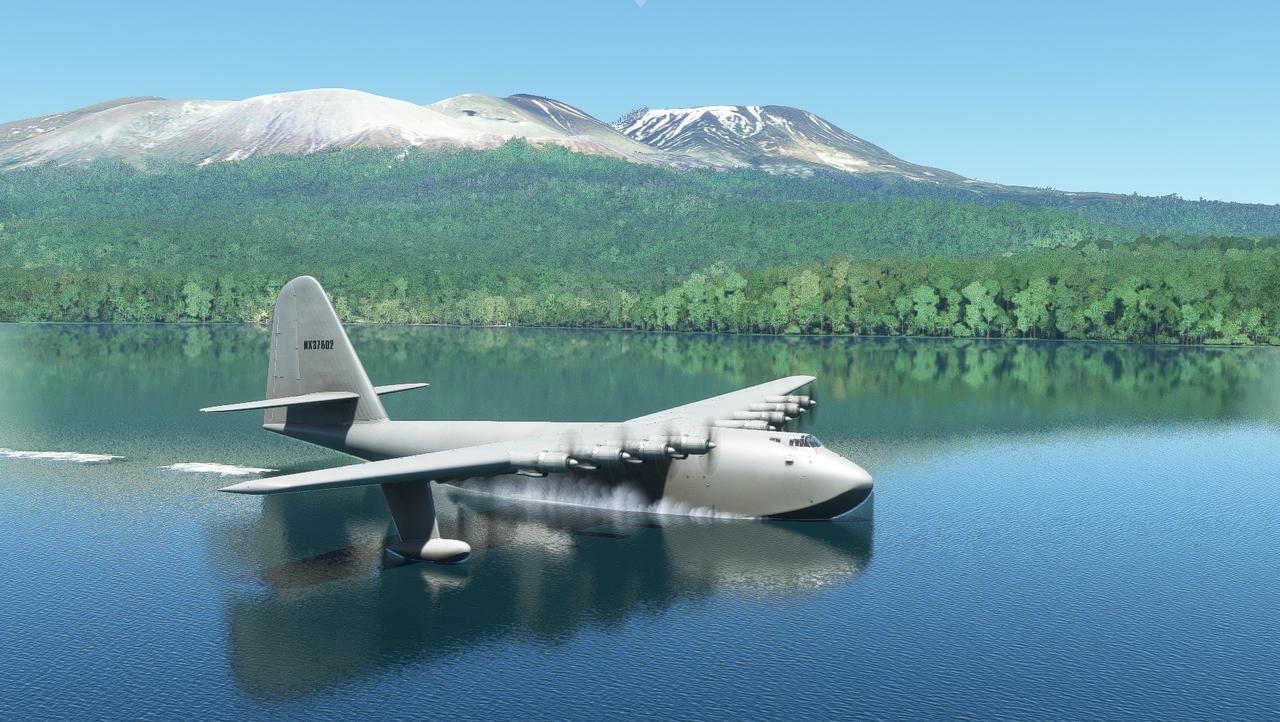
Hughes H-4 Hercules is a massive transport aircraft made entirely of wood, developed during World War II by American aviator and businessman Howard Hughes and shipbuilder Henry J. Kaiser. It is also known by the popular nickname “Spruce Goose,” which was widely used by the public but rejected by Howard Hughes. With a wingspan of 97.54 meters, it held the title of the aircraft with the largest wingspan in the world for decades. The aircraft was designed to enable large-scale transport of troops and equipment by air during the war, when strategic materials were scarce and submarine threats endangered sea convoys.
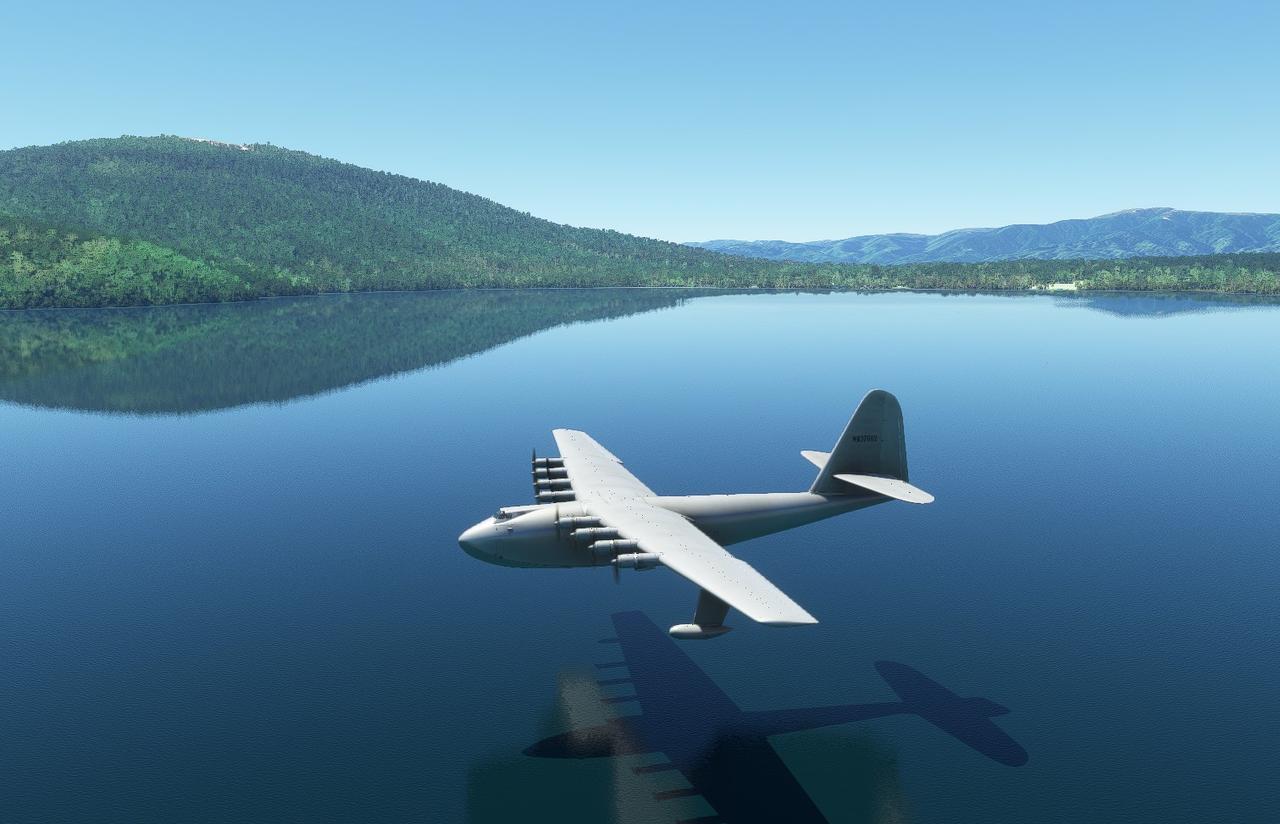
Hughes H-4 Hercules (Flickr)
The design and development of the Hughes H-4 Hercules emerged from the convergence of World War II’s logistical demands and one of the most ambitious engineering visions in aviation history. The project began in 1942 when the United States War Department sought an alternative to ships vulnerable to German U-boats in the Atlantic Ocean—a vehicle capable of transporting massive payloads by air. Initiated by shipbuilder Henry J. Kaiser and aviator Howard Hughes, the initiative was based on the concept of a “flying ship” that pushed the technological boundaries of its time.
During the war, strategic metals such as aluminum and steel were prioritized for fighter and bomber aircraft, making their use in the H-4 nearly impossible. As a result, Howard Hughes and his engineering team opted to construct the aircraft’s primary structure from wood. The core method employed was an advanced laminated wood technology called Duramold. In this process, thin birch wood layers were impregnated with special resins and bonded under high pressure. This technology provided the fuselage with metal-like durability while also imparting a smooth outer surface that reduced aerodynamic drag. Although the aircraft became popularly known as the “Spruce Goose,” the majority of its structural integrity was achieved using birch wood.
The H-4 Hercules surpassed all contemporary aviation standards with its 97.54-meter wingspan. Its wing structure was designed with an internal, multi-cellular beam system to support this enormous scale and the weight of eight engines. The thickness at the point where the wings meet the fuselage is approximately 3.5 meters. This internal volume was planned to allow engineers to access the engines and perform mechanical interventions via tunnels inside the wings during flight. The control surfaces were so large that it was physically impossible for a pilot to move them using muscle power alone. To solve this problem, Hughes developed a revolutionary hydraulic power-assisted flight control system, which transmitted pilot inputs from the cockpit through high-pressure hydraulic actuators to the massive control surfaces, ensuring the aircraft’s controllability【1】.
The immense thrust required for takeoff was provided by eight Pratt & Whitney R-4360 Wasp Major radial engines mounted along the leading edges of the wings. Each engine had 28 cylinders and together produced a total of 24,000 horsepower. Synchronizing the engines, managing fuel flow, and controlling the torque of the massive propellers constituted one of the most complex engineering challenges during development. Howard Hughes’s obsession with technical detail and his insistence on flawless components caused the assembly process to fall far behind the original schedule.

Hughes H-4 Hercules Technical drawing (generated by artificial intelligence)
Although the contract signed in 1942 anticipated completion within two years, construction was only finished in 1946, after the war had ended, due to the complexity of the design and difficulties in material procurement. With the war over, the project’s strategic value came under scrutiny and triggered serious budget debates in the U.S. Senate. Hughes invested substantial personal funds to complete the project and continued development until the test flight on 2 November 1947, to prove the aircraft’s flyability.
The Hughes H-4 Hercules occupies a unique place in aviation history due to its extraordinary physical dimensions and technical capacity, all calculated to lift over 180 tons from water using 1940s technology. Despite its entirely wooden composite structure, its aerodynamic efficiency and power-to-weight ratio represented the pinnacle of its era. The aircraft’s most prominent technical feature is its wingspan of 97.54 meters (320 feet), which made it the aircraft with the largest wingspan in the world until 2019.
The fuselage length is 66.65 meters and the total height is 24.18 meters. The empty weight of the H-4 is approximately 113,400 kilograms (113 tons), and its maximum takeoff weight with full load is 181,437 kilograms (181 tons). This immense internal volume was statically calculated to carry either 750 fully equipped troops or two M4 Sherman tanks, each weighing approximately 30 tons.
The H-4 Hercules derives its power from eight Pratt & Whitney R-4360 Wasp Major radial engines symmetrically arranged along the wings. The technical details of these engines are as follows:
The aircraft’s flight control surfaces, due to their massive size, are equipped with a complex hydraulic system. Force applied by the pilot to the control yoke is transmitted to the control surfaces via high-pressure hydraulic pumps rather than mechanical linkages. The fuselage material, Duramold, is created by cross-laminating birch wood layers with phenolic resin and finished with a special polish to ensure surface smoothness. The 3.5-meter height at the wing root serves as a technical corridor allowing engineers to access the engines from within during flight. The fuel system consists of 14 massive tanks located beneath the fuselage, each capable of storing approximately 2,300 liters of fuel.
Hughes H-4 Hercules (Youtube)
The Hughes H-4 Hercules is a project that never entered serial production and remains the only prototype ever built. Consequently, the aircraft does not have a broad family of variants as seen in modern military or commercial aircraft. The following are the situations that have been described as “variants” during the project’s development and subsequent planning:
The only built version of the H-4 Hercules is the prototype registered as NX37602. This variant is a full-scale model developed to demonstrate the aircraft’s design, engineering, and flight capabilities. All technical features—from the Duramold construction to the eight-engine configuration—are embodied in this prototype. The single flight conducted on 2 November 1947 was performed using this specific airframe. In aviation literature, when referring to the “variant” of the aircraft, the original structure on display is intended.
At the project’s inception, the code HK-1, derived from the initials of Kaiser and Hughes’s surnames, was used. This designation represented an evolutionary phase of the project rather than a technical variant. After Kaiser withdrew from the project in 1944, the name was fully replaced by H-4 under Hughes’s sole control. Early design concepts included variations in internal layout focused on military logistics and amphibious operations, but none were physically realized.
According to Hughes’s vision, if the prototype proved successful, additional logistical and transport variants were planned. These proposed models were intended to be specialized according to two primary mission profiles:
The end of the war and the rapid advancement of jet engine technology prevented these planned variants from entering production. As a result, the Hughes H-4 Hercules continues to exist as a singular engineering example preserved at the prototype stage in the history of aviation.
Although the Hughes H-4 Hercules did not achieve commercial or military success, it left deep and lasting impacts on the aviation industry and manufacturing engineering. The techniques developed during the project and the challenges encountered pioneered many innovations that form the foundation of modern aviation standards and large-aircraft design.
The H-4’s most significant legacy is its role as a precursor to the composite material technologies now widely used in modern aircraft. The Duramold process, developed due to metal shortages, introduced to aviation the principle of enhancing strength by laminating layers of material. Today’s carbon fiber-reinforced polymers used in the fuselages of aircraft such as the Airbus A350 and Boeing 787 Dreamliner are technological successors to the H-4’s concept of bonding disparate layers into a unified structure with resin.
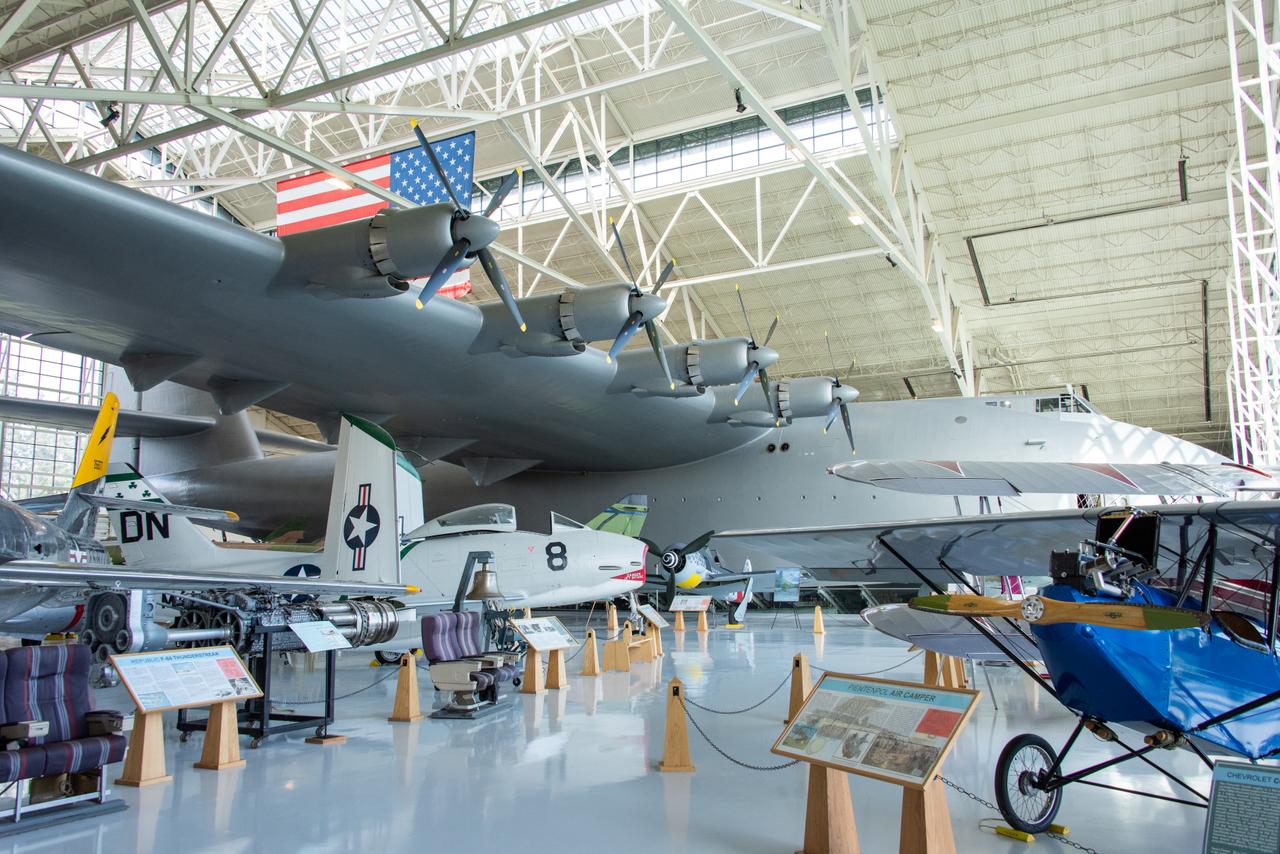
Hughes H-4 Hercules (Flickr)
The H-4 Hercules is among the first successful applications of comprehensive hydraulic power-assisted control systems designed to manage enormous control surfaces. At this scale, where pilot physical strength was insufficient to maneuver the aircraft, the necessity of using hydraulic pressure to transmit control inputs paved the way for the development of modern “Power-by-Wire” and “Fly-by-Wire” systems. This technological transition enabled aircraft size to expand beyond the physical limitations of human operators.
The H-4 fundamentally redefined the concept of strategic air transport. The vision of carrying 750 troops or heavy armored vehicles in a single flight shaped the doctrines of modern strategic transport aircraft such as the Lockheed C-5 Galaxy and Antonov An-124. Howard Hughes’s principle of “massive payload in one flight” is regarded as the first concrete objective of “intermodal” logistics in aviation.
The cost overruns and schedule delays experienced during the project’s development provided lessons on how project management and government-funded R&D in aviation should be structured. The U.S. Senate investigations marked a turning point in establishing transparency, oversight, and performance criteria for aviation projects. Additionally, the massive hangars and test facilities constructed for the aircraft’s assembly defined the physical infrastructure requirements for large-scale aircraft manufacturing.
Aero Icarus. “Hughes H-4 Hercules (HK-1); N37602@MMV; 04.04.2022.” Flickr, April 4, 2022. Accessed February 23, 2026. https://www.flickr.com/photos/aero_icarus/51987339511/.
Alex the Historian. “Hughes’ H-4 Hercules Flies! (1947).” YouTube video, November 2, 2021. Accessed February 23, 2026. https://www.youtube.com/watch?v=e5EgnoKb5Eo.
Collection, Gary Danvers. “Hughes H-4 Hercules Departing Lake Rotoaira with Mt Tarawera in the Background.” Flickr, November 20, 2022. Accessed February 23, 2026. https://www.flickr.com/photos/gcdnz/52511894995/.
Collection, Gary Danvers. “Hughes H-4 Hercules Landing on Lake Rotoaira.” Flickr, November 20, 2022. Accessed February 23, 2026. https://www.flickr.com/photos/gcdnz/52511685809/.
Evergreen Museum. "The Spruce Goose." Accessed February 23, 2026. https://www.evergreenmuseum.org/exhibit/the-spruce-goose/.
Kreniski, Algeu. “The Use of Seaplanes as an Advanced Weapon System.” Master's thesis, Naval Postgraduate School, 1992. Accessed February 23, 2026. https://calhoun.nps.edu/bitstream/handle/10945/23440/useofseaplanesas00kren.pdf.
Wigley, Tom. “Hughes H-4 Hercules.” Flickr, November 12, 2007. Accessed February 23, 2026. https://www.flickr.com/photos/amphalon/1982515752/.
[1]
Evergreen Museum. “The Spruce Goose”. Evergreen Museum. Erişim 23 Şubat 2026. https://www.evergreenmuseum.org/exhibit/the-spruce-goose/.
[2]
Evergreen Museum. “The Spruce Goose”. Evergreen Museum. Erişim 23 Şubat 2026. https://www.evergreenmuseum.org/exhibit/the-spruce-goose/.

Length(s) | 66.65 metres | ||||||||
|---|---|---|---|---|---|---|---|---|---|
Manufacturer(s) | Hughes Aircraft | ||||||||
Status | On display at the museum (Evergreen Aviation & Space Museum) | ||||||||
Height(s) | 24.18 metres | ||||||||
Type(s) | Heavy transport flying boat | ||||||||
First Flight(s) | 2 November 1947 | ||||||||
Cruise Speed | 400 km/h (250 mph) | ||||||||
Propellers | 8 × Hamilton Standard four-bladed propellers (5.23 m diameter) | ||||||||
Powerplant | 8 × Pratt & Whitney R-4360 Wasp Major radial engines (each 3,000 hp) | ||||||||
Maximum Takeoff Weight | 181,437 kg | ||||||||
Empty Weight | 113,398 kg | ||||||||
Wingspan | 97.54 metres | ||||||||
Capacity | 23,000 fully equipped soldiers or 2 M4 Sherman tanks | ||||||||
Crew | 3 | ||||||||
Cost | 23,000,000 USD (in 1940s currency) | ||||||||
Designer | Howard Hughes and Henry J. Kaiser | ||||||||
No Discussion Added Yet
Start discussion for "Hughes H-4 Hercules" article
Design and Development Process
Technical Specifications
Variants
Industry Legacy