
This article was automatically translated from the original Turkish version.
+1 More
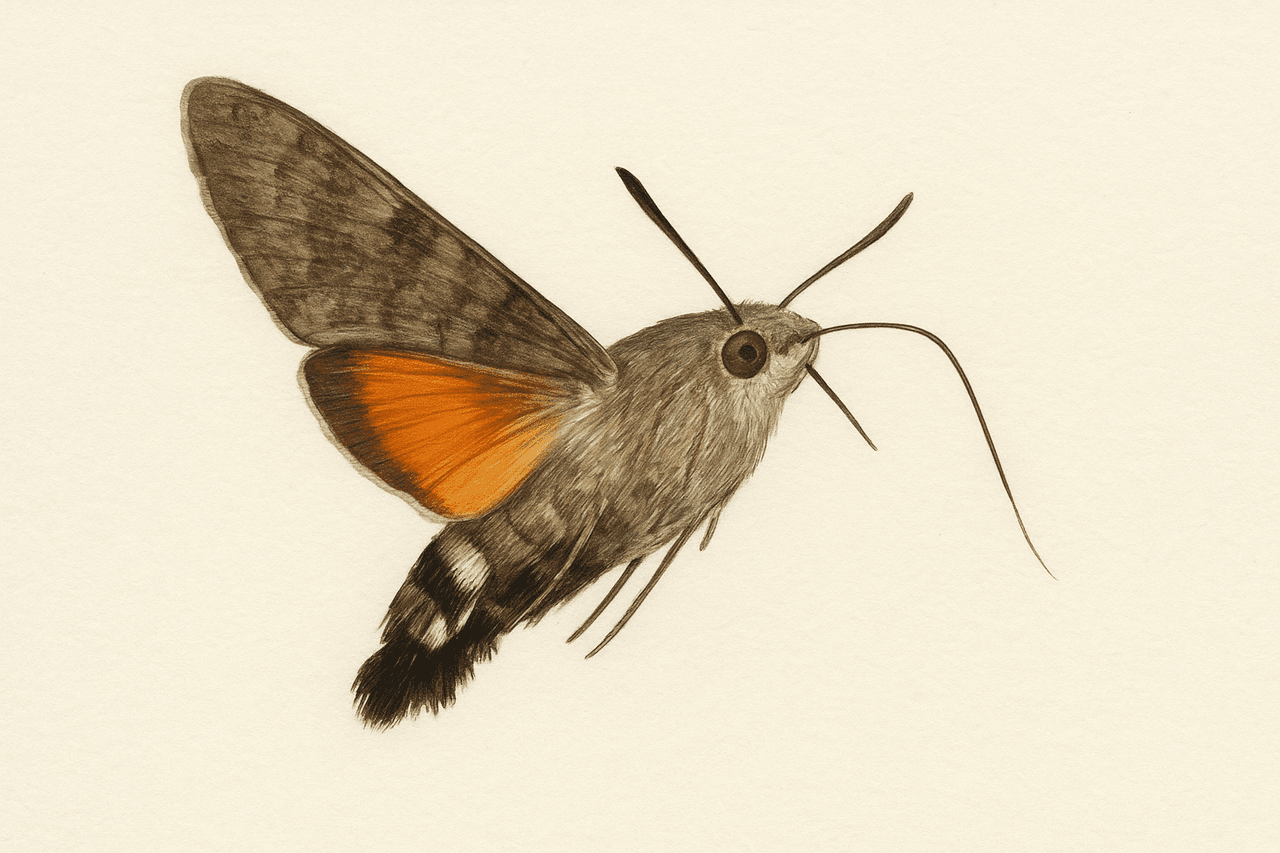
Hummingbird Hawk-moth (Macroglossum stellatarum) (Generated by Artificial Intelligence.)
Branch | Arthropoda | ||||||||
|---|---|---|---|---|---|---|---|---|---|
Class | Insecta | ||||||||
Team(s) | Lepidoptera | ||||||||
Family | Sphingidae (Sphinx moths) | ||||||||
Distribution Area | Europe, North Africa, Asia, Türkiye | ||||||||
Feeding | Nectar | ||||||||
Conservation Status | Not Threatened on the IUCN List | ||||||||
Pigeon hawk-moth (Macroglossum stellatarum) is a diurnal species of moth belonging to the Sphingidae family (hawk-moths). Due to its rapid wingbeats while feeding on nectar from flowers, it is often mistaken for a hummingbird.
The wingspan of the pigeon hawk-moth is approximately 40–45 mm. Its body is covered with brownish-gray scales. White and black tufts at the tip of the abdomen create a tail appearance reminiscent of a pigeon. The forewings are gray-brown with wavy patterns. The hindwings are bright orange and conspicuous during flight. Thanks to its proboscis, which is about 25–28 mm long, it can feed on nectar from tubular flowers.
This species is widespread across Europe, North Africa and Asia. It is commonly observed in temperate regions during summer months and migrates to Africa and South Asia for winter. In Türkiye, it can be observed in both rural and urban areas during summer.
This diurnal moth is easily noticeable, especially on sunny days. While feeding on nectar, it hovers in mid-air by flapping its wings rapidly, a flight behavior very similar to that of hummingbirds. Its primary nectar sources include flowers of Valeriana, Centranthus, Petunia, and plants in the Rubiaceae family. It moves quickly among flowers and contributes to pollination.
Females lay eggs primarily on plants of the Rubiaceae family. The larvae are green with white stripes and possess a characteristic horn at the posterior end. The pupal stage occurs in the soil, and adult moths emerge after several weeks.
Macroglossum stellatarum is frequently confused with hummingbirds due to its flight behavior. However, hummingbirds are found only in the Americas; therefore, any insect exhibiting this behavior in Europe, Asia or Türkiye is most likely this moth.
Other diurnal species in the same family, such as Hemaris fuciformis and Hemaris tityus, also resemble hummingbirds. However, these species have transparent wings. M. stellatarum can be distinguished by its orange hindwings, scaled body, white-and-black tufted tail tip, and rapid, straight flight.
The pigeon hawk-moth is not threatened due to its wide distribution and ability to adapt to various habitats. It has not been assigned to any threat category by the International Union for Conservation of Nature (IUCN). However, environmental factors such as climate change and habitat loss may affect populations in the long term.
This species is not harmful. On the contrary, it is ecologically beneficial due to its role in pollination. Its presence in gardens and flower beds is considered an indicator of a healthy natural environment. Its flight pattern is a notable attraction for nature photographers and observers.
Kelber A. "Innate Preferences for Flower Features in the Hawkmoth Macroglossum Stellatarum." Journal of Experimental Biology. 200(4). (1997): 827-36.
Kelber, A. "Colour Learning in the Hawkmoth Macroglossum Stellatarum. Journal of Experimental Biology 199, no. 5 (1996): 1127–31.

Hummingbird Hawk-moth (Macroglossum stellatarum) (Generated by Artificial Intelligence.)
Branch | Arthropoda | ||||||||
|---|---|---|---|---|---|---|---|---|---|
Class | Insecta | ||||||||
Team(s) | Lepidoptera | ||||||||
Family | Sphingidae (Sphinx moths) | ||||||||
Distribution Area | Europe, North Africa, Asia, Türkiye | ||||||||
Feeding | Nectar | ||||||||
Conservation Status | Not Threatened on the IUCN List | ||||||||
No Discussion Added Yet
Start discussion for "Hummingbird Hawk-moth (Macroglossum stellatarum)" article
Morphology
Distribution
Behavior and Ecology
Reproduction
Similar Species and Misidentification
Conservation Status
Relationship with Humans