

This article was automatically translated from the original Turkish version.
Team(s) | Diprotodontia | ||||||||
|---|---|---|---|---|---|---|---|---|---|
Family | Macropodidae | ||||||||
Distribution(s) | Papua New Guinea (Huon Peninsula) | ||||||||
Conservation Status | Endangered (IUCN) | ||||||||
Specie(s) | D. matschiei | ||||||||
Genus | Dendrolagus | ||||||||
Class | Mammalia | ||||||||
The Huon tree kangaroo (Dendrolagus matschiei) is an arboreal marsupial species belonging to the class Mammalia, order Diprotodontia, and family Macropodidae. Its scientific name honors the German zoologist Paul Matschie. Dendrolagus matschiei is endemic to the high-altitude regions of the Huon Peninsula in Papua New Guinea and possibly to the neighboring island of Umboi, where it was likely introduced by humans. Its total geographic range is estimated to be less than 14,000 km². This species is the only tree kangaroo found on the Huon Peninsula.
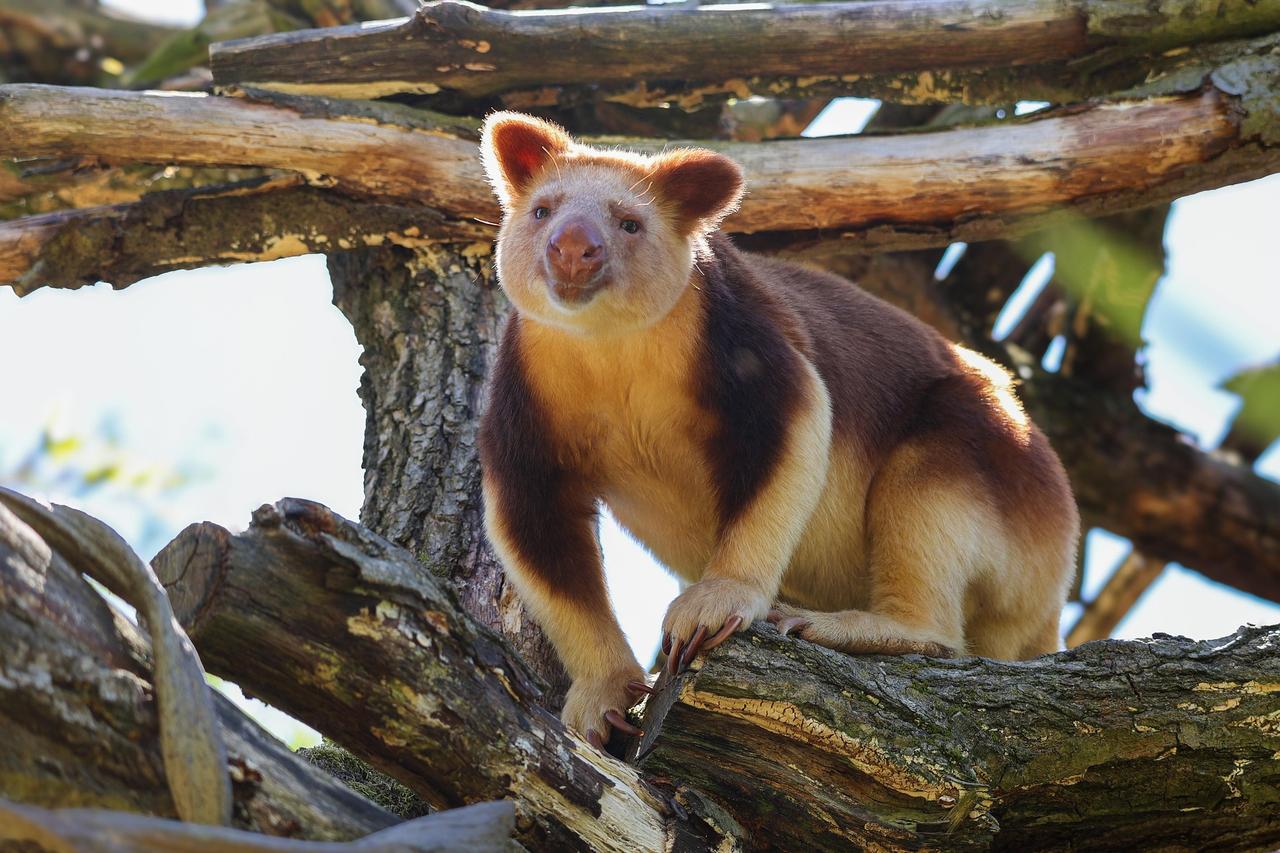
The Huon tree kangaroo possesses unique physical adaptations suited to its arboreal lifestyle. Its body length ranges from 55 to 63 cm, and its cylindrical tail, used for balance, is approximately equal in length to its body. Weighing between 6 and 13 kg, its fur varies from chestnut to reddish-brown, while the belly, tail, ear edges, and feet are bright yellow. The soles of its feet are covered with rough, cushion-like pads, and its claws are partially curved to aid climbing. Unlike other macropods, its forelimbs and hindlimbs are proportionally closer together, enhancing its ability to move vertically along tree trunks. Additionally, the backward-facing growth of fur on its back and neck allows water to drain easily from its body when it is in a crouched position.

Huon Tree Kangaroo (Pixabay)
The species inhabits montane forests between 1,000 and 3,300 meters above sea level. The habitat structure features deciduous trees at lower elevations and coniferous trees at higher elevations. These regions are rich in epiphytes and tree ferns, with a thick layer of leaf litter on the forest floor. Research indicates that these high-altitude habitats may have low productivity, which likely explains the species’ need for extensive home ranges.
Dendrolagus matschiei is primarily folivorous, favoring mature leaves, but its diet also includes wild fruits, flowers, nuts, tree bark, sap, and occasionally insects or bird eggs. Despite possessing the large fermentation chambered stomach typical of Macropodidae, its basal metabolic rate is only about 70 percent of that of the red kangaroo. This low metabolic rate is thought to have evolved as an adaptation to a diet dominated by toxic leaves. These animals feed intermittently throughout the day and spend approximately 60 percent of their time sleeping or resting.
Huon tree kangaroos are highly agile among tree branches and can make downward leaps of up to 9 meters between adjacent trees. Observations have shown they can jump from heights of up to 18 meters to the ground without injury. When descending tree trunks, they always move backward, unlike opossums. On the ground, they move with a hopping or shuffling gait and can reach speeds of up to 4.8 km/h. Socially, they are generally solitary and tend to ignore one another except during breeding periods.

Dendrolagus Matschiei (Pixabay)
Female Huon tree kangaroos have a polyoestrous cycle and are not restricted to a specific breeding season. The oestrous cycle lasts between 51 and 79 days on average, with studies based on faecal progestin profiles determining the mean cycle length at 58.9±2.4 days. Gestation lasts between 39 and 45 days, the longest recorded gestation period of any marsupial. 【1】Unlike many other macropods, this species does not exhibit delayed implantation or embryonic diapause. The joey begins to peek out of the pouch at approximately 250 days, makes its first exit from the pouch at 300 days, and permanently leaves the pouch at around 350 days. Sexual maturity is reached at approximately two years of age, and individuals in captivity have been recorded to live up to 14 years.
The home ranges of Huon tree kangaroos are considerably larger than those of their Australian counterparts; average home ranges for males and females are 81.3±16.9 hectares and 139.6±26.5 hectares respectively. Females defend core areas of 20.9±4.1 hectares as activity centers, with minimal overlap (4.8 percent) between neighboring females. However, there is extensive overlap (20 to 34 percent) across the entire home range level. Male home ranges typically overlap with those of multiple females, indicating a polygynous mating system. Female density is estimated at approximately one individual per 19.4 hectares in suitable habitats.
The species is listed as Endangered by the IUCN (International Union for Conservation of Nature). Primary factors contributing to population decline include habitat loss due to deforestation for agriculture or settlement, and hunting pressure from local communities. In captive populations, high susceptibility to atypical mycobacterial infections, particularly from avian tuberculosis strains, has been observed. Conservation efforts have led to the establishment of protected areas in Papua New Guinea such as the YUS Conservation Area, and scientific methods including radio telemetry and faecal hormone analysis are being employed to better understand the species’ biology.
Animal Diversity Web. "Dendrolagus matschiei." 1999. *Animal Diversity Web*. Accessed March 19, 2026. https://animaldiversity.org/accounts/Dendrolagus_matschiei/
Burns, Dana L., Roberta S. Wallace, and J. Andrew Teare. "Successful Treatment of Mycobacterial Osteomyelitis in a Matschie’s Tree Kangaroo (Dendrolagus matschiei)." Journal of Zoo and Wildlife Medicine 25, no. 2 (1994): 274–80. Accessed March 19, 2026. http://www.jstor.org/stable/20095375
Koester, D. C., M. R. Plocek, E. S. Dierenfeld, K. R. Amato, and N. T. Dunham. "Variation in Zoo Diets, Offerings of Leafy Browse, and Body Condition Scores in Matschie's Tree Kangaroos (Dendrolagus matschiei) and Their Associations with Gut Microbiome Composition." PeerJ 14 (2026): e20875. Accessed March 19, 2026. https://doi.org/10.7717/peerj.20875
North, Lindsay A. and John D. Harder. "Characterization of the Estrous Cycle and Assessment of Reproductive Status in Matschie’s Tree Kangaroo (Dendrolagus matschiei) with Fecal Progestin Profiles." General and Comparative Endocrinology 156, no. 1 (2008): 173–180. Accessed March 19, 2026. https://doi.org/10.1016/j.ygcen.2007.12.007
Pixabay. "ağaç kanguru hayvan meraklı memeli." Accessed March 19, 2026. https://pixabay.com/tr/photos/a%c4%9fa%c3%a7-kanguru-hayvan-merakl%c4%b1-memeli-8842796/
Pixabay. "ağaç kanguru okyanusya dendrolagus." Pixabay. Accessed March 19, 2026. https://pixabay.com/tr/photos/a%c4%9fa%c3%a7-kanguru-okyanusya-dendrolagus-1385575/
Pixabay. "kanguru ağaç kanguru hayvan." Accessed March 19, 2026. https://pixabay.com/tr/photos/kanguru-a%c4%9fa%c3%a7-kanguru-hayvan-6547755/
Pixabay. "kanguru keseli memeli ağaç." Pixabay. Accessed March 19, 2026. https://pixabay.com/tr/photos/kanguru-keseli-memeli-a%c4%9fa%c3%a7-9043234/
Porolak, G., L. Dabek, and A. K. Krockenberger. "Spatial Requirements of Free-Ranging Huon Tree Kangaroos, *Dendrolagus matschiei* (Macropodidae), in Upper Montane Forest." *PLOS ONE* 9, no. 3 (2014): e91870. Accessed March 19, 2026. https://doi.org/10.1371/journal.pone.0091870
[1]
Animal Diversity Web. "Dendrolagus matschiei," Animal Diversity Web, 1999, accessed 19 March 2026, https://animaldiversity.org/accounts/Dendrolagus_matschiei/

Team(s) | Diprotodontia | ||||||||
|---|---|---|---|---|---|---|---|---|---|
Family | Macropodidae | ||||||||
Distribution(s) | Papua New Guinea (Huon Peninsula) | ||||||||
Conservation Status | Endangered (IUCN) | ||||||||
Specie(s) | D. matschiei | ||||||||
Genus | Dendrolagus | ||||||||
Class | Mammalia | ||||||||
No Discussion Added Yet
Start discussion for "Huon Tree Kangaroo (Dendrolagus matschiei)" article
Morphological Characteristics and Anatomical Adaptations
Habitat Requirements and Ecological Distribution
Feeding Ecology and Metabolic Adaptations
Behavioral Characteristics and Locomotion Patterns
Reproductive Biology and Juvenile Development
Spatial Requirements and Population Density
Conservation Status and Health Concerns