

This article was automatically translated from the original Turkish version.
Hurramshahr (Khorramshahr) is a liquid-fueled medium-range ballistic missile (MRBM) system developed by Iran. This missile emerged as part of Iran’s long-term missile development program aimed at enhancing its military deterrence capacity. First publicly unveiled in 2017, Hurramshahr has since been developed into various configurations, including variants such as “Khorramshahr-2,” “Khorramshahr-3,” and “Khorramshahr-4 (Kheibar).”
The Khorramshahr-1 and Khorramshahr-2 models are largely based on the North Korean Hwasong-10 (BM-25) system. However, in 2023 Iran introduced the Khorramshahr-4 variant, which diverges structurally through a more compact design and optimized propulsion systems.
In the Khorramshahr-4, the motor section has been made more compact, reducing the overall body length. Modifications to the fuel system have improved the missile’s suitability for long-term storage and reduced its launch preparation time to approximately 12 minutes. These adjustments are designed to enhance the system’s operational responsiveness.
The Hurramshahr missile is a result of technical cooperation between Iran and North Korea during the 2000s. During this period, Iranian engineers implemented local adaptations and structural improvements based on North Korean systems. In particular, modifications to control surfaces and re-entry vehicle design have enhanced the missile’s maneuverability and targeting accuracy.
The stabilized fin systems used in the Khorramshahr-4 variant were developed to increase both the missile’s range and hit probability. These technological advances reflect Iran’s incremental progress in its missile capabilities.

Hurramshahr Missile Launch Moment (Ahmet Dursun. Anadolu Agency)
The missile system has a warhead payload capacity of up to 1,800 kg. This capacity is sufficient to generate significant destructive effects even when using conventional warheads. This feature stands out as a key technical parameter in evaluating regional air defense systems. Additionally, the potential for the system to carry multiple independently targetable re-entry vehicles (MIRVs) could exert pressure on high-altitude defense systems.
Liquid-fueled missile systems generally require longer pre-launch preparation times compared to solid-fueled systems. However, certain variants include structural improvements designed to enhance maneuverability during the re-entry phase. The aerodynamic warhead design of the Khorramshahr-4 enables course adjustments and velocity changes during the terminal phase.

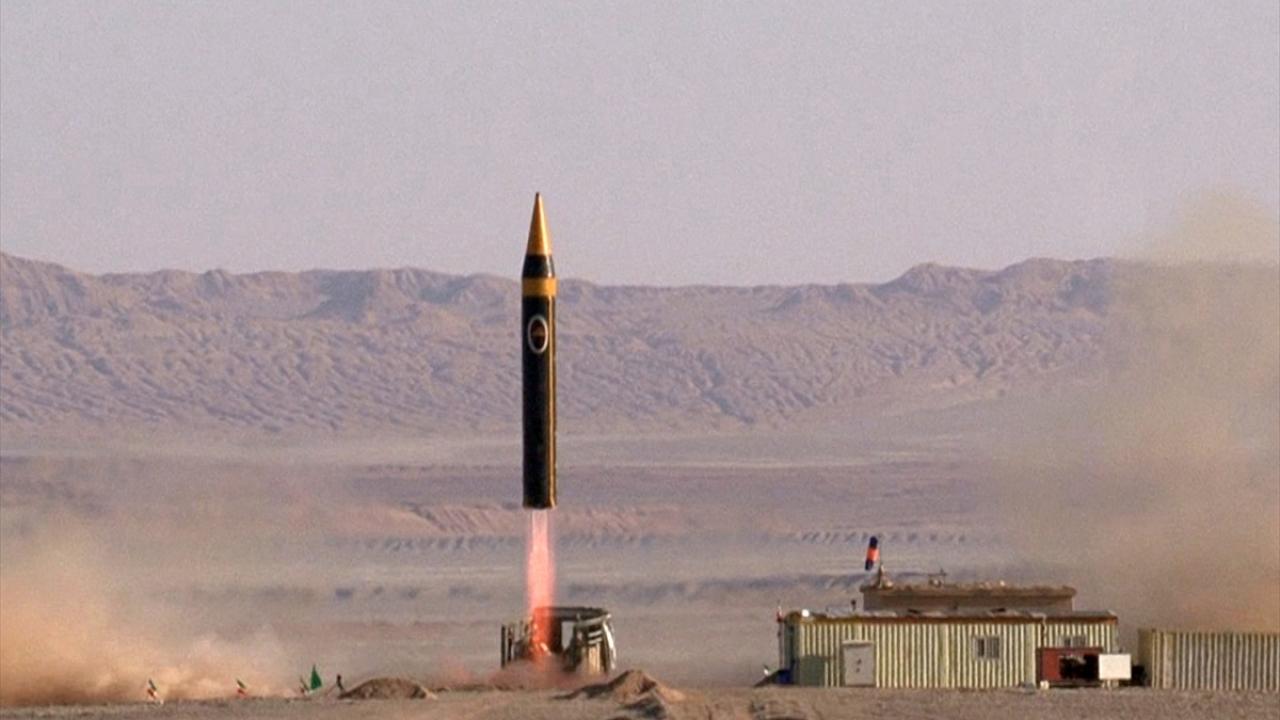
A Launched Hurramshahr Missile (Ahmet Dursun - Anadolu Agency)
Although Iran has not officially declared any limits on its missile range, the Hurramshahr missile system is closely monitored internationally due to its capacity and warhead payload. The missile’s potential to carry multiple warheads and its technical similarities to Iran’s space launch vehicles have led to assessments that it could evolve into an intercontinental ballistic missile (ICBM) capability in the future.
The Hurramshahr missile holds a significant place within Iran’s military doctrine. With a range exceeding 2,000 kilometers, high warhead capacity, and maneuverability, it serves not only as a military asset but also as a tool in diplomatic strategy. Advanced variants such as the Khorramshahr-4 reflect Iran’s efforts to expand its technological capabilities and influence regional missile defense balances. At the same time, these systems are closely observed in the context of regional arms dynamics and international security debates.
Iran Hurramshahr Missile Test (NBC News)
Anadolu Ajansı. “İran, Orta Menzilli Yeni Balistik Füzesini Tanıttı.” aa.com.tr. May 25, 2023. Accessed June 18, 2025. https://www.aa.com.tr/tr/dunya/iran-orta-menzilli-yeni-balistik-fuzesini-tanitti/2905468
Center for Strategic and International Studies. *Khorramshahr*. Missile Threat. Accessed June 18, 2025. https://missilethreat.csis.org/missile/khorramshahr/?utm_source=chatgpt.com
International Institute for Strategic Studies. *Addressing the Iranian Missile Threat: A Regional Approach to Risk Reduction and Arms Control*. March 2022. https://www.iiss.org/globalassets/media-library---content--migration/files/research-papers/2022/03/addressing-the-iranian-missile-threat-a-regional-approach-to-risk-reduction-and-arms-control.pdf?utm_source=chatgpt.com
NBC News. "Iran test-fires latest version of ballistic missile with a 1240-mile range." YouTube. Accessed June 19, 2025. https://www.youtube.com/watch?v=Lv5NY2xIJsk
Savelsberg, Ralph. “Beyond the 2,000 km Range Limit: Iranian IRBMs and the Pursuit of Strategic Effect.” Hollanda Savunma Akademisi (Netherlands Defence Academy), 2021. https://faculteitmilitairewetenschappen.nl/attachment/7ae41402-f14d-47a7-b520-399203fb0cfa?utm_source=chatgpt.com
TRT Haber. "İran Orta Menzilli Yeni Balistik Füzesini Tanıttı." Accessed June 19, 2025. https://www.trthaber.com/foto-galeri/iran-orta-menzilli-yeni-balistik-fuzesini-tanitti/56660/sayfa-1.html

No Discussion Added Yet
Start discussion for "Hürremşehr Füzesi (Khorramshahr)" article
Technical Characteristics
Development Process
Strategic Assessment
High Warhead Weight Capacity
Performance Against Defense Systems
System Limitations
Arms Control and International Security Perspective