


This article was automatically translated from the original Turkish version.
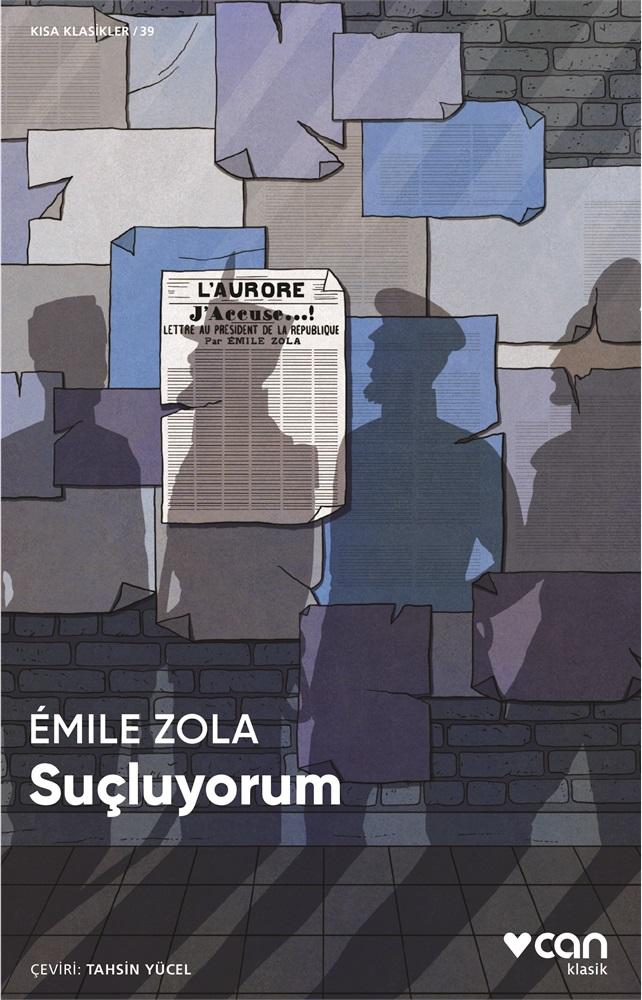
I Blame (Book)
Author(s) | Emile Zola | ||||||||
|---|---|---|---|---|---|---|---|---|---|
Translator(s) | Tahsin Yücel | ||||||||
Number of Pages | 43 | ||||||||
Type(s) | Open Letter | ||||||||
Original Title | J’accuse…! | ||||||||
Publication Place | L’Aurore Newspaper, First Page, Paris | ||||||||
Published in Newspaper | 13 January 1898 Thursday | ||||||||
I Accuse (J’accuse…!), written by Émile Zola in the context of the Dreyfus Affair, is an open letter that functioned as a public intervention. Published on 13 January 1898, it directly accused the military and political authorities of the time and carried the character of a public outcry. The text opened debates on the rule of law, antisemitism, state responsibility and individual conscience, and significantly influenced the course of one of the most controversial cases in French history. The work is regarded as a reference point in modern discussions of public opinion and human rights, both historically and intellectually.
Émile Zola’s open letter titled “I Accuse” was published on the front page of the newspaper L’Aurore on 13 January 1898. The letter was addressed directly to then French President Félix Faure. In response to the secretive nature of the proceedings, allegations of fabricated evidence and doubts about the impartiality of the military court, Zola launched a direct appeal to public opinion. He argued for a retrial and made a direct appeal to the highest authority of the state.
The Dreyfus Affair is not viewed merely as a case of espionage in French history but as a crisis that challenged the principles of the rule of law, justice, citizenship and human rights. In 1894, French army officer Captain Alfred Dreyfus, of Jewish descent, was accused of treason based on a document allegedly sent to the German military attaché. He was convicted by a military court. The core of the accusation rested on similarities in handwriting. However, the controversial nature of the expert reports, the inclusion of forged documents in the file and the closed nature of the trial process undermined the legal legitimacy of the case. The proceedings unfolded in a public atmosphere increasingly dominated by antisemitic rhetoric, and Dreyfus’s Jewish identity played a decisive role in the social acceptance of the accusations.
Written in the form of an open letter, the text is structured as a systematic chain of accusations. Zola names and criticizes the military and administrative officials involved in the investigation and trial, particularly:
He emphasizes their roles and responsibilities in the investigation and trial. According to Zola, Dreyfus’s conviction was a decision taken to distort evidence and protect the institutional prestige of the military authorities. Fundamental legal principles were violated during the trial, and truth was sacrificed for institutional interests. At the heart of the text are the concepts of “truth” and “justice.” Zola insists that speaking the truth is a civic duty and condemns silence as complicity.
“I Accuse” triggered a major public reaction in France. The army and government interpreted the letter as an insult to military authorities. Immediately after its publication, investigations were launched against Zola and the newspaper. Zola’s trial began on 17 February 1898. On 23 February 1898, he was sentenced to 3000 francs in fines and one year in prison. Faced with mounting pressure after the verdict, Zola fled to England. However, the letter played a decisive role in bringing the Dreyfus Affair back into public focus and intensified calls for a retrial. On 2 April 1898, the Court of Cassation overturned the verdict against Zola. The Dreyfus Affair continued from 1894 until 1899 and ultimately ended in 1906 when Dreyfus’s honor and rank were fully restored.
Although polemical in nature, the text exhibits a deliberate and well-structured rhetorical form. It employs direct address. The repeated phrase “J’accuse” (“I Accuse”) creates a recurring structure that gives the text a manifesto-like character. Legal argumentation and moral emphasis proceed in tandem. In this way, the work occupies a space between journalistic writing and political proclamation, serving as an example of how literary rhetoric can function in the public sphere.
“J’accuse…!” is not merely a defense of Dreyfus; it is regarded as one of the earliest and most influential examples of public intervention and intellectual responsibility in the modern sense. The text remains a reference point in debates on the rule of law, state accountability and press freedom. Within the context of the Dreyfus Affair, which divided France, Zola’s intervention made visible the tension between individual conscience and state authority. The work is considered a central text in late 19th-century European political culture, addressing the core issues of antisemitism, nationalism and justice.

I Blame (Book)
Author(s) | Emile Zola | ||||||||
|---|---|---|---|---|---|---|---|---|---|
Translator(s) | Tahsin Yücel | ||||||||
Number of Pages | 43 | ||||||||
Type(s) | Open Letter | ||||||||
Original Title | J’accuse…! | ||||||||
Publication Place | L’Aurore Newspaper, First Page, Paris | ||||||||
Published in Newspaper | 13 January 1898 Thursday | ||||||||
Origin of the Text
The Dreyfus Affair
Content and Accusations
Political and Social Impact
Literary and Intellectual Characteristics
Historical Significance