This article was automatically translated from the original Turkish version.
+1 More
Author(s) | Madeline Miller | ||||||||
|---|---|---|---|---|---|---|---|---|---|
Genre | Roman Mitoloji Uyarlaması | ||||||||
Publication Year | 2018 | ||||||||
Publisher(s) | İthaki Yayınları | ||||||||
Translator(s) | Seda Çıngay Mellor | ||||||||
ISBN | 9786053759584 | ||||||||
I am Circe, a mythological novel written by Madeline Miller and published in 2018. The author reimagines the myth of Circe from Homer’s Odyssey and other classical sources through a feminist lens. The novel narrates the life story of Circe, the sorceress goddess of ancient Greek mythology, in her own voice and through first-person singular narration.
The story begins with Circe’s childhood as the daughter of the sun god Helios and a sea nymph. It explores her sense of alienation among the gods of Olympus, her discovery of magical powers during exile on the island of Aiaia, and her complex relationships between humans and gods. Circe is positioned as an outsider shaped by her curiosity toward humans, her critical stance toward the gods, and her pursuit of autonomy.
Throughout the novel, Circe encounters mythological figures such as Hermes, Odysseus, Medea, the Minotaur, and Penelope. Her relationship with Odysseus holds a central place in the narrative. Circe’s inquiries into both the divine realm and human existence enable a profound existential portrayal of her character.
The novel is structured around themes of power, loneliness, immortality, motherhood, female identity, and freedom. Miller reinterprets the role of women in classical myths, transforming Circe from a passive figure into an autonomous subject. The book also examines nature, magic, and the boundaries between humans and gods.
Although inspired by classical sources, Miller employs modern language to explore the inner world of the character in rich detail. The novel’s first-person singular narration emphasizes Circe’s subjective experience. This choice places the voice of Circe, traditionally relegated to a minor role in ancient mythology, at the center of the narrative.
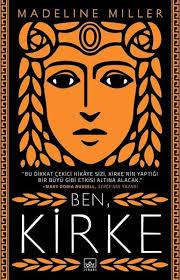
Miller, Madeline. *Kirke* Book Cover Image. Translated by Çıngay Mellor, Seda. Istanbul: İthaki Yayınları, 2019. Accessed August 16, 2025. https://www.ithakiyayingrubu.com/ben-kirke.aspx

Author(s) | Madeline Miller | ||||||||
|---|---|---|---|---|---|---|---|---|---|
Genre | Roman Mitoloji Uyarlaması | ||||||||
Publication Year | 2018 | ||||||||
Publisher(s) | İthaki Yayınları | ||||||||
Translator(s) | Seda Çıngay Mellor | ||||||||
ISBN | 9786053759584 | ||||||||
Plot
Themes
Characters
Narrative and Style