

This article was automatically translated from the original Turkish version.
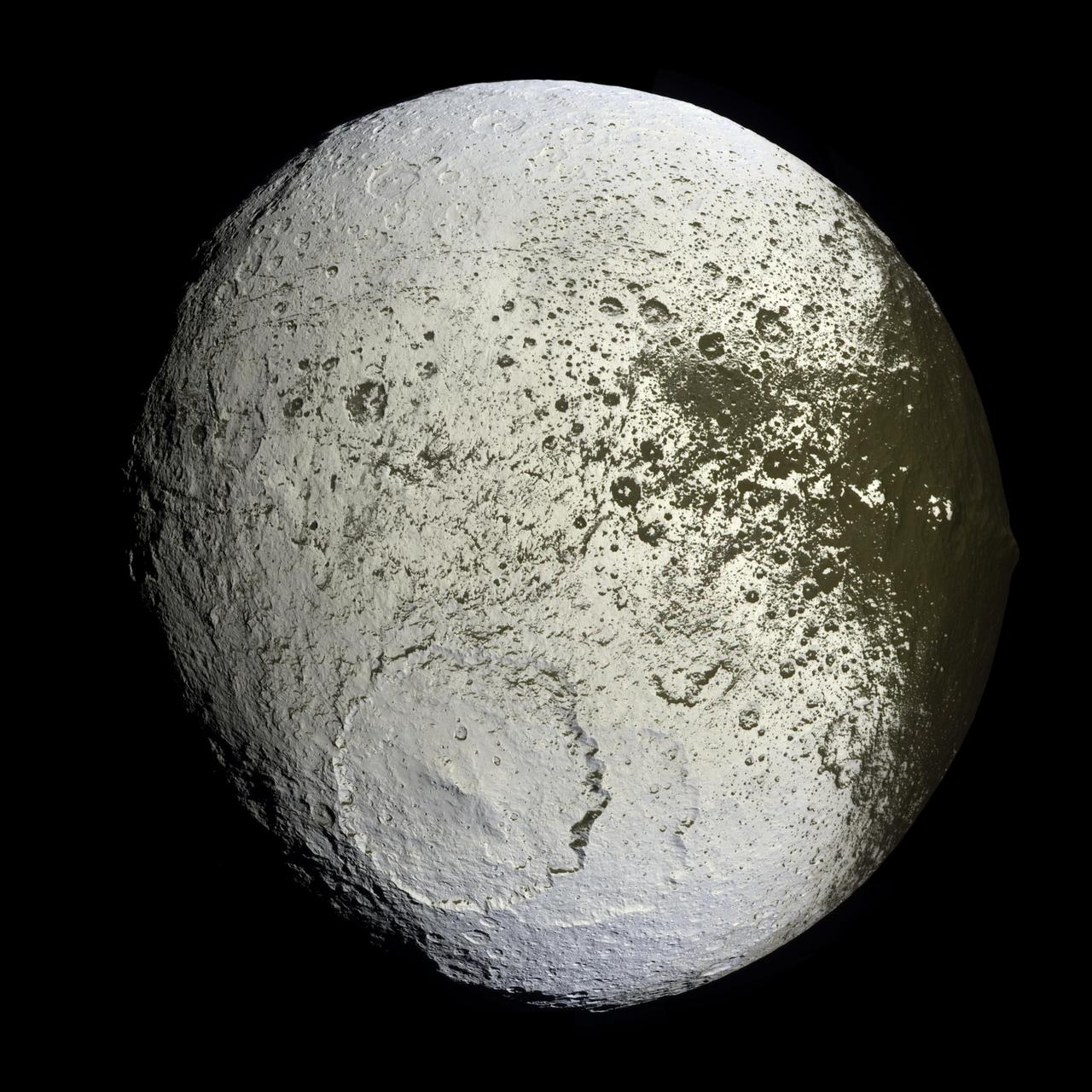
Iapetus is one of the natural satellites of the planet Saturn. It is defined by its highly inclined orbit, the sharp contrast in brightness between its two distinct hemispheres, and an extraordinary ridge structure that runs along its equator. Among Saturn’s large moons, Iapetus occupies a distinctive position in terms of surface morphology and orbital characteristics.
Iapetus was observed in 1671, during the early period of astronomical studies when Saturn’s moons began to be systematically identified. The moon was discovered by the astronomer Giovanni Cassini. Cassini noticed that Iapetus’s brightness varied regularly as it moved around Saturn, leading him to confirm its existence. Later studies determined that this variation in brightness was due to the moon’s non-uniform surface.
The moon’s name is derived from Iapetus, a Titan in Greek mythology. This naming was done by Cassini and aligns with the tradition of naming Saturn’s large moons after figures from mythology. The designation was established during the early stages of classifying Saturn’s satellites.

Iapetus (NASA)
Iapetus is one of Saturn’s mid-distance moons and is among the farthest large satellites from the planet. Its orbit has a significant inclination relative to Saturn’s equatorial plane. The distance from Saturn is a key factor determining its orbital dynamics and surface conditions.
The moon completes its orbit around Saturn with synchronous rotation, meaning it always presents the same face toward the planet. This condition allows the two distinct color regions on its surface to remain stable over long timescales.
Iapetus has a diameter of approximately 1,470 kilometers; measurements vary slightly, with one estimate placing its width from pole to pole at about 1,436 kilometers. While generally spherical, the presence of the equatorial ridge prevents it from appearing as a perfect sphere and causes deviations from sphericity. The moon’s average density is low.
The low density indicates that its interior is composed largely of ice, with rocky components present in secondary proportions.
Iapetus’s surface is heavily cratered. Both large and small impact craters reveal that the surface has not undergone significant resurfacing over long periods. Similar crater densities are observed in both dark and bright regions. Numerous impact craters are found in the northern and southern polar regions. One prominent topographic feature is a crater basin approximately 450 kilometers wide. This structure is one of at least nine large basins on Iapetus and is associated with an older, similarly sized basin that overlaps it in the southeast. Additionally, another ancient impact basin, approximately 400 kilometers wide, is located near the center of the disk.
Iapetus exhibits a striking dichotomy in surface reflectivity (albedo).
The leading hemisphere of the moon is covered by a dark region known as Cassini Regio, which has very low reflectivity—approximately 4 percent. This region constitutes a large portion of the surface and absorbs most sunlight. The dark material is rich in carbonaceous compounds, including nitrogen-containing organic molecules such as cyanogen, hydrated minerals, and other carbon-rich substances. The dark material is distributed in layered deposits, suggesting an ancient underlying surface. Hypotheses regarding its origin include endogenous sources or the accumulation of exogenous particles deposited on the surface.
The trailing hemisphere and high latitudes consist of bright, icy regions with albedo values exceeding 60 percent. These areas are predominantly composed of water ice. Because dark surfaces absorb more heat, ice sublimates from them and migrates to the colder, brighter regions, where it recondenses. This thermal process causes the dark regions to become darker and the bright regions to become brighter over time.
Complex transition zones exist between the dark and bright surface areas. The upper regions are streaked with darker features aligned in a north-south direction. Dark material is particularly concentrated on equator-facing slopes and crater floors, but becomes thinner and less abundant as latitude increases, giving way to brighter terrain.
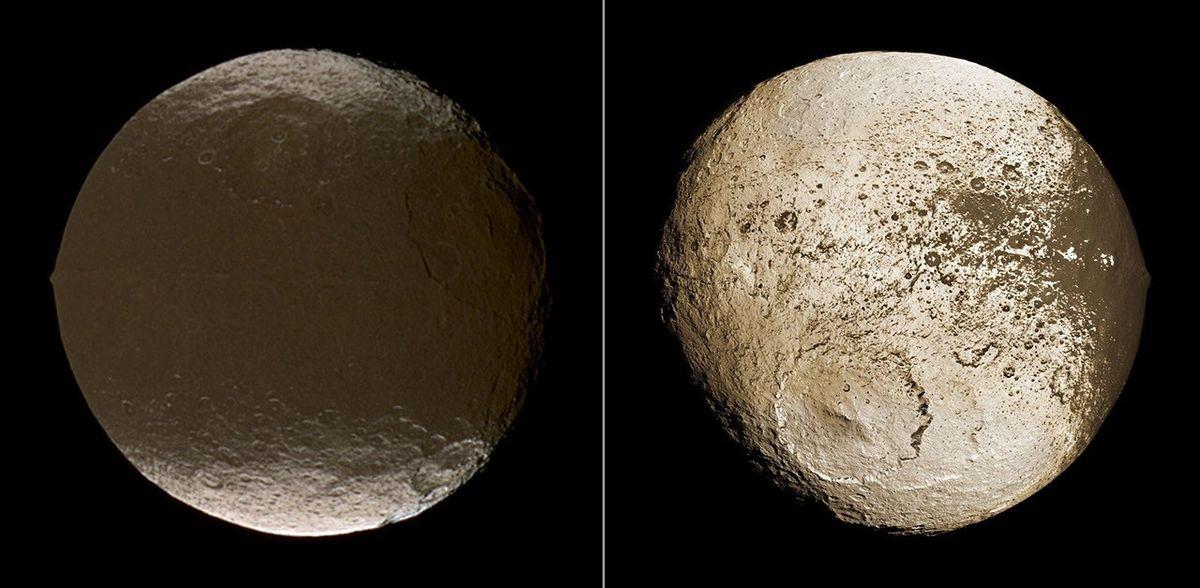
Global images documenting the sharp albedo contrast on Iapetus’s surface. The left panel shows the moon’s dark leading hemisphere, while the right panel shows its bright trailing hemisphere. (NASA)
One of Iapetus’s most distinctive surface features is a prominent ridge that runs along its equator and nearly encircles the entire moon. This structure rises locally up to 20 kilometers and continues intermittently for hundreds of kilometers. The ridge extends approximately 1,300 kilometers from west to east and is about 20 kilometers wide. In some locations, its height reaches 13 kilometers. The ridge is interrupted by craters and exhibits morphological characteristics suggesting it formed during the moon’s early history.
The mountainous terrain along the equatorial ridge, reaching heights of about 10 kilometers, is known as the Iapetus Himalayas. In this region, bright ice buried beneath the dark coating is exposed by impacts, creating a striking contrast. Imagery shows the mountainous zone appearing as a band parallel to the equator.

Iapetus Himalayas (NASA)
NASA Science. "Encountering Iapetus." September 10, 2007. Accessed January 26, 2026. https://science.nasa.gov/resource/encountering-iapetus-2/
NASA Science. "Farewell to Iapetus." September 18, 2017. Accessed January 26, 2026. https://science.nasa.gov/resource/farewell-to-iapetus/
NASA Science. "Iapetus." Saturn Moons. Last updated December 15, 2023. Accessed January 26, 2026. https://science.nasa.gov/saturn/moons/iapetus/
NASA Science. "The Himalayas of Iapetus." Photojournal. January 10, 2005. Accessed January 26, 2026. https://science.nasa.gov/photojournal/the-himalayas-of-iapetus/
NASA Science. "The Other Side of Iapetus." Photojournal. January 10, 2005. Accessed January 26, 2026. https://science.nasa.gov/photojournal/the-other-side-of-iapetus/


Discovery and Naming
Discovery History and Observations
Mythological Origin and Naming
Orbital Properties and Motion
Position and Orbital Inclination
Synchronous Rotation
Physical Properties
Size, Shape, and Density
Internal Structure
Surface Morphology and Geology
Craters and Basins
Two-Toned Surface (Albedo Contrast)
Dark Hemisphere (Cassini Regio) and Surface Composition:
Bright Hemisphere and Thermal Processes:
Transition Zones:
Equatorial Ridge and Topographic Features
General Structure and Dimensions
Iapetus Himalayas