


This article was automatically translated from the original Turkish version.
Ibecik Bezi is a fine handwoven textile produced in Ibecik Village, Gölhisar District, Burdur Province, using traditional methods and 100% cotton yarn. Registered with a geographical indication on 07.08.2023, this fabric is directly linked to the cultural heritage and economic life of the region and is distinguished by its production process and motif system.
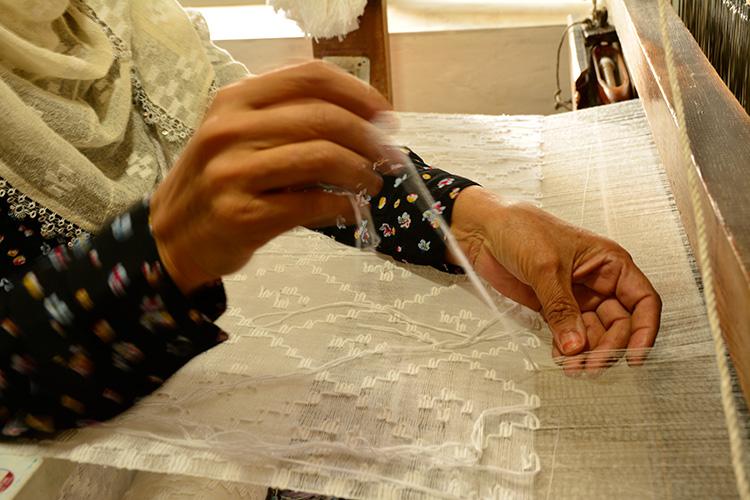
Ibecik Bezi (AA)
Ibecik Bezi is woven using a plain weave structure. The weft and warp threads are typically of the same thickness and made from 20/1 tightly twisted raw cotton yarn. During weaving, the threads are passed alternately under and over the warp threads to create a tight fabric structure. The motif threads are selected from finer cotton yarns and are wound twelve times to thicken them. These threads are manually carried across the fabric instead of using a shuttle and are applied in a freehand pattern onto the fabric surface.
The fabric has a natural cream color, characteristic of undyed cotton. Although cotton is the primary material, wool and occasionally silk yarns are also used in some products. The looms are traditionally crafted by carpenters in Burdur from walnut wood and are known as “düven.” These looms are two-frame, powerful, and pedal-operated.

Ibecik Bezi (Turkish Patent)
The production of Ibecik Bezi is entirely manual and consists of the following stages:
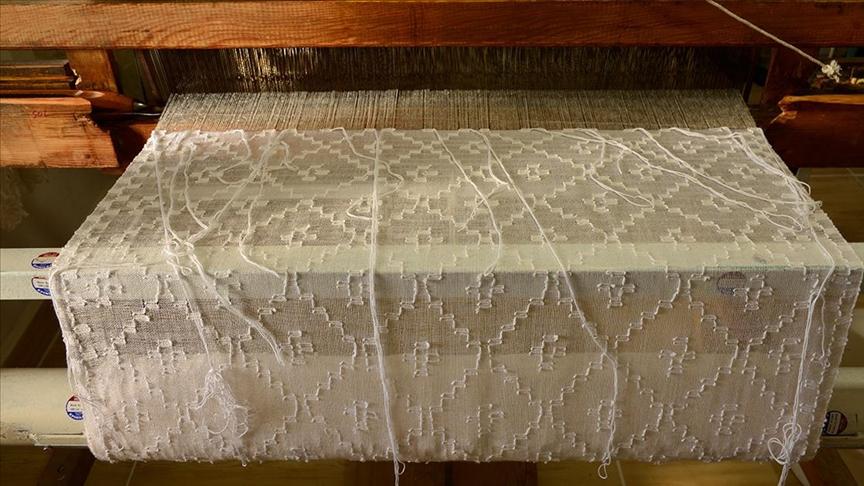
Ibecik Bezi (AA)
Historically used in items such as men’s headwear (dastar), dish towels, tablecloths, handkerchiefs, and belts, Ibecik Bezi is now utilized in home textiles and apparel. It is employed in the production of headscarves, shawls, dresses, tablecloths, sofa covers, and curtains.
The production of Ibecik Bezi occurs exclusively in Ibecik Village, Gölhisar District, Burdur Province. This geographical boundary is directly tied to the product’s reputation. All stages of production are carried out within this defined area.
Inspections are conducted at least once a year under the coordination of the Gölhisar Municipality, with participation of experts from the Gölhisar District Directorate of Agriculture and Forestry and the Gölhisar Community Education Center. These inspections verify the suitability of looms and threads, the accuracy of motifs, and compliance with the geographical indication mark.

Technical Characteristics
Production Process
Applications
Geographical Link and Oversight
