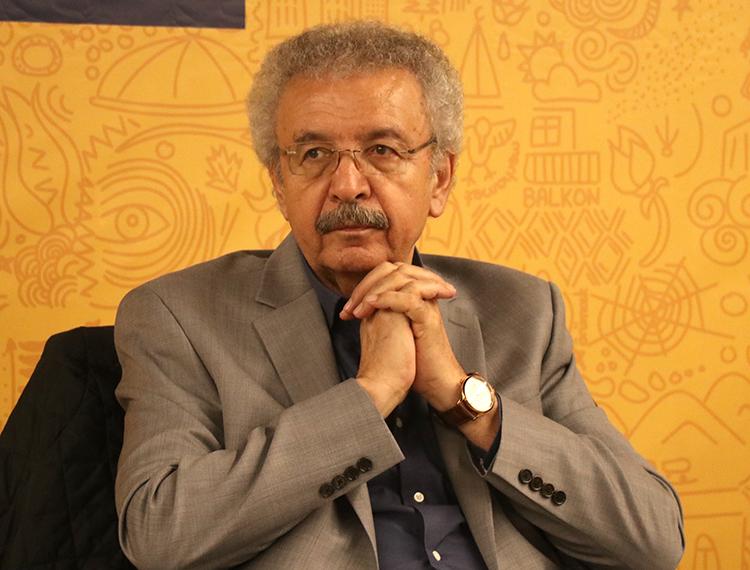


+2 More

Birth | 1954, Amman (Jordan) | ||||||||
|---|---|---|---|---|---|---|---|---|---|
Origin(s) | A Palestinian family expelled from the village of al-Bureij near Jerusalem | ||||||||
Profession(s) | Poet cultural manager journalist photographer novelist | ||||||||
Education | UNRWA schools and the Amman Teachers Institute | ||||||||
Areas of Work | Novel, poetry, children's literature, photography, film criticism | ||||||||
Period(s) | Contemporary Arab Literature | ||||||||
Prominent Themes | Palestinian history, collective memory, exile, resistance, popular culture | ||||||||
Award(s) | Sultan Al Owais Poetry Prize Neustadt Prize (2026) IPAF (2018) Katara Novel Prize Arar Literature Prize | ||||||||
Languages of Works | Arabic (his works have been translated into English, Italian, Turkish, etc.) | ||||||||
Life | He lives in Amman as a freelance writer. | ||||||||
Ibrahim Nasrallah (b. 1954), born into a Palestinian family in Amman, Jordan, is one of the leading contemporary Arab writers, known for his contributions to poetry, novel writing, photography, journalism, and cultural management. Nasrallah’s literary output is particularly focused on Palestinian history, collective memory, the experience of exile, and popular culture, securing him a prominent place among the modern representatives of the Arab novel.
TV Program Featuring Ibrahim Nasrallah (TVNET)
Ibrahim Nasrallah is the child of a family forcibly displaced from Palestine in 1948. His family’s roots trace back to the village of al-Bureyc near Jerusalem. He was born in 1954 in the Al-Wihdat Palestinian Refugee Camp in Amman, established by the United Nations, and spent his childhood and early youth in this camp. He completed his primary, secondary, and high school education at UNRWA and camp schools, before graduating from the Amman Teachers Institute.
After completing his education, Nasrallah worked as a teacher in the Al-Qunfudhah region of Saudi Arabia from 1976 to 1978. The experiences he lived through during this period formed the foundational material for his first novel, Berârî el-Hummâ (Prairies of Fever).
After returning to Jordan, he worked in journalism from 1978 to 1996, contributing to various newspapers, primarily Ad-Dustur. Since 1996, he has held the position of cultural manager under the Abdulhamid Shouman Foundation and later at the Khalid Shoman House of Art.
Nasrallah is recognized not only for his literary identity but also for his engagement with the art of photography. He held photographic exhibitions in Jordan in 1995 and in South Korea in 2004. He has also served on the Honorary Council of the Amman Film Producers Cooperative and the General Assembly of the Khalil Sakakini Cultural Center in Ramallah.

Ibrahim Nasrallah (Anadolu Agency)
Ibrahim Nasrallah began his literary career as a poet. His first poetry collection, el-Huyûl ʿalâ meşârifi’l-medîne, was published in 1980. To date, he has authored seventeen poetry collections and two poetry books for children.
Feeling that poetry was insufficient to convey certain experiences, he turned to the novel form. His first novel, Berârî el-Hummâ, was published in 1985 and is regarded as one of the notable modern novels in the Arab world.
Nasrallah’s novels exhibit a broad and continuous diversity of themes. The main themes include:
These themes are prominently developed in his expansive novel series el-Melhâtu’l-Filistîniyye.
This series of ten novels constitutes a comprehensive literary project that explores approximately 250 years of Palestinian history through diverse characters, locations, and social processes. Some of the significant novels in the series include:
In these works, historical material, testimonies, and lived experiences are seamlessly integrated into the fictional narrative structure.
In Nasrallah’s works, there is a strong connection between historical events and literary fiction. Historical knowledge merges with individual and collective testimonies to nourish the aesthetic structure of the novel. This approach imbues his novels with both documentary value and literary intensity.
Popular culture occupies a prominent place in his novels. Rituals of birth, marriage, and death; folk medicine practices; everyday beliefs and superstitions; life in tent camps and experiences of migration; oral culture, elegies, and proverbs are all incorporated into the literary fabric. This dimension grants Nasrallah’s works an anthropological depth.
In several novels, especially A‘râs Âmine, women emerge as central figures in social resistance and the transmission of memory. Female characters guide the narrative as bearers of both familial resilience and collective struggle.
Nasrallah’s language is simple, fluid, and realistic. At times, it exhibits poetic intensity. His narrative techniques include the protagonist-narrator structure, the use of flashbacks, and dialogues infused with regional dialects of Palestine and Jordan.

Ibrahim Nasrallah (Anadolu Agency)
Ibrahim Nasrallah has received numerous literary awards. His principal honors include:
His works have been translated into English, Italian, Spanish, Danish, and Turkish; featured at international festivals; and are recognized as among the foremost representatives of the Palestinian narrative in contemporary world literature.
Nasrallah’s literary output forms a cohesive memory framework that examines the political, social, and emotional history of Palestinian society from a broad perspective. Themes of exile, loss, identity, and resistance converge into a narrative universe where historical experience and individual stories are interwoven. In his novels, historical testimonies, social realities, and personal dramas are treated with tight unity, establishing a unique approach to “literary historiography” within Palestinian literature.
AUC Press. "Ibrahim Nasrallah." Accessed November 25, 2025. https://aucpress.com/author/ibrahim-nasrallah/
Alyasi Essa, Zainab. “İbrahim Nasrallah’ın Beyaz Atlar Zamanı Adlı Eserinde Tarih ve Roman.” Şarkiyat Mecmuası 38 (2021): 183–192. doi:10.26650/jos.842105. Accessed November 25, 2025. https://iupress.istanbul.edu.tr/journal/jos/article/history-and-the-new-novel-ibrahim-nasrallahs-the-time-of-white-horses-as-a-model?id=866638
Anadolu Ajansı. "Filistin Asıllı Ürdünlü Yazar Nasrallah: ‘Filistin’de İlk Ayaklananlar, İlk Direnişçiler Aslında Edebiyatçılardı.’" Accessed November 25, 2025. https://www.aa.com.tr/tr/yasam/filistin-asilli-urdunlu-yazar-nasrallah-filistinde-ilk-ayaklananlar-ilk-direnisciler-aslinda-edebiyatcilardi/3057359
Anadolu Ajansı. "Filistinli Şair Bağımsızlık Mücadelesini Geleceğe Taşımada Dizelerin Gücüne İnanıyor." Accessed November 25, 2025. https://www.aa.com.tr/tr/kultur/filistinli-sair-bagimsizlik-mucadelesini-gelecege-tasimada-dizelerin-gucune-inaniyor/3608076
Bostancı, Ahmet. “İbrahim Nasrallah’ın Hayatı, Eserleri ve Ağras Amine Adlı Romanının İncelenmesi.” Nüsha: Şarkiyat Araştırmaları Dergisi 34 (2012): 151–168. Accessed November 25, 2025. http://ktpmakale.isam.org.tr/detayilhmklzt.php?navdil=.trandidno=186697andtarama=tuhfe%20i%20mahmud&midno=88106250&Dergivalkod=0478
Digital Memory Center. "İbrahim Nasrallah – Biyografi." Digital Memory. Accessed November 25, 2025. https://dijitalhafiza.com/biyografiler/ibrahim-nasrallah
Hemşinli, Tuba Nur. “İbrahim Nasrallah’ın Tuyûru’l-Hazer Romanındaki Bazı Halk Kültürü Unsurları.” Kafkas Üniversitesi İlahiyat Fakültesi Dergisi 9, no. 17 (January 2022): 239–255. Accessed November 25, 2025. https://dergipark.org.tr/tr/pub/kafkasilahiyat/issue/64654/1029741
International Literature Festival Berlin. "Ibrahim Nasrallah." Literaturfestival.com. Accessed November 25, 2025. https://literaturfestival.com/en/authors/ibrahim-nasrallah/
Neustadt Prize Organization. “Ibrahim Nasrallah Wins the 2026 Neustadt Prize.” Neustadt Prize. Accessed November 25, 2025. https://www.neustadtprize.org/ibrahim-nasrallah-wins-the-2026-neustadt-prize/
TVNET. "Şiir, Roman, Çocuk Kitabı, Edebiyat ve Sanat Merkezli Tam 50 Eser: İbrahim Nasrallah | Bin1." YouTube video. Accessed November 25, 2025. https://www.youtube.com/watch?v=RZUS5ZCr6hE

Birth | 1954, Amman (Jordan) | ||||||||
|---|---|---|---|---|---|---|---|---|---|
Origin(s) | A Palestinian family expelled from the village of al-Bureij near Jerusalem | ||||||||
Profession(s) | Poet cultural manager journalist photographer novelist | ||||||||
Education | UNRWA schools and the Amman Teachers Institute | ||||||||
Areas of Work | Novel, poetry, children's literature, photography, film criticism | ||||||||
Period(s) | Contemporary Arab Literature | ||||||||
Prominent Themes | Palestinian history, collective memory, exile, resistance, popular culture | ||||||||
Award(s) | Sultan Al Owais Poetry Prize Neustadt Prize (2026) IPAF (2018) Katara Novel Prize Arar Literature Prize | ||||||||
Languages of Works | Arabic (his works have been translated into English, Italian, Turkish, etc.) | ||||||||
Life | He lives in Amman as a freelance writer. | ||||||||
Life
Origins and Childhood Years
Teaching Career
Journalism and Cultural Work
Photography and Art
Literary Career
Beginning in Poetry
Transition to the Novel
General Themes in His Novels
The “el-Melhâtu’l-Filistîniyye” Series
Literary Style and Themes
The Relationship Between History and the Novel
Elements of Popular Culture
Women and Resistance
Language and Narrative
Awards and International Recognition
Works
Poetry Collections
Novels
Independent Novels
The “el-Melhâtu’l-Filistîniyye” Series
The “eş-Şurufât” Series
Children’s Books
Autobiography / Memoirs
Other Books
His Place in Palestinian Culture and Collective Memory