


This article was automatically translated from the original Turkish version.
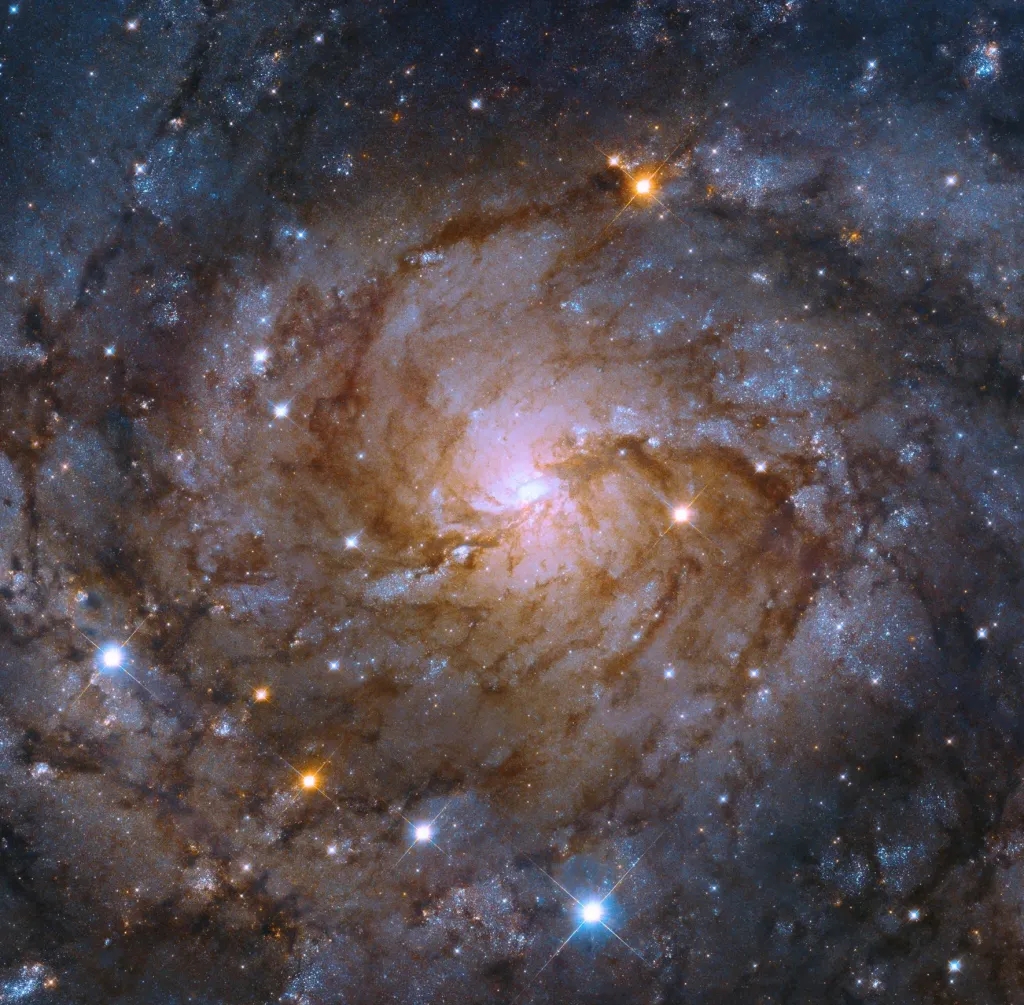
The IC 342 (Caldwell 5) Galaxy is a spiral galaxy located in the constellation band, particularly within the constellation Camelopardalis. This celestial object is situated at a distance of approximately 10.7 million light-years and, although not visible to the naked eye from Earth, is identified as one of the largest spiral galaxies in sky images. This galaxy, designated as IC 342 in the Index Catalogue, was first discovered in 1895 by the German astronomer Max Wolf.

The IC 342 Galaxy (NASA)
IC 342 has a morphological classification of SAB(rs)cd, indicating a weakly barred spiral structure with loosely wound spiral arms. The galactic center is a highly active star-forming region, and observations of this area reveal significant levels of star formation activity.
The diameter of the galaxy is estimated to be between 75,000 and 100,000 light-years. Based on these properties, it is considered to be of similar size to the Milky Way Galaxy. IC 342 is the brightest and most massive member of the small IC 342/Maffei Group of galaxies, located just outside the Local Group.
Due to its proximity to the galactic plane, IC 342 suffers from significant observational obstruction caused by dust and gas clouds of the Milky Way along the line of sight. As a result, observations in visible light wavelengths reveal the galaxy as faint and diffuse. However, infrared, radio, and X-ray observations have been able to reveal its structural details more clearly.

Position of IC 342 (NASA)
Due to these observational challenges, historical distance measurements of IC 342 have varied. The currently accepted average distance is around 3.3 megaparsecs (approximately 10.7 million light-years).
IC 342 is among galaxies exhibiting a high rate of star formation. In particular, molecular gas clouds in its central region provide favorable conditions for the birth of new stars. Spectroscopic data such as carbon monoxide (CO) emission confirm the presence of dense star-forming regions.
There is evidence suggesting the possible presence of a low-luminosity Seyfert-like active galactic nucleus (AGN) at the galaxy’s core. However, current observations have not yet reached definitive conclusions, and the central activity of IC 342 is primarily associated with star formation rather than an AGN.
IC 342 is the most prominent member of the IC 342/Maffei Group, which also includes the galaxies Maffei I and Maffei II, from which the group derives its name. This group is of significant astrophysical interest due to its proximity to the Local Group. IC 342’s dominant mass within the group directly influences its dynamical structure and evolution.
While definitive findings regarding interactions among galaxies in this group remain elusive, the distribution of neutral hydrogen (H I) around IC 342 reveals structures indicative of past galactic interactions.
Radio astronomical observations have revealed significant structures within IC 342 across various wavelengths. In particular, the 21 cm emission line of neutral hydrogen provides detailed information about the distribution of gas in the galaxy’s spiral arms. Additionally, radio frequency observations have yielded data on the galaxy’s magnetic field structure and cosmic ray distribution.
Infrared observations, especially those made with the Spitzer Space Telescope, have provided detailed insights into IC 342’s dust composition and star-forming regions. These observations indicate a high rate of star birth and an irregular internal structure within the galaxy.
Despite observational challenges, IC 342 remains an important subject of study for astrophysicists investigating the internal dynamics of spiral galaxies, star formation processes, and the structure of galaxy groups in the local universe. Its relative proximity to the Milky Way enables high-resolution observations. At the same time, IC 342 serves as a key example for understanding galaxies with high star formation rates but relatively low luminosity.

No Discussion Added Yet
Start discussion for "IC 342 (Caldwell 5) Galaxy" article
General Characteristics
Position and Observability
Star Formation and Central Activity
The IC 342/Maffei Galaxy Group
Spectral and Radio Observations
Scientific Importance