


This article was automatically translated from the original Turkish version.
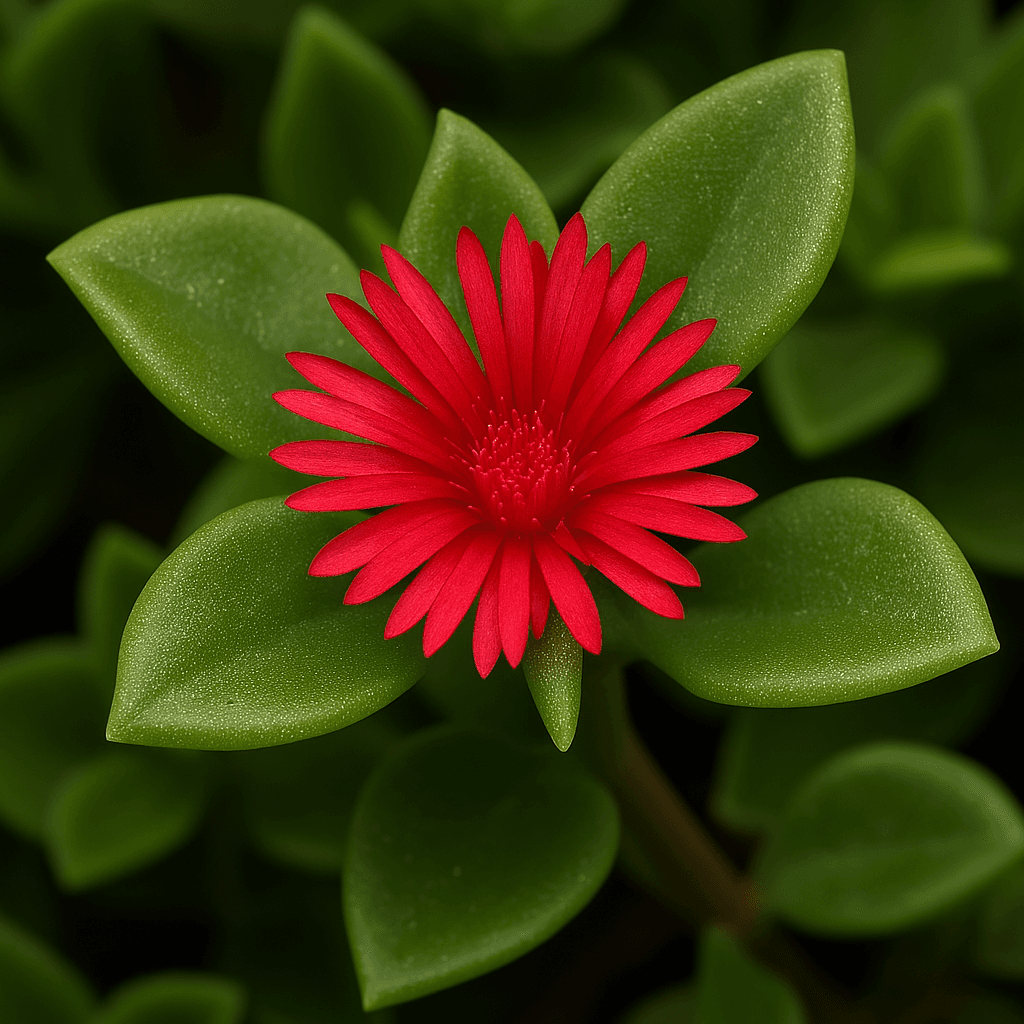
Ice Plant (Aptenia cordifolia)
Family | Aizoaceae | ||||||||
|---|---|---|---|---|---|---|---|---|---|
Origin(s) | South Africa | ||||||||
Plant Type | Ground cover, Succulent | ||||||||
Structure(s) | 3–10 cm tall Spreading horizontally | ||||||||
Leaf | Fleshy, Glossy, Dark green, Egg-shaped | ||||||||
Flower | Small, Red, Pink, Can flower throughout the year | ||||||||
Light | Full sun | ||||||||
Soil | Sandy/gravelly, Well-drained | ||||||||
Use(s) | Hanging basket Ground cover Rock garden | ||||||||
Hardiness | High drought tolerance, Frost sensitive | ||||||||
Distribution(s) | Observed in the flora of South Africa and Provence (France) | ||||||||
Ice Plant (Aptenia cordifolia) is a low-growing, trailing groundcover plant belonging to the Aizoaceae family and native to South Africa. It is distinguished by its thick, fleshy, and glossy dark green leaves. It produces small, red, daisy-like flowers that typically bloom from spring through autumn. It thrives in full sun and well-drained soils. Thanks to its drought-tolerant nature, it forms a dense and lush green groundcover. Due to these characteristics, it is widely used in hanging baskets and small landscape areas such as rock gardens.

Ice Plant (Pixabay)
Aptenia cordifolia is a prostrate, groundcover-forming plant that typically grows to a height of 3–4 inches (approximately 7–10 cm). Its leaves are simple, arranged in opposite or subopposite pairs, ovate in shape, and have smooth margins. The leaves are glossy, fleshy, and dark green. The stems and branches are succulent, green, flexible, and brittle. The plant is evergreen and exhibits slow growth. Its flowers are small, bright red, and showy, and can be observed throughout spring, summer, and autumn.
Aptenia cordifolia naturally grows in the hot and arid climate regions of South Africa. Adapted to these conditions, the species is also found naturalized in areas with a Mediterranean climate. For instance, it has been documented to naturalize in regions such as Provence in France and exhibits phenological flexibility. It is also noted to be hardy and cultivable year-round in USDA plant hardiness zones 10–11.
The Ice Plant is commonly preferred as a groundcover in small-scale landscape designs, rock gardens, and coastal areas. Its trailing and cascading habit makes it ideal for use in hanging baskets or allowed to spill over walls. Valued as an ornamental plant, it offers long-lasting visual impact in sunny locations with minimal maintenance requirements. Its slow growth and dense texture provide a neat and tidy appearance.

Ice Plant (Pixabay)
For healthy growth, well-drained soils are essential, and the soil should be allowed to dry between waterings. Although tolerant of drought, excessive moisture can lead to root rot. The plant grows more vigorously in full sun but may exhibit weak growth in shade. Due to its sensitivity to frost, it should be brought indoors or moved to protected areas in very cold regions. In container cultivation, watering must be carefully controlled to avoid excess moisture.
GBIF. "Aptenia cordifolia (L.fil.) Schwantes." Global Core Biodata Resource. Accessed May 31, 2025. https://www.gbif.org/species/5384309
Gilman, Edward F., Ryan W. Klein, and Gail Hansen. "Aptenia cordifolia Baby Sunrose." Gainesville, FL: UF/IFAS Extension, University of Florida, 1999. Accessed May 31, 2025. https://www.researchgate.net/publication/382844052_Aptenia_cordifolia_Baby_Sunrose_FPS-47FP047_82018
Pixabay. "Aptenia cordifolia Aptenia Çalı JPG." Accessed May 31, 2025. https://pixabay.com/tr/photos/aptenia-cordifolia-aptenia-%C3%A7al%C4%B1-187101/
Pixabay. "Etli Aptenia cordifolia JPG." Pixabay. Accessed May 31, 2025. https://pixabay.com/tr/photos/etli-aptenia-cordifolia-5352192/

Ice Plant (Aptenia cordifolia)
Family | Aizoaceae | ||||||||
|---|---|---|---|---|---|---|---|---|---|
Origin(s) | South Africa | ||||||||
Plant Type | Ground cover, Succulent | ||||||||
Structure(s) | 3–10 cm tall Spreading horizontally | ||||||||
Leaf | Fleshy, Glossy, Dark green, Egg-shaped | ||||||||
Flower | Small, Red, Pink, Can flower throughout the year | ||||||||
Light | Full sun | ||||||||
Soil | Sandy/gravelly, Well-drained | ||||||||
Use(s) | Hanging basket Ground cover Rock garden | ||||||||
Hardiness | High drought tolerance, Frost sensitive | ||||||||
Distribution(s) | Observed in the flora of South Africa and Provence (France) | ||||||||
No Discussion Added Yet
Start discussion for "Ice Plant (Aptenia cordifolia)" article
Morphological Characteristics
Geographical Distribution
Uses
Cultivation Practices