

This article was automatically translated from the original Turkish version.
+1 More
To detect neutrinos—nearly massless subatomic particles produced by radioactive decay—the IceCube Observatory is a particle detector constructed from Antarctic ice and extending approximately 2,500 meters below the surface. IceCube, the first gigaton neutrino detector ever built, is designed to observe the most intense neutrinos in the universe through the ice.
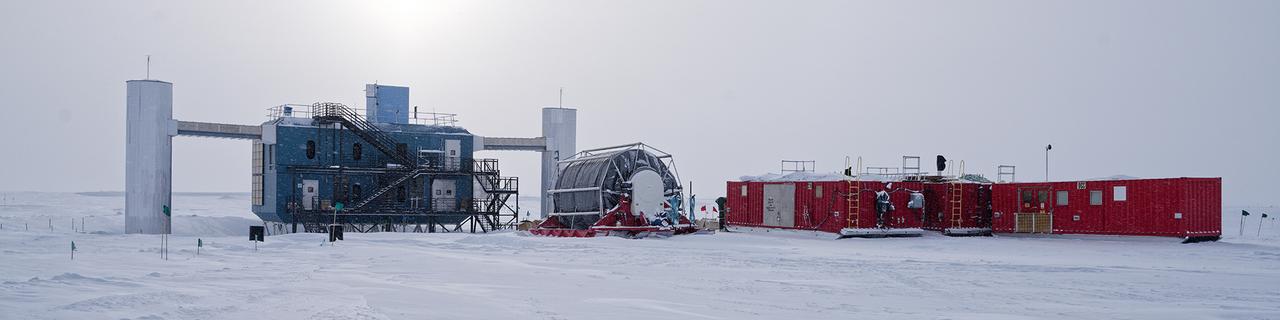
View of the IceCube Laboratory. Source: Ilya Bodo (IceCube Neutrino Observatory)
Antarctica is a valuable location due to its extreme conditions—low temperatures, low humidity, prolonged darkness, and the ability of detectors to remain in low background noise environments under polar cold, enabling continuous and sensitive observations. Countries have established research stations at suitable locations across the continent. To date, 128 stations have been built by 30 different countries. One of these stations is the IceCube Observatory.
Construction of IceCube began in 2004 and was completed after seven years of work. It is located at the Amundsen-Scott South Pole Station, the United States base in Antarctica. It is a particle detector composed of one cubic kilometer of Antarctic ice. Buried beneath the surface, it extends to a depth of approximately 2,500 meters and consists of a surface array called IceTop and an inner component called DeepCore.
The ice-based component of IceCube comprises 5,160 digital optical modules (DOMs), each equipped with a 10-inch photomultiplier and associated electronics. The DOMs are frozen into 86 boreholes and arranged in vertical strings spanning depths from 1,450 to 2,450 meters across a cubic kilometer. The strings are positioned on a hexagonal grid with 125-meter spacing, each containing 60 DOMs. The vertical separation between DOMs is 17 meters.
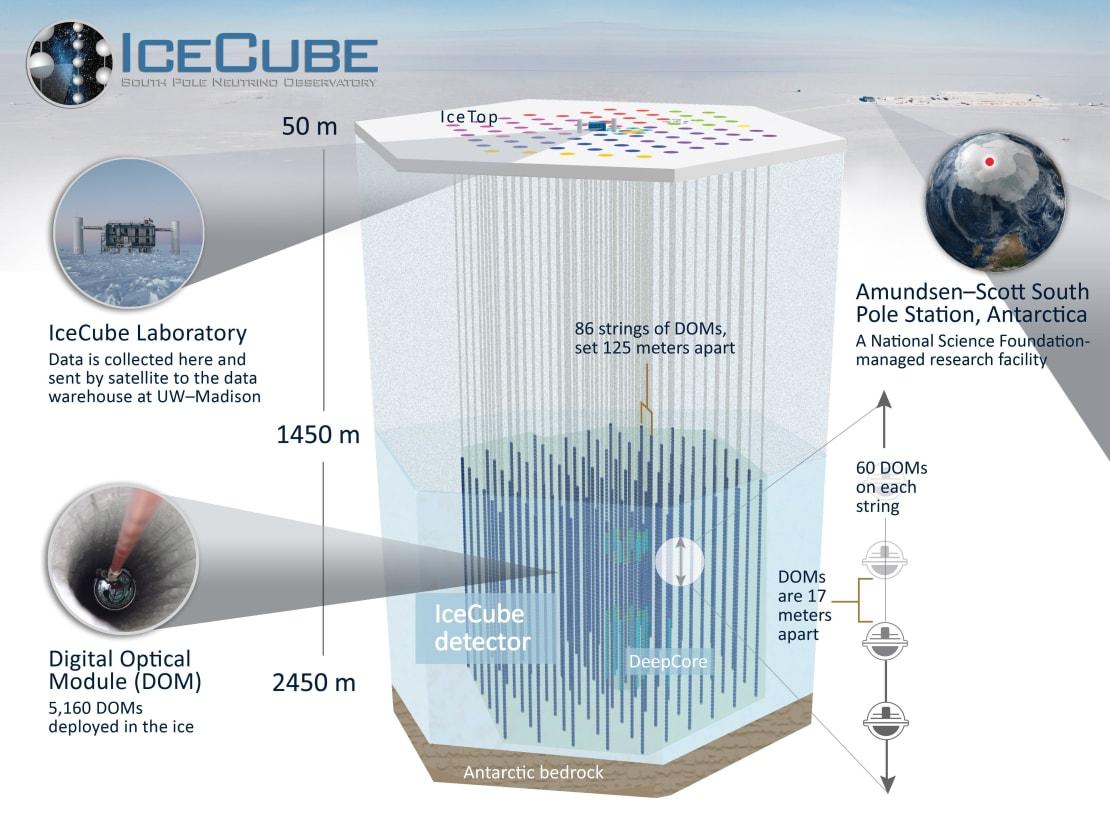
Digital Optical Module (DOM) (IceCube Neutrino Observatory)
IceTop consists of 81 stations located above the same number of IceCube strings. Each station has two tanks, each equipped with two downward-facing DOMs. Built as a veto and calibration detector for IceCube, IceTop also detects air showers produced by cosmic rays. The surface array measures not only the arrival directions of cosmic rays in the Southern Hemisphere but also their flux and composition.
Eight of the strings in the center of the array are arranged in a more compact configuration with horizontal DOM spacing of approximately 70 meters and vertical spacing of 7 meters. This denser configuration forms the DeepCore sub-detector, which lowers the neutrino energy threshold to about 10 GeV and enables the study of neutrino oscillations.
The discovery of neutrinos began in 1930 when Wolfgang Pauli proposed them as a hypothesis to explain energy loss in beta decay. Their existence was confirmed in 1956 through experiments conducted by Clyde Cowan and Frederick Reines. Initially thought to be massless, observations from the Super-Kamiokande experiment in 1998 demonstrated that neutrinos have a very small but non-zero mass. Current research suggests their mass lies between 0.1 eV and 1 eV—less than a millionth the mass of an electron. Since they carry no electric charge, they interact almost never with matter, earning them the nickname ghost particles.
There are three types of neutrinos: electron neutrinos, muon neutrinos, and tau neutrinos. These neutrinos, which do not conform directly to the Standard Model, interact with other particles only via gravity. It has also been discovered that neutrinos can transform into one another according to the rules of quantum mechanics. This phenomenon is known as neutrino oscillation.
Because neutrinos are not blocked by cosmic dust and gas, as electromagnetic waves are, they provide direct insight into the most extreme astrophysical events. Their nature allows scientists to uncover gaps in the fundamental laws of physics beyond the Standard Model. Studying neutrinos can yield critical information about the universe’s highest-energy processes and mysterious phenomena such as dark matter. Additionally, tracking neutrino motion may reveal how cosmic rays are accelerated and propagated throughout the universe.
Neutrinos cannot be observed directly, but when they interact with ice, they produce charged secondary particles. These particles travel through the ice faster than light propagates in that medium, generating Cherenkov radiation. The amount and pattern of this radiation provide information about the particle’s direction and energy.

Photon energy. (IceCube Neutrino Observatory)
IceCube discovered PeV-energy neutrinos with a flux comparable to, and possibly exceeding, that of high-energy gamma rays originating beyond our galaxy. In 2013, using only two years of data, IceCube identified the first high-energy astrophysical neutrino flux, offering a unique and unobstructed view of the cosmic ray accelerators responsible for the highest-energy radiation reaching Earth.
After collecting ten years of data with the completed IceCube detector, a high-purity sample from 670,000 muon neutrinos revealed astrophysical sources. Eighty TeV-energy neutrino events were found to originate from the active galaxy NGC 1068 (M77), located just 0.18 degrees away. NGC 1068 is also the most significant astrophysical neutrino source identified through a search of the positions of 110 previously selected high-energy gamma-ray sources.
Data indicate that the sites where cosmic rays are accelerated and neutrinos are produced are the obscured dense cores near supermassive black holes in certain active galaxies. Consequently, gamma rays accompanying cosmic neutrinos lose energy within the obscured core and emerge at MeV or lower energies. Thus, neutrinos have provided the first glimpse into the still-mysterious cosmic accelerators that produce high-energy cosmic rays.
The IceCube Collaboration consists of approximately 458 physicists from 58 institutions across 15 countries. The international team is responsible for the scientific program, and most collaborators contributed to the design and construction of the detector.
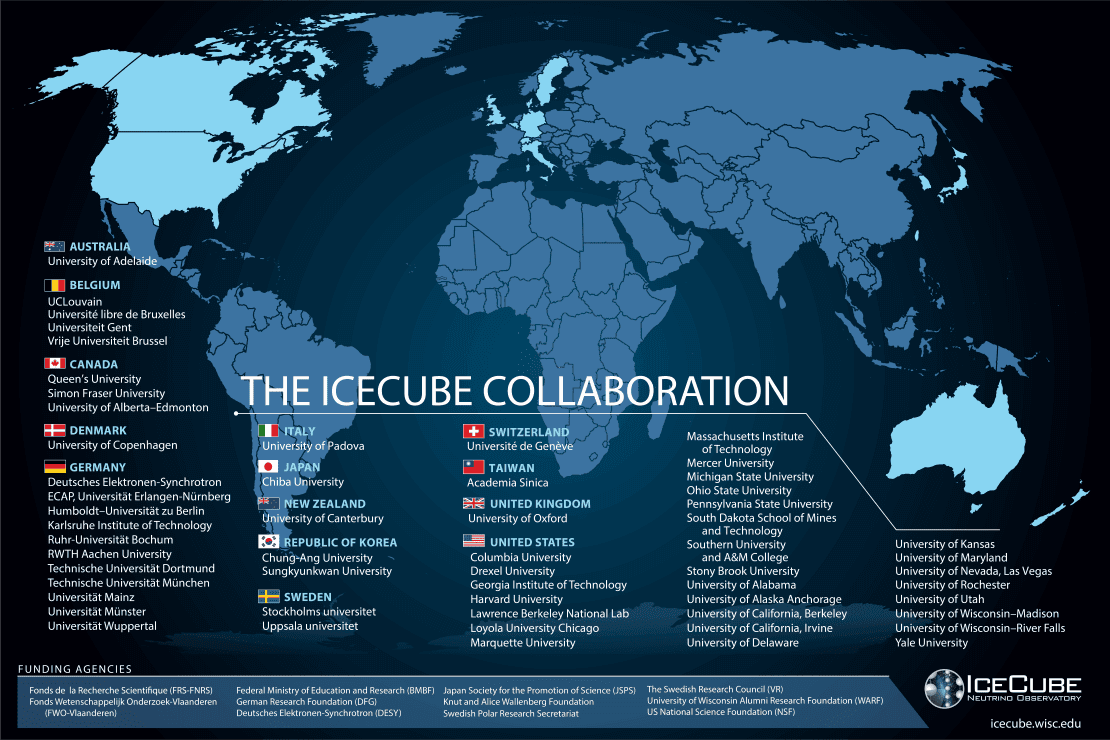
Map of all institutions participating in the IceCube Collaboration as of April 2025. (IceCube Neutrino Observatory)
The ongoing maintenance and operation of IceCube are supported by various funding sources. The University of Wisconsin–Madison, with support from the National Science Foundation grant, is the leading institution responsible for IceCube’s management. These funds are supplemented by contributions from other funding agencies outside the United States, as well as in-kind contributions and service work provided by members of collaborating institutions. Scientific research conducted by the IceCube Collaboration is financed by separate grants provided by institutions in each collaborating country.
Accessed November 26, 2025.
Accessed November 26, 2025.
Accessed November 26, 2025.
Aksaker, Nazım; Anıl Akın Tanrıöver; Sinan Kaan Yerli; Mehmet Akif Erdoğan; Zühal Kurt. "Astronomi İçin Antarktika’da Yer Seçimi." Turkish Journal of Astronomy and Astrophysics 4, no. 3 (Özel Sayı: 22, 31 Aralık 2023): 303–305. TÜBİTAK Proje No. 121F251 yürütücüsü Nazım Aksaker’dır. Accessed August 4, 2025.
IceCube Collaboration (Ümit Kaya). "Recent Results from the IceCube Experiment." Sunum, 13th International Conference on Topics in Astroparticle and Underground Physics, Venedik, 2013. TÜBİTAK Projesi No. 114F337 kapsamında hazırlanmıştır. Accessed August 4, 2025.
IceCube Collaboration. "IceCube Neutrino Observatory – Research." University of Wisconsin–Madison. Accessed August 4, 2025.
Yeşiltaş, Mehmet. "Kutuplarda Astronomi ve Uzay Araştırmaları." TÜBİTAK Ansiklopedi. Accessed August 4, 2025.
“Görünmez Parçacıklarla Evreni Anlamak: Nötrino Astronomisi.” Kurious, Koç Üniversitesi, 2022. Accessed August 4, 2025.

No Discussion Added Yet
Start discussion for "IceCube Observatory" article
Location and Structure of the IceCube Observatory
Neutrinos
The IceCube Experiment
The IceCube Collaboration