
This article was automatically translated from the original Turkish version.
+1 More
Ritual Elements | Water Candle Fire | ||||||||
|---|---|---|---|---|---|---|---|---|---|
Basic Themes | Fertility Renewal Purification | ||||||||
Related Figure | Brigid | ||||||||
Imbolc, a seasonal festival of ancient Celtic origin, constitutes the third of the eight sabbats known as the Wheel of the Year. In the Northern Hemisphere it is typically observed between 31 January and 1 February, while in the Southern Hemisphere, due to seasonal inversion, it is celebrated around 1 August. Calendar-wise, it corresponds to the midpoint between the Winter Solstice and the Spring Equinox. This positioning makes Imbolc a threshold period symbolizing the end of winter’s absolute dominance and the emergence of the first signs of spring.
The festival marks a time when nature has not yet visibly surfaced but is beginning to awaken from within. The noticeable lengthening of days, the approaching lambing season in animal husbandry, and the first signs of plant life form the core context of Imbolc. For ancient societies, this period held both symbolic and practical significance.

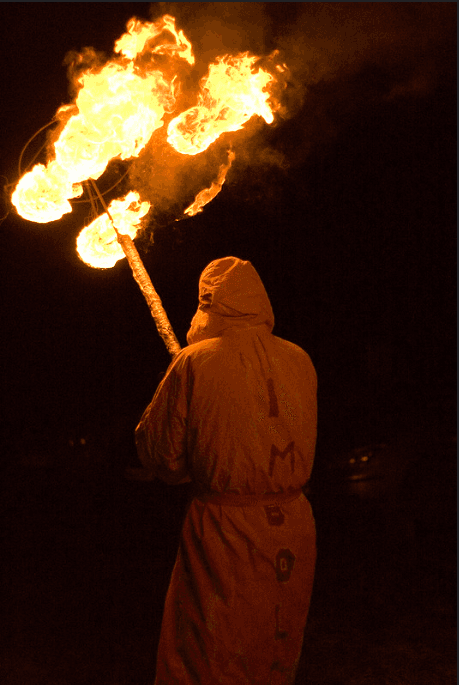
Imbolc Celebrations, Green Man and Hare (Rabbit) - (Flickr)
The term “Imbolc” is derived from the Old Irish phrase “i mbolg”, meaning “in the belly,” which directly refers to the pregnancy of sheep. The term represents not only a biological condition but also a seasonal phase in which the land is filled with potential for fertility. In this context, Imbolc defines the latent yet inevitable vitality of nature about to emerge.
The festival is also known as “Oimelc”, which means “ewe’s milk,” referring to the time in midwinter when ewes begin to give birth and produce milk. In pre-industrial societies, fresh dairy products were unavailable during winter months, making this period a vital threshold. The renewed availability of fresh milk, butter, and cheese significantly enhanced Imbolc’s economic and life-sustaining value.【1】
For ancient agricultural societies, Imbolc was not merely a ritual day but a functional marker regulating the seasonal cycle. Its position as the midpoint between the Winter Solstice and the Spring Equinox transformed this period into a stage for replanning agricultural activities. Farmers would observe the soil, begin preparations for the first sowing, and perform blessing rituals to ensure continued fertility.
From an animal husbandry perspective, Imbolc coincides with the beginning of the lambing season. The completion of the ewes’ gestation period and the first births were regarded as the most concrete indicators that the life-threatening aspects of winter had passed. Thus, the festival is directly linked to the renewal of food security and productivity.

Fire, Poetry, Healing and Craft Goddess Brigid (Generated by AI)
The Imbolc festival is strongly associated with the Celtic goddess Brigid, who is revered as the patroness of poetry, learning, healing, fertility, and blacksmithing. She is also a protective figure linked to hearth and home. Due to her connection with fire, Imbolc is frequently described in sources as a “winter fire festival.”
With the spread of Christianity, the figure of Brigid was reinterpreted as Saint Brigid, and the Imbolc festival merged with Candlemas. During this transformation, themes of light, fire, and purification were preserved, but the religious framework was shifted into a Christian context.
The central themes of Imbolc revolve around purification, the return of light, hope, and new beginnings. The festival symbolizes the earth awakening from its winter slumber and daylight beginning to overcome darkness. These themes are consistently reflected in both rituals and symbols.
The theme of purification is addressed on both physical and symbolic levels. Cleaning homes, ventilating spaces, and water-based cleansing rituals are seen as essential ways of welcoming the coming spring. The theme of light is embodied through candles and fire, representing the increasing power of the sun.
Imbolc celebrations are viewed as an extensive purification process conducted before nature’s awakening. Spring cleaning is one of the most prominent practices of this period, regarded not only as physical cleansing but also as the removal of stagnation accumulated over winter. Smudging rituals and water-based purification rites are integral to spatial and personal renewal.
Symbols used in the festival reflect themes of protection and fertility. The Brigid’s Cross, woven from reeds or straw, is hung above doorways to serve a protective function. Candles and fire symbolize the return of light; while snowdrops, blooming in the heart of winter, are regarded as the most visible sign of nature’s awakening. The tradition of blue cloth is associated with Brigid’s healing and protective qualities.

Brigid’s Cross (Generated by AI)
Dietary customs specific to Imbolc are directly tied to the animal husbandry cycle. Milk and dairy products hold a central position, both in the festival’s etymology and practical significance. Breads made from stored grains and foods containing seeds represent concepts of abundance and continuity. Consumption of plants such as dandelion is linked to Brigid’s healing aspect. These foods not only carry symbolic meaning but also functioned as essential nutritional sources enabling survival under late-winter conditions.
For the ancient Celts, Imbolc was a time of careful observation of nature for divinatory purposes. Weather conditions were considered a key indicator of when spring would arrive. According to the Cailleach legend, a sunny day on Imbolc signified a prolonged winter, while stormy and harsh weather indicated the imminent arrival of spring.
Changes in plants and animals were also closely monitored. The appearance of snowdrops, the budding of hedgerow plants, and the song of the rook were interpreted as signs of nature’s awakening. These observations formed a functional calendar system in pre-modern meteorological societies.
Although Imbolc originates in Ireland and the broader Celtic region, the festival is now celebrated across diverse geographical areas. In Ireland, particularly in Kildare, it holds a central position due to the tradition of Saint Brigid. In the United Kingdom, modern pagan communities regularly organize events in centers such as Edinburgh and Glastonbury.
In Northern Europe and the United States, Imbolc is maintained within the frameworks of modern Druidry and Wicca. In Southern Hemisphere countries, the festival is observed on a date opposite to that of the Northern Hemisphere due to seasonal differences. This practice demonstrates that Imbolc is a ritual tradition adaptable to diverse geographical and seasonal contexts.
Brigit’s Garden. "Who is Brigit & What Are Her Traditions for Imbolc?" Accessed March 12, 2026. https://brigitsgarden.ie/brigit-traditions-for-imbolc/
CPRE. "Imbolc: The Quickening of the Year." Accessed March 12, 2026. https://www.cpre.org.uk/discover/imbolc-the-quickening-of-the-year/.
Castlefest. "Vana Grimoire: Imbolc." Accessed March 12, 2026. https://castlefest.nl/en/news/vana-grimoire-imbolc.
Douglas, Rebecca. "What is Imbolc? A Guide to the Season of Renewal." Accessed March 12, 2026. https://rebeccadouglas.co.uk/what-is-imbolc-a-guide-to-the-season-of-renewal/.
Earnshaw, Steven. "Imbolc Procession." Flickr, February 12, 2007. Photograph. Accessed March 12, 2026. https://www.flickr.com/photos/stevenearnshaw/379315373/in/photostream/
Earnshaw, Steven. "Imbolc Procession." Flickr, February 12, 2007. Photograph. Accessed March 12, 2026. https://www.flickr.com/photos/stevenearnshaw/379317708/in/photostream/
Earnshaw, Steven. "The Green Man and the Hare." Flickr, February 12, 2007. Photograph. Accessed March 12, 2026. https://www.flickr.com/photos/stevenearnshaw/379305855/in/photostream/
Glastonbury Information Centre. "What is Imbolc?" January 29, 2024. Accessed March 12, 2026. https://glastonburyinformationcentre.co.uk/2024/01/29/what-is-imbolc/
Mabon House. "A History of Imbolc." Accessed March 12, 2026. https://www.mabonhouse.co/ahistoryofimbolc.
The Beltane Fire Society. "Imbolc." Accessed March 12, 2026. https://beltane.org/imbolc/
The Druid Way. "Imbolc." Accessed March 12, 2026. https://druidry.org/druid-way/teaching-and-practice/druid-festivals/imbolc
The National Forest. "Imbolc – The First Signs of Spring and the Return of Light." Accessed March 12, 2026. https://www.nationalforest.org/whats-new/article/imbolc-the-first-signs-of-spring-and-the-return-of-light.
[1]
Mabon House, “A History of Imbolc,” accessed 12 March 2026, https://www.mabonhouse.co/ahistoryofimbolc.
Ritual Elements | Water Candle Fire | ||||||||
|---|---|---|---|---|---|---|---|---|---|
Basic Themes | Fertility Renewal Purification | ||||||||
Related Figure | Brigid | ||||||||
Etymology and Semantic Framework
Imbolc in the Agricultural Calendar
Goddess Brigid and Religious Context
Themes and Conceptual Structure
Rituals and Symbolic Practices
Food and Daily Practices
Nature Observations and Weather Divination
Geographical Spread and Contemporary Practices