


This article was automatically translated from the original Turkish version.

Improvisational Theatre (Generated with Artificial Intelligence)
Origin(s) | 16th-century Italy Commedia dell'Arte | ||||||||
|---|---|---|---|---|---|---|---|---|---|
Equivalent in Turkish Theatre | Tuluat, Orta Oyunu | ||||||||
Fundamental Principle | Yes, and... (Accept and add) | ||||||||
Key Skills | Listening, Teamwork, Risk Taking | ||||||||
Important Formats | Short Form (Theatre Sport), Long Form (Harold) | ||||||||
Improvisational theatre is a performance art that progresses through spontaneous dialogues, characters, and plot developments created by actors on stage, without relying on a pre-written script, text, or rigid dramatic structure. Unlike traditional theatre, which emphasizes memorization and repetitive rehearsal processes, this form focuses on immediate spontaneity on stage, innovative thinking, interactive collaboration, and collective creation. The fundamental operating principles of improvisational theatre consist of actors carefully listening to one another, demonstrating mutual adaptation, and moving in cooperation with their scene partners.
This art form is not merely a process among actors; it is also shaped through direct interaction with the audience. The audience is not a passive observer but at times becomes an active director or, indirectly, an integral part of the performance. With this characteristic, improvisational theatre possesses an interactive and dynamic structure, generating a unique, non-repeating experience on stage every time.
The historical origins of improvisational theatre trace back to the Commedia dell’Arte tradition that emerged in 16th-century Italy. This tradition, characterized by improvised staging centered around fixed character types, social roles, and masks, is regarded as one of the foundational examples of modern improvisational theatre. Alongside this European development, similar dynamics can be found within the Ottoman-Turkish theatre tradition. In particular, tuluat theatre and orta oyunu are considered significant historical counterparts of improvisational art due to their direct audience interaction, reliance on improvised dialogue, and fluid narrative structure that emerges in the moment rather than following a fixed dramatic text.
Today, improvisational theatre is not only a branch of performing arts but is also used as a methodological tool in diverse fields such as education, psychology, communication studies, and corporate team-building programs. This form, which highlights actors’ abilities in quick thinking, effective communication, and collaborative creation, continues to be one of the most popular and intensively discussed areas in contemporary theatre.
The origins of improvisational theatre are traced to the Commedia dell’Arte tradition that emerged in 16th-century Italy and symbolized the development of professional theatre troupes in European theatre history. This movement is known for its stereotyped character types such as Arlecchino, Pantalone, and Colombina, representing social roles. Commedia dell’Arte actors performed on stage not with a detailed pre-written script but based solely on a basic plot outline (canovaccio), developing their dialogues and stage actions spontaneously. This performance style, which began on Italian streets, quickly spread to France, Spain, and England, leaving a lasting impact on Western theatre traditions.
By the 19th century, improvisation began to be referred to in Western theatre terminology as “improvisational theatre” or simply “improv,” and was reinterpreted within modern theatre education and acting pedagogy. During this period, improvisation became not only a part of folk performances but also an essential component of theatre theory and staging methods.
In the 20th century, improvisational theatre began to develop as an independent discipline within contemporary performing arts. Particularly in the United States, Viola Spolin is recognized as one of the founders of modern improv through her development of “theatre games,” a method for improvisational acting training. Spolin’s work gained widespread popularity through the Chicago-based group The Second City, pioneering the systematic application of improvisation in both theatre and television.
Another key figure, Keith Johnstone, transformed improvisation into a stage format based on audience participation and competition through the development of his Theatresports system in England and Canada. Johnstone’s book “Improv” is among the foundational works that explain the theoretical underpinnings of improvisation and remains a reference in educational contexts.
In Turkish theatre, local traditions with similar improvisational features exist. The Ottoman-era orta oyunu progressed around fixed character types and a central plot structure without reliance on a written text. Following orta oyunu, tuluat theatre became popular in cities from the 19th century onward, maintaining its structure based on direct audience interaction. These forms drew attention through actors’ quick wit, improvisational responsiveness, and ability to make rapid references to social events, forming strong historical examples of improvisational tradition in Turkey.
These historical developments demonstrate that improvisational theatre emerged across different geographies through similar dynamics, yet each society developed its own unique forms within its cultural and aesthetic context. Today, improvisational theatre holds a significant position in the theoretical and practical foundations of modern performing arts, alongside both Western systematic approaches known as “improv” and local historical traditions.
Improvisational theatre may appear as spontaneous chaos to an outside observer. However, this form is built upon specific principles and rules that enable actors to advance a shared story coherently and fluidly. These rules provide a framework that guides both actor cohesion and audience experience. While traditional theatre emphasizes rehearsed dialogue and staged arrangements, improvisation places far greater importance on mutual trust, team awareness, and collaborative creation practices.
This is considered the most fundamental principle of improvisational theatre. Any suggestion offered by an actor on stage, no matter how unusual or illogical it may seem, must be accepted by other actors (“Yes”). This accepted suggestion is then developed further by adding new information, action, or detail (“...and”). Thus, the stage continuously moves forward, and the story progresses without interruption. For example, if one actor says, “Look, a flying elephant!” the other actor should not reject it but respond with, “Yes, and it’s wearing a pink polka-dot pajama!” This maintains the continuity of the scene. This approach nurtures the productivity and dynamism of improvisation, while rejecting responses disrupt the flow of the stage.
The goal on an improvisational stage is not individual prominence but collective success. Each actor’s responsibility is to support and enhance the ideas presented by their scene partner. This principle emphasizes that the stage is not a competitive arena but a collaborative space. Through mutual support and trust, actors elevate not only their partners but the entire stage to a stronger level. Therefore, in improvisation, team spirit and the understanding of mutual enhancement are foundational, rather than personal ambition or individual spotlighting.
In improvisation, unexpected situations, verbal slips, misunderstandings, or surprises in the stage flow are not considered mistakes. Instead, they are regarded as “gifts” and seen as opportunities to add new dimensions to the scene. This approach removes the fear of making errors and encourages risk-taking. As a result, the door is opened for spontaneous innovation on stage, creating a unique, non-repeating experience for the audience.
The three essential elements that must be clarified at the beginning of an improvisational stage are: who the characters are, where the event takes place, and when it occurs. Rapid answers to these questions provide actors with a solid foundation for their performance and help the audience comprehend the scene more easily. Establishing a clear context prevents the stage from becoming random and directs subsequent dialogues.
These principles reveal that improvisational theatre is not merely an entertaining performance style but an art form built on collaboration, trust, and innovation. The stated rules constitute the building blocks of improvisation and contribute to the emergence of a unique yet coherent whole on stage every time.
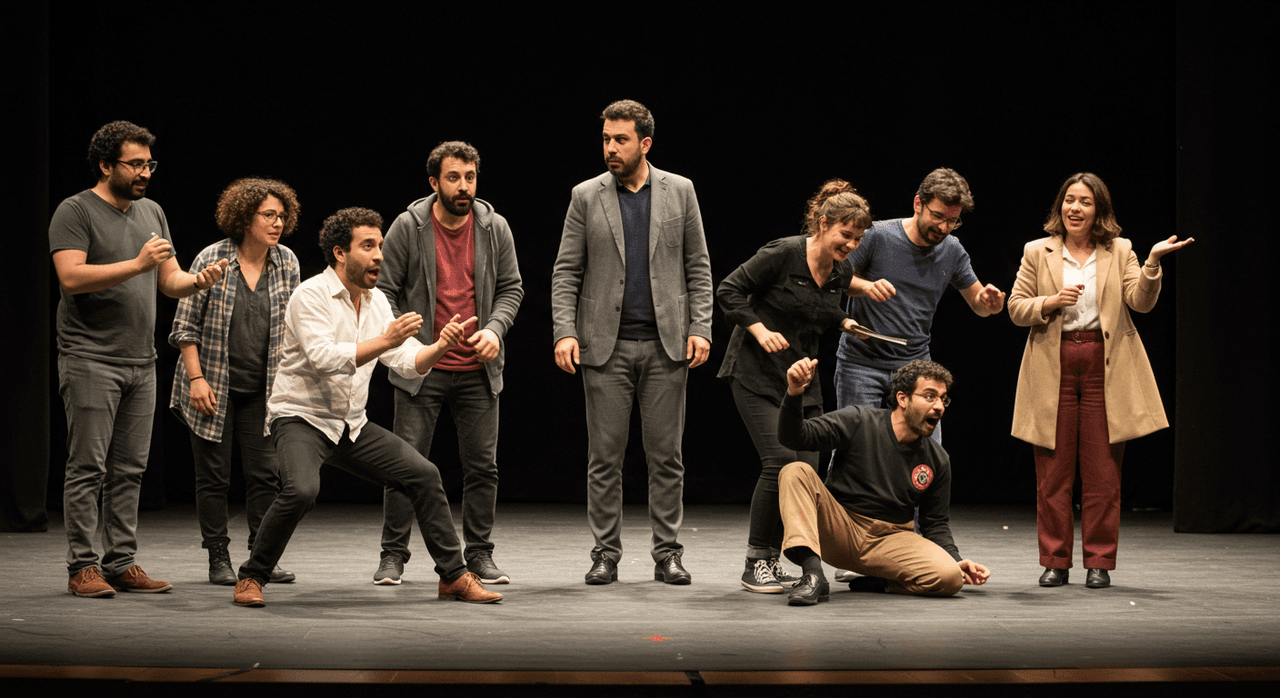
Improvisational Theatre - 1 (Generated by Artificial Intelligence)
Improvisational theatre is divided into different formats according to its staging style. These formats vary based on duration, structure, staging approach, and the degree of audience interaction. The most common categorization groups them into two main categories: short form and long form. In addition, alternative formats have been developed for specific social or pedagogical purposes.
Short-form improvisation consists of independent, brief scenes. These scenes are typically based on suggestions from the audience and are performed within specific game rules, often with a humorous tone. Each game has its own structural boundaries, which guide the actors’ abilities. For this reason, short form is one of the most popular types of improvisational theatre due to its entertaining and fast-paced nature. One of the best-known short-form examples in Turkey and worldwide is the “Theatresports” format developed in the second half of the 20th century.
Developed by Canadian theatre theorist and practitioner Keith Johnstone, this format presents improvisational theatre as a competitive structure. Actors are typically divided into two teams and perform short improvisational scenes based on ideas gathered from the audience. At the end of each round, the audience has the right to evaluate the performance and directly participate through scoring. The winning team is determined at the end of the show. This format has become one of the most well-known applications of improvisational theatre due to its enhanced audience interaction and the addition of a competitive element to the performance.
Long-form improvisation includes performances that are more continuous and develop from a single central idea. In this format, the performance usually begins with a single suggestion from the audience and proceeds without interruption to construct a more complex narrative structure. Actors deepen their characters throughout the scene, connect events to one another, and create a coherent unity by the end. Long form has greater potential for dramatic intensity and character development than short form. One of its best-known examples is the “Harold” technique developed by Del Close in the 1960s. The Harold format is based on connecting different scenes originating from a single thematic idea and concluding with a unified whole.
The scope of improvisational theatre is not limited to entertainment and dramatic performances. Various formats have been developed with social and educational functions. For instance, Brazilian theatre theorist Augusto Boal developed “Forum Theatre,” which does not leave the audience in a passive spectator role but actively encourages them to intervene on stage and engage in finding solutions to social issues. This format demonstrates how improvisation can serve as a political and pedagogical tool by granting the audience the opportunity to intervene in on-stage events and propose alternative solutions.
Improvisational theatre is not merely a performing art; it is also a powerful tool for personal development that helps individuals acquire skills applicable across various areas of life. Experiences gained on stage directly influence participants’ daily lives and professional activities after the performance ends. For this reason, improvisation has become a frequently used method in both individual and institutional education and development contexts.
Improvisational theatre encourages individuals to generate rapid and innovative solutions to unexpected situations. The spontaneous ideas developed by actors on stage enhance mental flexibility and strengthen problem-solving capacity. This skill enables a solution-oriented approach in professional settings, such as responding to an unexpected question during a meeting or handling a technical glitch during a presentation, instead of succumbing to panic.
The success of improvisation depends on actors’ attentive listening and understanding of their partner’s suggestions. This deep listening practice strengthens empathy and mutual understanding in interpersonal relationships outside the stage. Participants learn through improvisation to better grasp others’ perspectives and consider their interlocutors’ needs during communication processes.
The improvisational principle of “no mistakes, only opportunities” encourages individuals to experiment, take risks, and step outside their comfort zones. The freedom to express ideas on stage provides practice in public speaking and enhances overall self-confidence. This approach significantly contributes to overcoming stage fright.
Improvisational theatre is based on collective creation rather than individual performance. Trust among actors, mutual support, and shared responsibility for the stage are fundamental conditions for a successful performance. This experience is regarded as an important model that strengthens team spirit and enhances collaboration and the capacity to achieve shared goals in professional life.
Research has demonstrated tangible benefits of improvisational training in corporate environments. For example, one study reported that sales students who received improvisational training achieved 43 percent more ticket sales than the control group. This finding indicates that improvisational exercises develop critical business skills such as communication, persuasion, and rapid adaptability. Moreover, many companies have incorporated improvisational workshops into their human resources and leadership programs to enhance employees’ communication skills, creativity, and ability to think flexibly during crises.
In these respects, improvisational theatre transcends the realm of performing arts and has gained value as an innovative tool in both personal development and the professional world.

Improvisational Theatre - 2 (Generated by Artificial Intelligence)
Modern improvisational theatre gained visibility in Türkiye’s performing arts scene particularly from the 2000s onward and quickly reached a broad audience. The pioneering role in this field belongs to the Mahşer-i Cümbüş group, founded in 2001 by theatre students from the Department of Theatre at Ankara University’s Faculty of Language, History, and Geography. Mahşer-i Cümbüş is recognized as one of the first groups in Türkiye to systematically bring improvisational theatre to the stage. The group introduced the internationally widespread “Theatresports” format to Turkish audiences for the first time and, through the 2007 television program “Anında Görüntü Show,” expanded the reach of improvisation beyond the stage by introducing it to wider audiences via television. This initiative became one of the key turning points in increasing the visibility of improvisational theatre in Türkiye.
Following Mahşer-i Cümbüş’s lead, new improvisational theatre groups emerged in different cities and communities. Groups such as İstanbulimpro, AZOT, Tiyatrohane’s Doğaçhane team, Apartman Sahne, and Dilli Düdük began regularly performing across various improvisational formats, from short to long form. These groups’ stage practices have contributed to the diverse interpretation and development of improvisational theatre in Türkiye.
In particular, the Doğaçhane team has stood out for its innovative approaches to improvisational theatre. The group staged a performance titled “Herıld Yani,” blending Del Close’s long-form Harold technique with a 1990s theme, and has also experimented with artificial intelligence-assisted applications in improvisational performances. Such innovative initiatives demonstrate that improvisational theatre can evolve not only through traditional forms but also through interaction with contemporary technologies.
One of the key events sustaining the improvisational theatre culture in Türkiye is the Improvisational Theatre League. Organized by Beşiktaş Culture Center (BKM) Mutfak, this event brings together different groups who perform in a competitive format. The league provides both improvisational teams with opportunities for self-development and audiences with the chance to experience diverse improvisational styles.
Today, improvisational theatre regularly appears in independent stages, university theatre groups, workshop settings, and various festival events in Türkiye. Thus, improvisational theatre fulfills an active role not only as a form of entertainment but also in theatre pedagogy and community-building processes.
McLaughlin, J. A. “Radical Improvisation Part 1: The Liberation of the Individual.” *Comedy Studies* 13, no. 2 (2022): 175–185. https://doi.org/10.1080/2040610X.2022.2091733
Peter, Akpan. *History of Improv*. n.d. Accessed August 30, 2025. https://www.academia.edu/4302429/HISTORY_OF_IMPROV
Seppänen, Sirke, Kaisa Tiippana, Iiro Jääskeläinen, Olli Saari, and Tapio Toivanen. “Theater Improvisation Promoting Interpersonal Confidence of Student Teachers: A Controlled Intervention Study.” *EjSBS - Issue 1*, 5–25. Future Academy, 2019. https://doi.org/10.15405/ejsbs.2019.01.issue-1
West, Colin G. “Lessons for Instructor–Student Interactions in Physics from the World of Improvisational Theater.” *The Physics Teacher* 61, no. 4 (April 2023): 246–248. https://doi.org/10.1119/5.0076745

Improvisational Theatre (Generated with Artificial Intelligence)
Origin(s) | 16th-century Italy Commedia dell'Arte | ||||||||
|---|---|---|---|---|---|---|---|---|---|
Equivalent in Turkish Theatre | Tuluat, Orta Oyunu | ||||||||
Fundamental Principle | Yes, and... (Accept and add) | ||||||||
Key Skills | Listening, Teamwork, Risk Taking | ||||||||
Important Formats | Short Form (Theatre Sport), Long Form (Harold) | ||||||||
No Discussion Added Yet
Start discussion for "Improvisational Theater" article
History
Core Principles and Rules
“Yes, and...”
Make Your Partner Shine
No Mistakes, Only Gifts
Who, Where, When?
Improvisational Theatre Formats
Short Form
Theatresports
Long Form
Other Formats
Contributions to Personal and Professional Development
Problem Solving
Listening and Empathy
Risk-Taking and Self-Confidence
Teamwork
Applications in the Business World
Improvisational Theatre in Türkiye