


This article was automatically translated from the original Turkish version.
+4 More
Improvisation
Application Area(s) | Music Television Comedy Dance Drama Theatre | ||||||||
|---|---|---|---|---|---|---|---|---|---|
Basic Principle | Re-expressing an existing element from a different perspective | ||||||||
Instruments in Music | Chords and scale sequences | ||||||||
Improvisation is a form of expression that emerges without a pre-established plan, found in many branches of art and various aspects of everyday life. It is a fundamental component of performance arts such as music, theater, and drama. Improvisation is not merely about creating something entirely new; it is also a process of reinterpreting existing knowledge, skills, and structures from a different perspective and shaping them instantaneously. This act highlights the artist’s or participant’s creativity, ability to make spontaneous decisions, and interaction with their environment.
In its purest form, improvisation is the process of reinterpreting what already exists, reshaping it within a different context, and assigning it new meaning. This approach provides a rich foundation both aesthetically and intellectually. Like most artistic expressions, improvisation is not merely a technical skill but also an existential attitude. The act, which simultaneously engages the individual’s past experiences, intuitions, immediate emotional state, and environmental conditions, occurs in a unique way each time.
This concept can be more concretely examined in the context of music. A definition from Ferhat Çelikoğlu’s work Improvisation Theory captures the essence of improvisation: “What matters in improvisation is not saying something new, but saying something existing from a different perspective.”【1】 This statement reveals that improvisation is not merely spontaneous sound production or an unplanned sequence of movements, but rather a process of reconstruction in which past experiences are consciously or intuitively activated. Here, the aim is to transform and express existing motifs or themes without being bound rigidly to them, yet without severing their connection either.
In this sense, improvisation is situated not within a composition defined by fixed boundaries, but within a universe of possibilities. Even when it develops within a specific structure or form, no performance, movement, or utterance will ever be identical to the previous one, because the spirit of the moment, the atmosphere of the space, and the performer’s mental and physical state are constantly changing. In this context, improvisation is not the mechanical repetition of memorized patterns, but the conscious and flexible reorganization of those patterns. The forms, melodies, themes, or expressions in the artist’s repertoire are brought to the stage each time in a unique composition specific to that moment.
This process also involves cognitive and emotional competencies such as listening, perception, responsiveness, and immediate awareness, in addition to technical skills. Improvisation often focuses more on the process itself than on the resulting product. The artist’s conscious adaptation to the flow of the moment allows improvisation to be defined not merely as an aesthetic activity but as one of the forms of existence with a philosophical orientation.
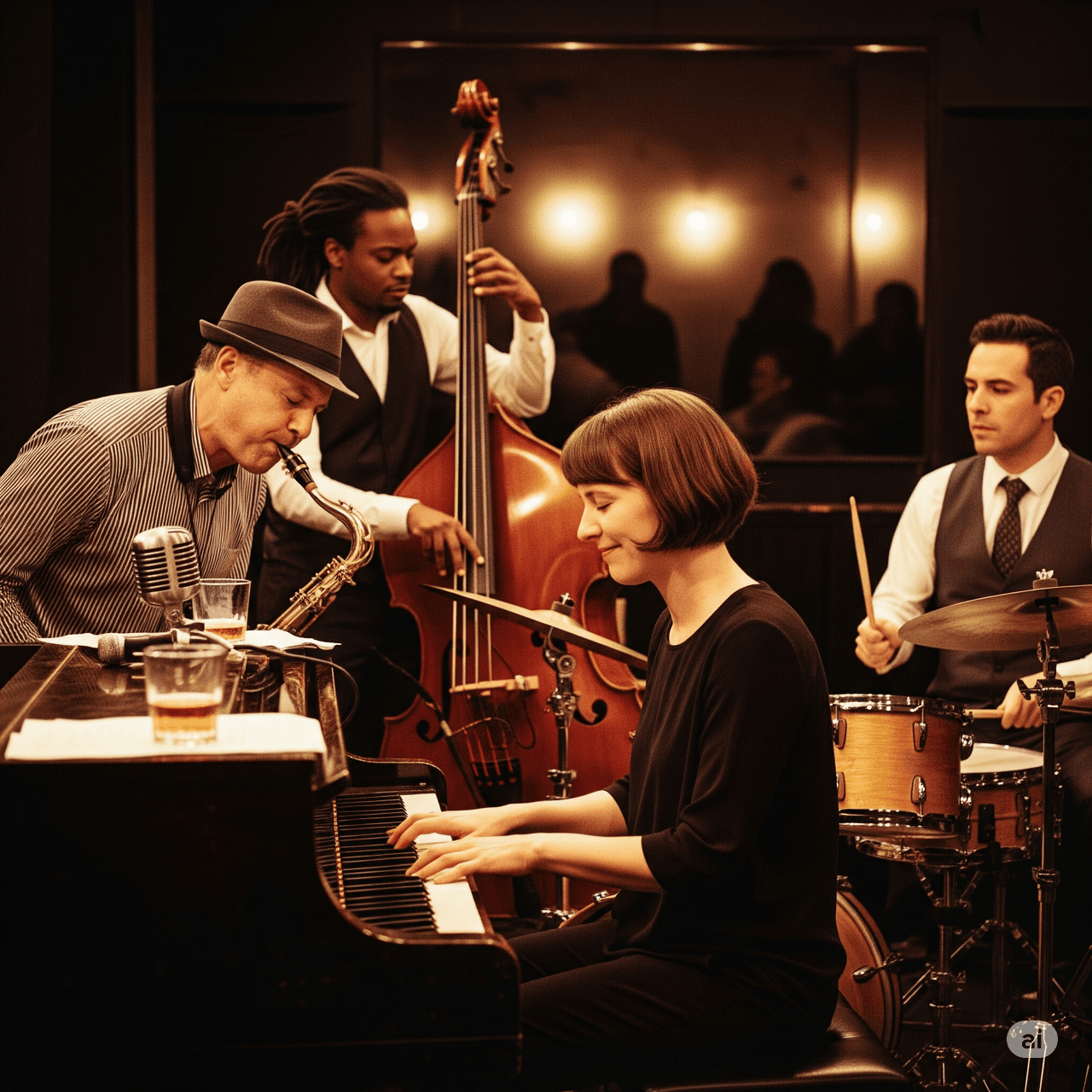
Music is among the foremost art forms in which improvisation manifests itself most naturally, vividly, and powerfully. This art form, limited in time but boundless in emotion, takes shape through the convergence of spontaneous decisions, inner intuition, and technical proficiency. In contemporary genres such as jazz, blues, and rock, as well as in traditional folk music, improvisation is not merely a supplementary element but often the central pillar that constitutes the essence of the work.
Musical improvisation consists of spontaneous musical expressions carried out within a specific harmonic structure, rhythmic pattern, or thematic framework. In this process, the musician translates their theoretical knowledge—such as scales, modes, arpeggio structures, and cadences—directly into the world of sound, without being bound to a predetermined sequence of notes. However, this translation is not mechanical; it is the product of an emotional, aesthetic, and intuitive process.
Yet the power of improvisation is not limited to technical proficiency alone. The decisive factor is the musician’s ability to capture the moment and imbue it with meaning. Musical improvisation is the outward expression of an emotion, thought, or internal association that has not been rehearsed beforehand. In this sense, it is both an individual mode of expression and a collective experience. Especially in collective improvisations, the musical dialogue established among musicians through attentive listening and immediate responses highlights the social dimension of improvisation.
This interaction also enables a strong bond to form between the audience and the performer. Each moment of improvisation is unique; it cannot be repeated and belongs solely to that instant. This imbues music with extraordinary vitality and dynamism. The spectator does not merely listen to a piece; they witness its very birth.

Musical Improvisation (Generated by Artificial Intelligence.)
Improvisation emerges as a vital tool, particularly in early childhood education and theater-based drama activities. These activities support children’s social-emotional, cognitive, and linguistic development while also fostering their imagination and ability to express themselves. The concepts of drama, play, and improvisation are closely interrelated in this context and typically enrich children’s active learning processes through integrated practices.
Improvisation activities used in education are generally structured in distinct stages. The first step consists of introductory and warming-up games that help participants establish connections with each other and the environment. This is followed by trust-building exercises and communication games that strengthen group cohesion and enhance interaction. The purpose of this preparatory phase is to facilitate children’s emotional and physical adaptation to the drama process. After these preparatory stages, improvisational enactments centered around specific themes are introduced. The themes chosen for such activities are typically selected to capture children’s interest, encourage participation, and support various developmental domains. Examples include:
These structured improvisation practices provide children with a safe framework to express themselves while simultaneously supporting essential skills such as decision-making, emotional recognition, and navigating within a community. The content of these activities can be adapted according to children’s age and developmental characteristics, making improvisation a flexible, inclusive, and effective learning tool.
Improvisation is not confined to educational settings or classical art forms; it has also found a significant place within the dynamic structure of popular culture. In particular, the relationship between improvisation and comedy in television and stage arts is striking. As a genre centered on spontaneous reactions, immediacy, and direct audience interaction, comedy is one of the fields that most effectively employs improvisational approaches.
The application of improvisation in television productions differs from traditional scripted formats. In such productions, actors are provided only with the general framework of the scene and the core characteristics of their characters. Dialogues, staging, and reactions are often shaped in real time through the actors’ intuitive guidance. This approach infuses the performance with vitality and naturalness, allowing viewers to experience a more intimate and authentic viewing experience in which the boundaries between actors and stage appear blurred.
One example of this practice in the Turkish television context is the episode titled “Improvisation” from the 2022 comedy series Var Bunlar. Directed by Gökdeniz Uslu and starring Giray Altınok and Kerem Özdoğan, this episode, as its title suggests, foregrounds improvisational techniques. The scenes are based on free performances shaped by the actors according to their understanding of the characters’ inner worlds and the unfolding dynamics of the scene, rather than adhering strictly to pre-written dialogues.
Such improvisation-focused television content also deepens the connection with the audience. The unpredictable flow of the script offers viewers an unforeseeable comedic experience and generates energy derived from the spontaneous nature of humor. Moreover, because improvisational productions directly showcase the actors’ talents and reflexes, they enhance the uniqueness of the performance.
In conclusion, improvisation continues to hold significance as an innovative narrative tool even in mass media such as television. Within popular culture, particularly through comedy, this approach blurs the boundaries between art and entertainment, enabling a closer and more intimate bond between the audience and the performance.
Bailey, Derek. Improvisation: Its Nature and Practice in Music. New York: Da Capo Press, 1993.
Bresnahan, Aili. “Improvisation in the Arts.” *Philosophy Compass* 10, no. 9 (2015): 573–582. Accessed August 2, 2025. https://doi.org/10.1111/phc3.12251
Larsson, Christina, and Eva Georgii-Hemming. “Improvisation in General Music Education – A Literature Review.” *British Journal of Music Education* 36, no. 1 (2019): 49–67. Accessed August 2, 2025. https://doi.org/10.1017/S026505171800013X
Lewis, George E. “Improvised Music after 1950: Afrological and Eurological Perspectives.” *Black Music Research Journal* 16, no. 1 (1996): 91–122. Accessed August 4, 2025. https://doi.org/10.2307/779379.
Lobman, Carrie. “‘Yes and’: The Uses of Improvisation for Early Childhood Professional Development.” *Journal of Early Childhood Teacher Education* 26, no. 3 (2005): 305–319. Accessed August 2, 2025. https://doi.org/10.1080/10901020500371353
Navarro Ramón, Laura, and Helena Chacón-López. “The Impact of Musical Improvisation on Children’s Creative Thinking.” *Thinking Skills and Creativity* 40 (2021): 100839. Accessed August 2, 2025. https://doi.org/10.1016/j.tsc.2021.100839
Nettl, Bruno. “Thoughts on Improvisation: A Comparative Approach.” *The Musical Quarterly* LX, no. 1 (1974): 1–19. Accessed August 2, 2025. https://doi.org/10.1093/mq/LX.1.1
Peters, Gary. The Philosophy of Improvisation. Chicago: University of Chicago Press, 2009.
Uslu, Arif Gökdeniz, dir. Var Bunlar. Türkiye: Z Medya, 2022.
Wilson, Samuel. “Listening to the Post-script: Intersections Between Improvisation and Indeterminacy in Music and Education.” *Postdigital Science and Education* 5 (2023): 359–385. Accessed August 2, 2025. https://doi.org/10.1007/s42438-022-00326-z
[1]
Ferhat Çelikoğlu, Doğaçlama Teorisi (Konya: Eğitim Yayınevi – Bilimsel Eserler, Temmuz 2021), s. 45.

Improvisation
Application Area(s) | Music Television Comedy Dance Drama Theatre | ||||||||
|---|---|---|---|---|---|---|---|---|---|
Basic Principle | Re-expressing an existing element from a different perspective | ||||||||
Instruments in Music | Chords and scale sequences | ||||||||
The Philosophy and Theoretical Framework of Improvisation
Improvisation in Music
Improvisation Through Drama in Education and Performing Arts
Improvisation in Popular Culture: A Television Example