


This article was automatically translated from the original Turkish version.
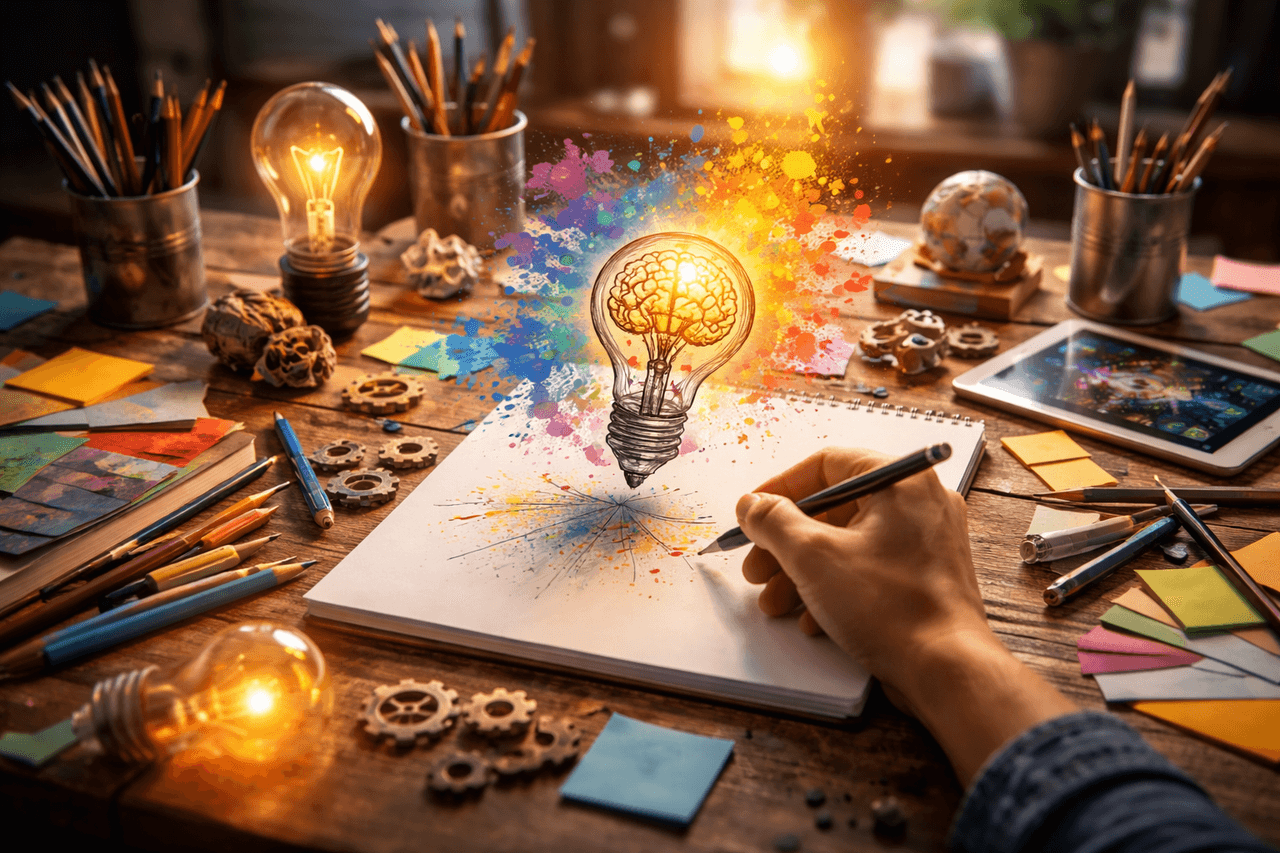
Creativity
(Generated with Artificial Intelligence)
Creativity
Basic Feature(s) | Elaboration Originality Flexibility Fluency | ||||||||
|---|---|---|---|---|---|---|---|---|---|
Related Areas | Industrial Design Education Technology Science Art | ||||||||
Lower Area | Higher-Order Thinking Skills | ||||||||
Upper Area | Cognitive Processes | ||||||||
Creativity is the ability to go beyond what exists by generating new and original ideas or approaching a known situation from an unconventional perspective. This concept refers to a mode of thinking that enables the evaluation of alternative possibilities and the development of diverse viewpoints. Creativity is associated with processes such as imagination, innovation, originality, and lateral thinking. In this process, individuals establish connections between ideas by demonstrating fluency and flexibility in thought, and by employing methods such as metaphor, analogy, and visualization.
Conceptually, creativity is a cognitive structure that generates alternative solutions through fundamental questions such as “what if,” “why,” and “how.” It involves stepping outside conventional patterns and considering different ways of seeing. In this sense, creativity is not limited to artistic production but also plays a vital role in solving scientific, technical, and everyday problems.
Cognitively, creativity aims to generate a wide range of ideas by thinking multidimensionally about a problem and then developing original solutions from among them. Neuroscientific research has shown that creativity and intelligence activate different regions of the brain during problem solving. At the core of creative thinking lies imagination, which allows individuals to view events “as if they could be otherwise.” During this process, the brain simultaneously integrates information, establishes connections, and questions existing conditions.

Creative Thinking Process
(Generated by Artificial Intelligence)
The relationship between intelligence and creativity has long been debated in psychology and educational sciences. While some researchers regard creativity as an independent construct from intelligence, others suggest a weak or moderate correlation between the two variables.
According to the “threshold theory,” above a certain level of intelligence, the relationship between creativity and intelligence weakens; however, this claim is not consistently supported by all studies. Various investigations have failed to find a significant correlation between IQ scores and levels of creativity. This suggests that individuals with different cognitive profiles may possess creative potential.
One of the defining characteristics of creative individuals is complexity. These individuals can simultaneously hold seemingly contradictory traits. For example, they may possess high energy yet remain calm, demonstrate discipline while exhibiting playful attitudes. The coexistence of opposing traits such as extroversion and introversion, tradition and innovation, or self-confidence and humility is a hallmark of creative personality structure. This holistic configuration emerges from the balancing of diverse extremes.
Creativity is one of the foundational building blocks of innovation (the process of implementing novelty). Creative thinking enables the emergence of original and distinct ideas, while innovation refers to transforming these ideas into concrete, applicable, and value-creating solutions. In other words, creativity “generates ideas,” and innovation “implements them.”
Several techniques systematically support creative thinking:
1. Brainstorming: A technique that encourages participants to generate as many ideas as possible without fear of judgment. The core principle is to avoid criticism in the initial stage and to maximize quantity, thereby increasing the likelihood of unconventional and original ideas emerging.
2. Reverse Brainstorming: Instead of asking “How can we solve this?” this method asks “How can we make this problem worse?” The goal is to anticipate potential errors and obstacles in order to strengthen possible solutions.
3. SCAMPER Technique: A creative thinking model based on questioning a problem or product from multiple angles. It is composed of the initial letters of English verbs:

Characteristics of Creative Individuals
(Generated by Artificial Intelligence)
This model provides an effective framework particularly for product development and process improvement initiatives.
4. Five Whys Method: Aims to move beyond the apparent cause of a problem to identify its root cause. The question “Why?” is asked at least five times in succession about the same issue. This technique facilitates the development of lasting solutions that target the fundamental problem rather than superficial symptoms.
5. Analogical Thinking: An approach to solving a problem by drawing parallels with a different domain. Examples drawn from nature, engineering, or social systems help generate new perspectives. It is especially effective in interdisciplinary innovation processes.
6. Six Thinking Hats: A method for evaluating a problem through six distinct perspectives representing different modes of thinking. Separately addressing logical, emotional, critical, optimistic, creative, and process-oriented viewpoints enhances cognitive flexibility and enables multidimensional analysis.
For creativity to develop sustainably, environments that are safe, supportive, and encourage constructive criticism are of great importance. Cultures that foster diverse perspectives, permit mistakes, and value cognitive diversity provide the essential foundation for nurturing both creative thinking and innovation.
Creativity is recognized as one of the core competencies in the evolving world of work in the 21st century. With the widespread adoption of digitalization, automation, and artificial intelligence, many routine and repetitive job domains are transforming; in contrast, professions requiring problem solving, innovation, and original thinking are gaining importance. In this context, creativity is no longer merely a concept tied to artistic production but has become a strategic element of economic and social development.
The jobs of the future require interdisciplinary thinking, the ability to analyze complex problems, and the capacity to design novel solutions. Individuals working in fields such as artificial intelligence development, data science, sustainable energy system design, biotechnology, space technologies, digital content creation, and experience design are expected not only to possess technical knowledge but also to bring a creative perspective. Progress in these fields is possible not through repeating existing knowledge but through reconfiguring it and integrating it across different contexts.
Creativity plays a decisive role especially in the following professional areas:
In the future workplace, creativity is evaluated alongside skills such as critical thinking, collaboration, communication, and digital literacy. International reports identify creative thinking, problem solving, and adaptability as key indicators of employability.
Beyond serving as a competitive advantage in future professions, creativity is a prerequisite for adapting to a changing world. As technological advances transform the nature of human labor, the ability to generate original ideas and foster innovation remains a defining human strength.
Early childhood is a critical developmental stage during which the foundations of creativity are laid. This period involves rapid development of cognitive flexibility, imagination, and symbolic thinking. Learning experiences provided during preschool and early elementary years can influence the direction and level of a child’s creative potential.
Fostering creativity in early education is not limited to artistic activities. Open-ended questions, exploration-based learning environments, and problem-centered activities support creative thinking. Offering children multiple possible solutions rather than a single correct answer enhances cognitive flexibility. Play-based learning is recognized as one of the natural tools for the development of creativity.【1】
The teacher’s role should be facilitative rather than directive. Overly structured environments that do not tolerate mistakes can inhibit creative expression. In contrast, classroom climates that ensure psychological safety and allow ideas to be expressed without judgment increase creative participation. Constructive feedback supports children’s courage to generate original ideas.
Early childhood creativity education is strengthened through interdisciplinary approaches. Integrating art, science, mathematics, and language activities enables children to make connections across domains. This approach supports not only aesthetic production but also analytical and critical thinking skills.
Research shows that creative skills supported in early years are linked to problem-solving capacity, academic achievement, and a tendency toward innovation in later life. Therefore, incorporating curiosity, questioning, exploration, and trial-and-error processes into early childhood education programs is essential for the sustainable development of creativity.
Developing creativity in early childhood not only helps uncover individual potential but also lays the groundwork for nurturing individuals capable of adapting to changing social and technological conditions.
Baloğlu, Arzu. *Yaratıcı Beynin Gizemi: Devrim Yaratan Dâhi Beyinler.* Nobel Akademik Yayıncılık. Accessed February 20, 2026. https://www.nobelyayin.com/e_tanitim/yaratici_beyin_jen_131129.pdf
Dinçeli, Duygu. “Yaratıcılık ve Sanat.” *Sanat Eğitimi Dergisi* 8, no. 1 (March 2020): 43–55. Accessed February 20, 2026. https://www.sanategitimidergisi.com/makale/pdf/1586514895.pdf
Miro. "Beyin fırtınası nedir? Teknikler ve yöntemler." Accessed February 20, 2026. https://miro.com/tr/brainstorming/what-is-brainstorming/
Ogurlu, Üzeyir. “Çocuklarda Zekâ ve Yaratıcılık İlişkisi.” *Mustafa Kemal Üniversitesi Sosyal Bilimler Enstitüsü Dergisi.* Accessed February 20, 2026. https://dergipark.org.tr/en/download/article-file/183376
Yeşilyurt, Etem. “Yaratıcılık ve Yaratıcı Düşünme: Tüm Boyut ve Paydaşlarıyla Kapsayıcı Bir Derleme Çalışması.” *OPUS © Uluslararası Toplum Araştırmaları Dergisi-International Journal of Society Researches* 15, no. 25 (May 2020): 1–42. Accessed February 20, 2026. https://dergipark.org.tr/en/download/article-file/1083219
[1]
Üzeyir Ogurlu, “The Relationship Between Intelligence and Creativity in Children,” Mustafa Kemal University Journal of Social Sciences Institute, accessed 20 February 2026, https://dergipark.org.tr/en/download/article-file/183376

Creativity
(Generated with Artificial Intelligence)
Creativity
Basic Feature(s) | Elaboration Originality Flexibility Fluency | ||||||||
|---|---|---|---|---|---|---|---|---|---|
Related Areas | Industrial Design Education Technology Science Art | ||||||||
Lower Area | Higher-Order Thinking Skills | ||||||||
Upper Area | Cognitive Processes | ||||||||
Conceptual Framework
Cognitive and Neurological Foundations
Creativity and Intelligence
Characteristics of Creative Individuals
Creative Thinking Techniques
Creativity and the Jobs of the Future
Developing Creativity in Early Childhood