This article was automatically translated from the original Turkish version.
+2 More
Location | Ilgaz (Çankırı) Çankırı–Kastamonu Road | ||||||||
|---|---|---|---|---|---|---|---|---|---|
Period(s) | Hellenistic Early Christianity | ||||||||
Structure(s) | Rock Tombs Chapels Caves | ||||||||
Feature(s) | Barrel-vaulted and Niche Rooms | ||||||||
Function(s) | Burial and Worship Area | ||||||||
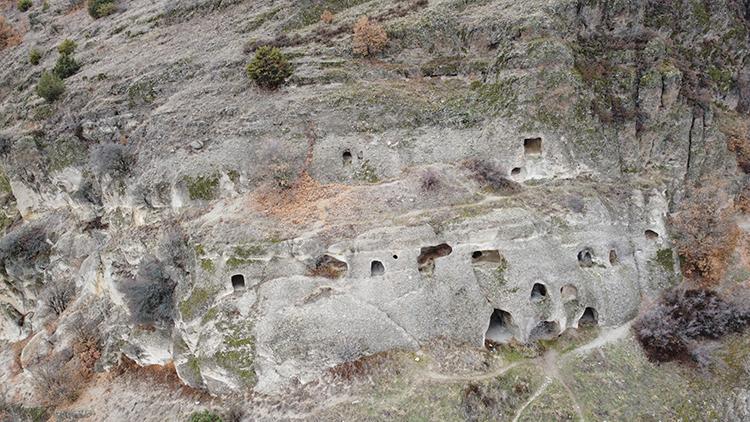
İndağı rock tombs constitute a settlement and sacred site located along the Çankırı-Kastamonu highway within the boundaries of Ilgaz district in Çankırı, with origins extending back to the Hellenistic period. Situated on the eastern slopes of a rocky, elevated hill south of the Devrez Çayı, the area features human-carved caves, rock tombs, chapels, spaces interpreted as temples, and indentations whose functions remain uncertain. The site was used during the early Christian period for worship and burial purposes and contains artifacts from the Roman and Byzantine eras alongside traces of settlement from much earlier periods.

İndağı Rock Tombs (Culture Portal)
Although the İndağı rock settlement is dated to the Hellenistic period, pottery fragments discovered in nearby mounds indicate that the region’s use extends to even earlier times. The dense concentration of Roman and Byzantine-era finds around Salman Höyüğü reveals the continuity of settlement and the long-term cultural stratification of the area.
Another element of the region’s historical significance is its location along the İstiklal Yolu and its former position on ancient caravan routes. The positioning of the rock structures is associated with the need to protect caravans from attacks, particularly at steep passes, and with their use for sacred purposes. During the early Christian period, it has been determined that individuals carved small chapels and places of worship directly into the rock to avoid communal worship during times of persecution. The site is documented as having been actively used between 310 and 320 CE.
İndağı rock tombs exhibit a multi-layered rock architecture bearing traces of different periods. The area contains rock tombs rising up to five levels and complex multi-chambered cave systems. The structures were carved into the tuff rock formation.
Some caves feature cradle vault ceilings and semer roof forms. The architectural characteristics of the structure interpreted as a rock church reveal the site’s religious use during the Late Roman–Early Byzantine period.

İndağı Rock Tombs (Anadolu Agency)
The site is assessed as a multifunctional complex. The presence of rock tombs, temples, chapels, and niches indicates its use as a burial, worship, and ritual space. The tomb chambers and niches support the theory that important individuals were interred in the rock-cut tombs. The units identified as temples are believed to have served both for sacred ceremonies and as places of prayer for travelers’ safety.
It is hypothesized that the sacred area may have been connected to the nearby mound and integrated with the older settlement surrounding it. The chapels and places of worship carved into the rock during the early Christian period reinforced the site’s religious identity.
The İndağı rock tombs are located immediately beside the Çankırı-Kastamonu highway, in the southeast of Ilgaz district, near the banks of the Devrez Çayı. Due to its position at the intersection of the Çankırı-Kastamonu and İstanbul-Samsun routes, the site is easily accessible.
In 2000, a road was constructed and asphalted to improve access to the site, and landscaping and lighting works were carried out. Following these improvements, the area began attracting visitors and has drawn interest from history enthusiasts and nature lovers alike. While climbing the slopes is challenging in places, the site offers panoramic views. Due to its natural environment and multi-layered cultural fabric, the region is included in historical, archaeological, and trekking routes.
Anadolu Ajansı. “Çankırı’daki İndağı Kaya Mezarları tarih ve doğa meraklılarının ilgisini çekiyor.” Accessed December 30, 2025. https://www.aa.com.tr/tr/kultur/cankiridaki-indagi-kaya-mezarlari-tarih-ve-doga-meraklilarinin-ilgisini-cekiyor/3783644
Ilgaz Municipality. "Ilgaz Tarihi Yerleri." Ilgaz Belediyesi Resmî Web Sitesi. Accessed December 30, 2025. https://www.ilgaz.bel.tr/%C4%B0l%C3%A7emiz/TarihiYerleri/tabid/18696/Default.aspx
Kunt, Sinem. "İndağı Kaya Mezarları." Türkiye Turizm Ansiklopedisi. 2019. Accessed December 30, 2025.
T.C. Kültür ve Turizm Bakanlığı. "Müzeler ve Örenyerleri (Çankırı)." T.C. Kültür ve Turizm Bakanlığı. Accessed December 30, 2025.
Türkiye Kültür Portalı. "İndağı Kaya Mezarları." T.C. Kültür ve Turizm Bakanlığı. Accessed December 30, 2025.
Çankırı Belediyesi. "İndağı Kaya Mezarları." Çankırı Municipality Official Website. Accessed December 30, 2024. https://cankiri.bel.tr/tarihi-merkez/indagi-kaya-mezarlari/10


Location | Ilgaz (Çankırı) Çankırı–Kastamonu Road | ||||||||
|---|---|---|---|---|---|---|---|---|---|
Period(s) | Hellenistic Early Christianity | ||||||||
Structure(s) | Rock Tombs Chapels Caves | ||||||||
Feature(s) | Barrel-vaulted and Niche Rooms | ||||||||
Function(s) | Burial and Worship Area | ||||||||
Historical Background
Architectural Features
Function and Sacred Character
Access and Tourism