

This article was automatically translated from the original Turkish version.
+1 More
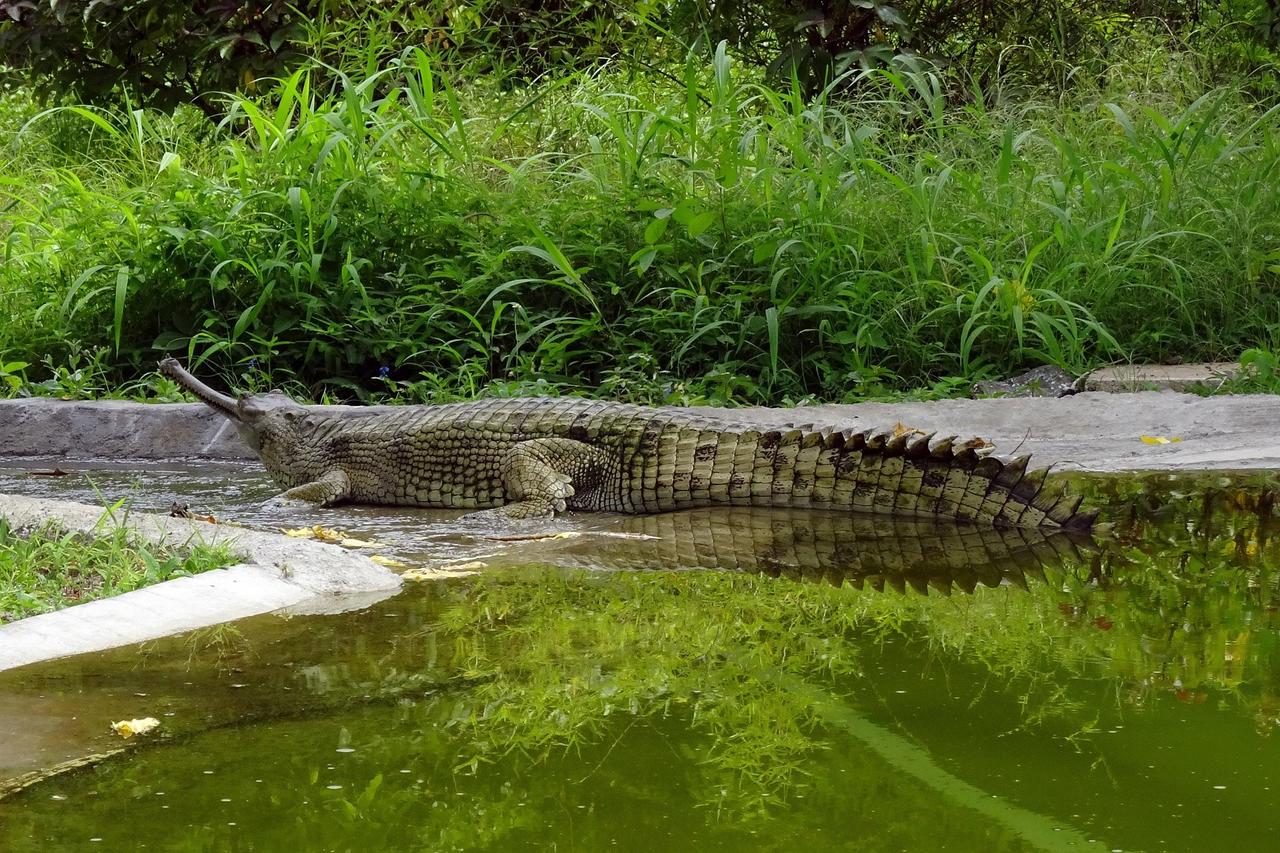
The Indian gharial, Gavialis gangeticus, is the only living representative of the family Gavialidae within the order Crocodylia of the class Reptilia. First scientifically described by Gmelin in 1789, this species is also known as the fish-eating crocodile, long-snouted crocodile, or simply gharial. Endemic to the Indian subcontinent, the gharial is distinctly distinguished from other crocodile species by its exceptionally long and slender snout. Although morphologically recognized as the sole surviving member of the family Gavialidae, recent molecular studies have provided evidence suggesting that the false gharial, Tomistoma schlegelii, may also belong to this family.
The Indian gharial is one of the largest crocodile species in the world and exhibits pronounced sexual dimorphism. Adult males typically reach lengths of 5 to 6 meters, with rare individuals exceeding 6.5 meters; females are smaller, reaching approximately 4 meters in length. Adult body weight averages around 160 kg.【1】 Physically, adult individuals have dark brown or greenish-brown upper bodies and undersides ranging from yellowish-white to white. Dark banding on the bodies and tails of juveniles tends to fade as they mature. Their jaws contain 106 to 110 razor-sharp teeth specialized for catching fish. Males possess a bulbous, cartilaginous structure at the tip of the snout called a ghara, which means "clay pot" in Hindi; this organ functions as a visual display signal during courtship, a sound resonator, and a mechanism for producing bubbles underwater. Gharials lack sufficiently strong leg muscles to lift their bodies off the ground, so they move on land by sliding on their bellies, making them among the most aquatic-dependent of all crocodile species.
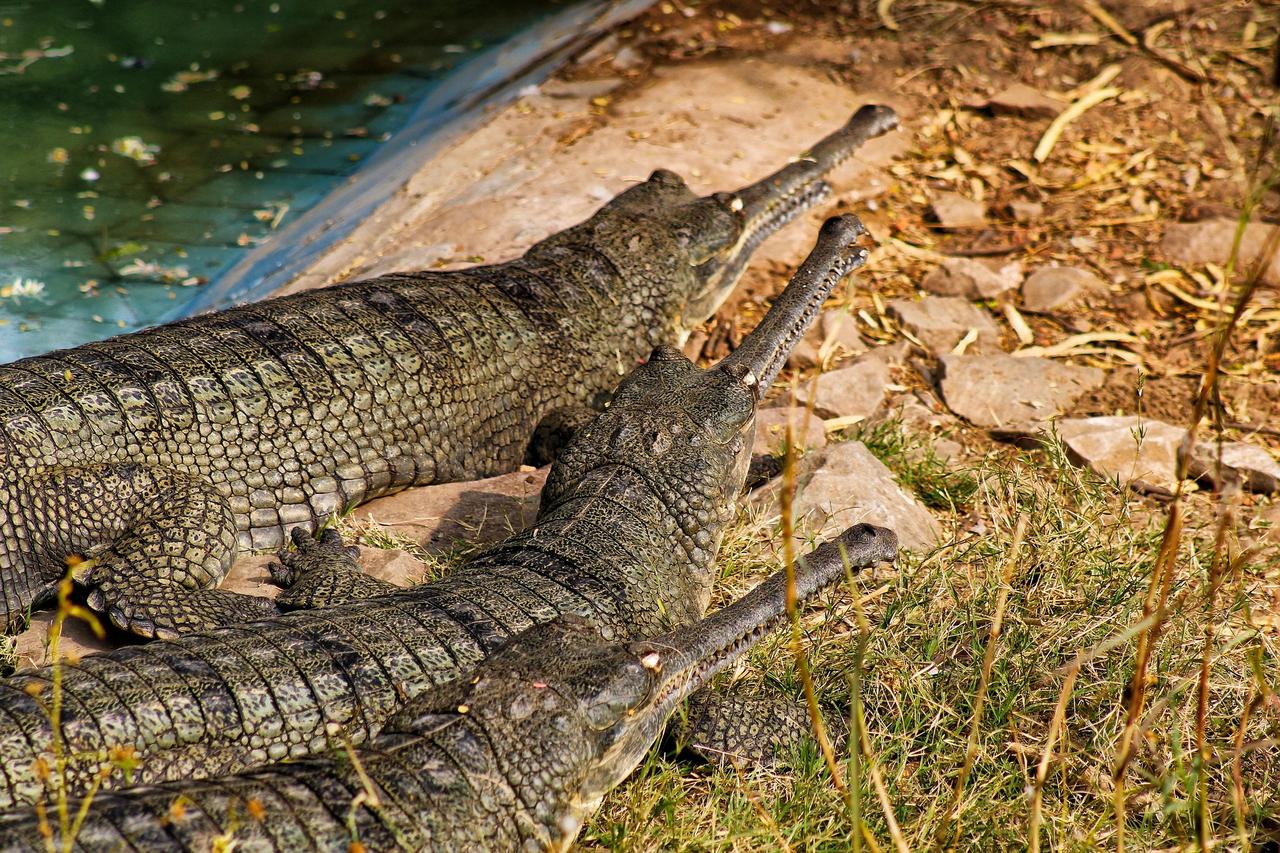
Indian Gharial (Pixabay)
Historically, the species had a wide distribution across the northern Indian subcontinent in the Indus, Ganges, Mahanadi, and Brahmaputra river systems. Today, it has been extirpated from approximately 95% of this range. Current populations persist in isolated groups within specific river systems in India and Nepal, such as the Chambal, Girwa, Rapti, and Gandak rivers. It is considered extinct in Pakistan, Bhutan, Myanmar, and Bangladesh. Gharials inhabit deep, fast-flowing, clear freshwater rivers. Due to their limited terrestrial mobility, they emerge from water primarily to bask in the sun and construct nests on sandy banks. During winter months, they prefer sandy mid-river shoals for thermoregulation, while juveniles utilize calmer side channels or small streams.
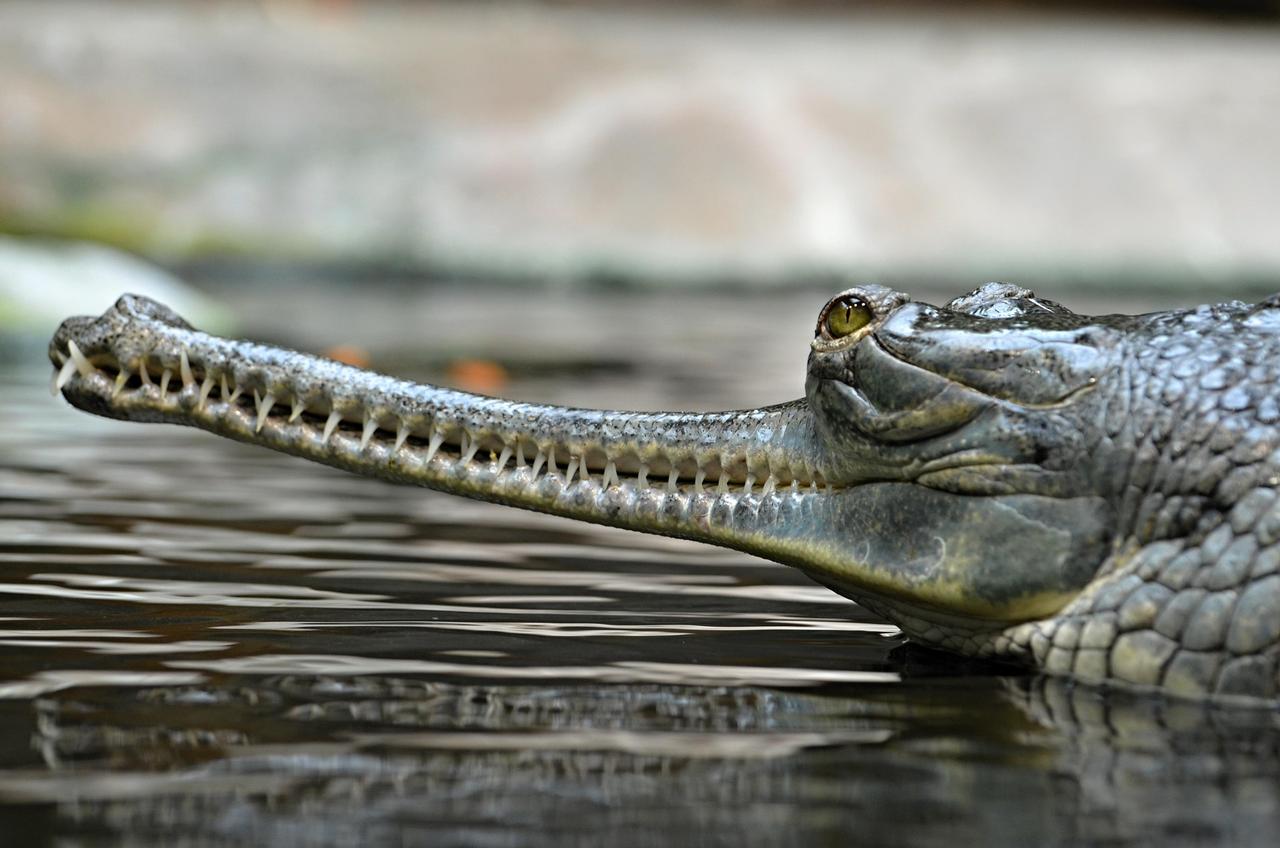
Indian Gharial Habitat (Pixabay)
The diet of the Indian gharial varies with age and size. Juveniles feed on small animals such as insects, crustaceans, and frogs. As they mature and their snouts become longer and more slender, they shift almost entirely to a fish-based diet. They employ three primary hunting strategies: remaining motionless underwater to ambush prey, detecting water vibrations through sensory organs in their scales, and executing rapid underwater strikes enabled by their slender jaws that create minimal water resistance. Due to the unsuitability of their teeth and jaw structure for attacking large mammals, gharials are not considered dangerous to humans.
Gharials breed once annually, typically during the dry season between November and February. Males attract females through vocalizations produced via the ghara, jaw-slapping on the water surface, and bubble-blowing underwater. Females dig nests approximately 50 cm deep into steep sandy riverbanks between March and May, laying 28 to 60 large eggs. The sex of the hatchlings is determined by incubation temperature. After an incubation period of about 60 to 80 days, the hatchlings emerge measuring approximately 18 cm in length. Females guard the nests and assist hatchlings in emerging from the eggs; the young remain in large groups under maternal care for several weeks. Females reach sexual maturity at approximately 8 years of age, while males mature at around 15 years.【2】
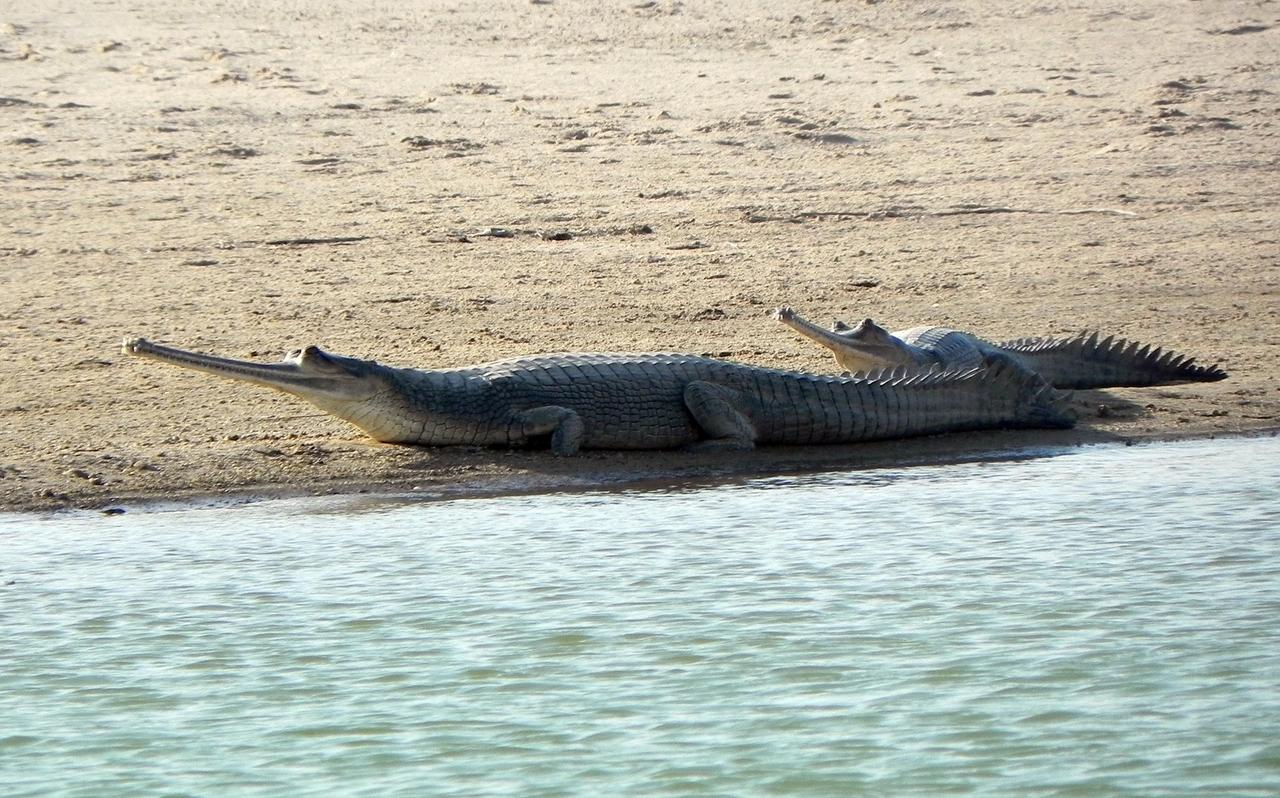
Indian Gharial and Hatchling(Pixabay)
The Indian gharial is listed as Critically Endangered on the IUCN Red List. Its population has declined by more than 80% since the 1940s, with current estimates suggesting only 300 to 900 adult individuals remain in the wild. Major threats include fragmentation of river ecosystems due to dam and weir construction, water extraction for agriculture and industry, sand mining along riverbanks, and accidental drowning in fishing nets. Additionally, the collection of eggs for food or medicinal purposes and the hunting of males for their ghara organs further increase population pressure. Conservation efforts include "head-starting" programs, in which eggs collected from wild nests are incubated in captivity and hatchlings are later released into the wild. The National Chambal Sanctuary in India serves as a critical refuge, hosting 77% of the global gharial population.
Bouchard, K. "Gavialis gangeticus." 2009. Animal Diversity Web. Accessed March 22, 2026. https://animaldiversity.org/accounts/Gavialis_gangeticus/
Lang, Jeffrey. "Gavialis gangeticus, Gharial." *The IUCN Red List of Threatened Species*. 2019. Accessed March 22, 2026. https://www.researchgate.net/publication/332246739_Gavialis_gangeticus_Gharial_THE_IUCN_RED_LIST_OF_THREATENED_SPECIES
Pixabay. "gharial balık yiyen timsah." Accessed March 22, 2026. https://pixabay.com/tr/photos/gharial-bal%c4%b1k-yiyen-timsah-7745720/
Pixabay. "gharial sürüngen hayvan gavial." Accessed March 22, 2026. https://pixabay.com/tr/photos/gharial-s%c3%bcr%c3%bcngen-hayvan-gavial-5656579/
Sarangi, Bishnu. "gharial gavialis gangeticus gavial." *Pixabay*. Accessed March 22, 2026. https://pixabay.com/tr/photos/gharial-gavialis-gangeticus-gavial-2658733/
Sarangi, Bishnu. "gharial timsah chambal river." Pixabay. Accessed March 22, 2026. https://pixabay.com/tr/photos/gharial-timsah-chambal-river-4883132/
Saurabh, U. "gharial balık yiyen timsahlar." Pixabay. Accessed March 22, 2026. https://pixabay.com/tr/photos/gharial-bal%c4%b1k-yiyen-timsahlar-7745715/
Stevenson, Colin and Romulus Whitaker. "Gharial Gavialis gangeticus." 2010. Accessed March 22, 2026. https://www.academia.edu/72338999/Gharial_Gavialis_gangeticus
Vashistha, Gaurav, Vivek Ranjan, Devvrat Singh, Shantanu S. Ugemuge, Akash Deep Badhawan, and Pulkit Gupta. "Hindistan'ın Yukarı Ghaghara Nehri'nde Kritik Tehlike Altındaki Gharial Gavialis gangeticus'un Durumu ve Girwa-Ghaghara Nehirlerinde Korunması." Oryx 58, no. 3 (2024): 336–39. Accessed March 22, 2026. https://doi.org/10.1017/S0030605323001485
Yadav, R. K., S. Lamichhane, D. R. Thanet, T. Rayamajhi, S. Bhattarai, A. Bashyal, and B. R. Lamichhane. "Gharial (Gavialis gangeticus, Gmelin, 1789) Abundance in the Rapti River, Chitwan National Park, Nepal." Ecology and Evolution 12, no. 10 (2022): e9425. Accessed March 22, 2026. https://doi.org/10.1002/ece3.9425
[1]
K. Bouchard, "Gavialis gangeticus," Animal Diversity Web, 2009, access date: 22 March 2026, https://animaldiversity.org/accounts/Gavialis_gangeticus/
[2]
K. Bouchard, "Gavialis gangeticus," Animal Diversity Web, 2009, access date: 22 March 2026, https://animaldiversity.org/accounts/Gavialis_gangeticus/

No Discussion Added Yet
Start discussion for "Indian Gharial (Gavialis gangeticus)" article
Morphological Features and Physiological Adaptations
Geographic Distribution and Habitat Preferences
Feeding Habits and Hunting Strategies
Reproductive Biology and Parental Care
Conservation Status and Anthropogenic Threats