


This article was automatically translated from the original Turkish version.
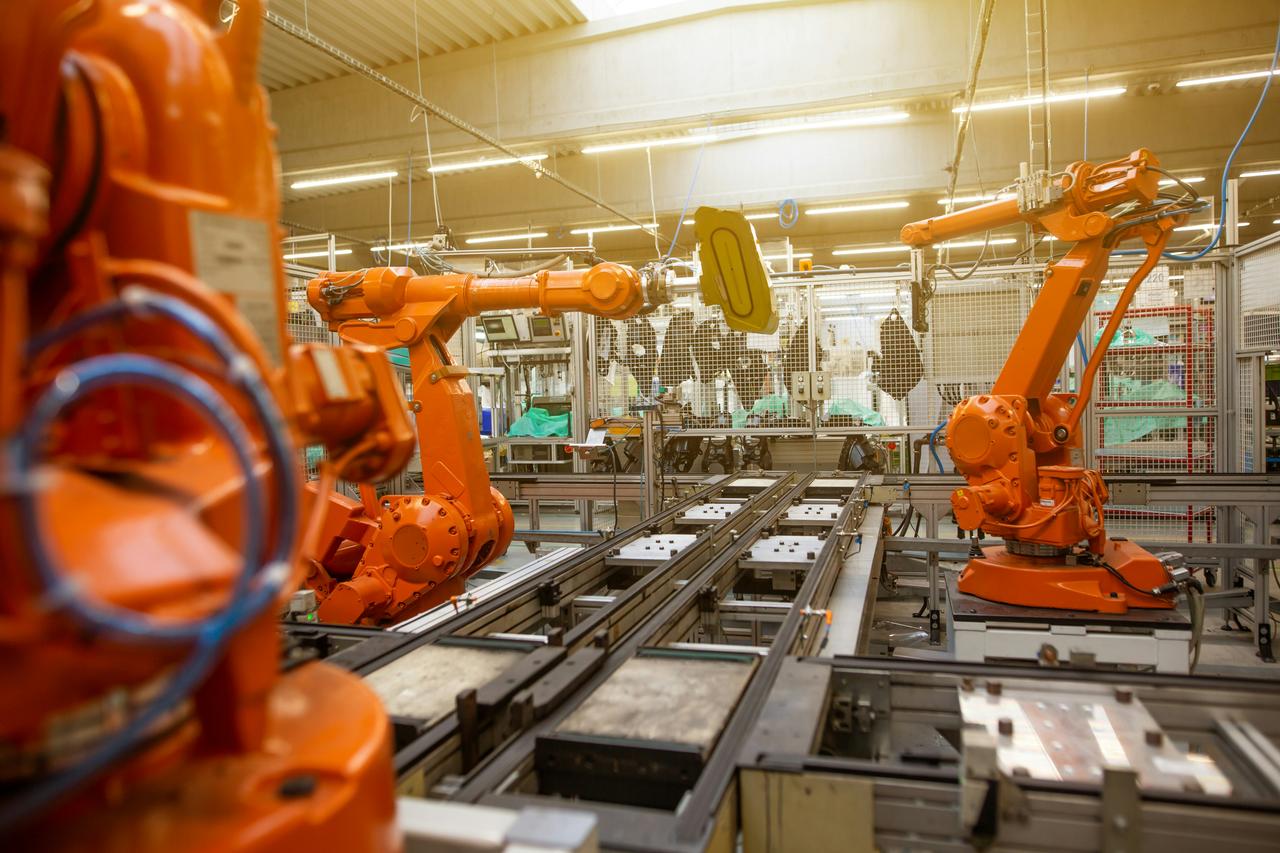
Industrial Robot
Definition(s) | Automated programmable production robot | ||||||||
|---|---|---|---|---|---|---|---|---|---|
First Use | 1961 – General Motors (Unimate) | ||||||||
Application Area(s) | Automotive construction food metal electronics | ||||||||
Robot Types | Cobot, autonomous, SCARA, Cartesian, delta | ||||||||
Technological Components | Sensor, software, IoT, artificial intelligence, control unit | ||||||||
An industrial robot is typically an automated, programmable, multi-axis machine system designed to perform various tasks in production environments. The term “robot” is derived from the Slavic word “robota,” meaning “forced labor” or “drudgery.” The modern usage of the word “robot” was first introduced in 1921 in Karel Čapek’s play R.U.R. – Rossum’s Universal Robots. Technically, the first industrial robot was the Unimate, which began operation in a General Motors factory in 1961.
The development of robot technologies has followed a trajectory parallel to the progression of industrial revolutions. The first industrial revolution introduced mechanical production systems, the second integrated electricity, and the third incorporated digital technologies; the fourth industrial revolution, known as Industry 4.0, has enabled robots to operate autonomously. In this evolutionary process, robots equipped with technologies such as sensors, artificial intelligence, the Internet of Things (IoT), and cloud computing have become particularly prominent.
With Industry 4.0, production processes have become more flexible, interconnected, and intelligent. Industrial robots at the center of this transformation are endowed with capabilities such as data collection, decision-making, learning, and collaboration. Production lines now possess not only mechanical but also digital and autonomous characteristics. Collaborative robots provide flexibility in production by working safely alongside humans in shared environments.
Robots are generally categorized into the following types:
This diversity enables solutions tailored to usage scenarios across different sectors.

Image of a humanoid robot (
Industrial robots are most commonly used in the automotive, electronics, metal, plastic, and food sectors. Typical applications include welding, assembly, material handling, painting, cutting, and quality control. Thanks to their high repeatability and operational speed, they reduce labor costs, improve quality, and increase productivity.

Image of a welding robot (
Collaborative robots (cobots) enhance production flexibility by safely sharing workspaces with operators. Autonomous robots, on the other hand, can perform tasks independently by perceiving their environment and making decisions. These robots offer significant opportunities in complex and high-risk environments such as construction.
An industrial robot system consists of the following key components:
The integration of these components enables robots to perform precise, repeatable, and safe operations.

Industrial robot arm (
Industrial robots can be controlled using open-source systems such as ROS (Robot Operating System). These systems provide flexibility in defining parameters such as position, speed, and task planning for robots. Modern industrial robots can be programmed via graphical interfaces, process sensor data, and integrate with production networks.
The safety of industrial robots is ensured through both software and hardware measures. Systems such as light curtains, emergency stop buttons, and area monitoring prevent potential accidents. In collaborative robots, force and torque sensors play a critical role by enabling the robot to stop immediately upon contact.
Industrial robots have become indispensable components in production processes, enhancing flexibility and efficiency. Next-generation robots supported by artificial intelligence, big data, and machine learning will become increasingly widespread in both manufacturing and service sectors. In developing countries such as Türkiye, increased R&D and technology investments are expected to further expand the adoption of industrial robots.
According to data from the International Federation of Robotics (IFR), the global number of operational industrial robots reached 4,282,000 in 2023, representing a 9.7% increase compared to 2022. In the same year, 541,302 new industrial robots were installed worldwide, the second-highest annual installation figure in history.
Regionally, in 2023, 70% of newly deployed robots were located in Asia, 17% in Europe, and 10% in the Americas. China remains the world’s largest market for industrial robots, with 276,300 installations in 2023.
In Türkiye, the number of newly installed robots in 2023 increased by 15% compared to the previous year, reaching 4,429. The total number of operational industrial robots in the country rose by 16% compared to 2022, reaching 26,413. With these figures, Türkiye ranks as the 16th country globally in terms of total robot stock. However, robot density in Türkiye’s manufacturing industry remains relatively low at 43 robots per 10,000 employees.
The IFR anticipates that advancements in generative AI, robot performance, and applicability will drive further growth in robot numbers. Additionally, demographic shifts leading to labor shortages are expected to increase demand for robots.
Accessed November 26, 2025.
Anadolu Ajansı. “Endüstriyel Robotların Sayısı Teknolojik Gelişmelerle Hızla Artıyor.” *AA*, November 3, 2023. https://www.aa.com.tr/tr/bilim-teknoloji/endustriyel-robotlarin-sayisi-teknolojik-gelismelerle-hizla-artiyor/3362350.
Dilibal, S., and H. Şahin. "İşbirlikçi Endüstriyel Robotlar ve Dijital Endüstri." International Journal of 3D Printing Technologies and Digital Industry 2, no. 1 (2018): 86–95.
Endüstriyel Robotların Kullanımı ve Programlanması. Eğitsel Yayın, 2022.
Köse, Abdullah. Endüstriyel Robot Kol Geliştirilmesi ve Prototipinin Üretilmesi. Master's thesis, Pamukkale Üniversitesi, 2023.
Özmen, Emine Fulya, Çağatay Takva, Sariye Aslan, and Zeynep Yeşim İlerisoy. "Endüstri 4.0 ve Bina Üretim Sektöründe Yeni Aktör: Robotik Sistemler ve Otonom Robotlar." Modular Journal 7, no. 1–2 (2024): 160–180.

Industrial Robot
Definition(s) | Automated programmable production robot | ||||||||
|---|---|---|---|---|---|---|---|---|---|
First Use | 1961 – General Motors (Unimate) | ||||||||
Application Area(s) | Automotive construction food metal electronics | ||||||||
Robot Types | Cobot, autonomous, SCARA, Cartesian, delta | ||||||||
Technological Components | Sensor, software, IoT, artificial intelligence, control unit | ||||||||
Historical Development and Its Relationship with Industrial Revolutions
The Role of Robots in Industry 4.0 and Digitalization
Classification and Types of Robots
Applications and Sectoral Distribution
Rise of Collaborative and Autonomous Robots
Components of Industrial Robot Systems
Software Infrastructure and Programming
Safety and Human-Robot Interaction
Future Perspective and Evaluation
Current Status of Industrial Robots Globally and in Türkiye