
This article was automatically translated from the original Turkish version.
Do you keep postponing your responsibilities to tomorrow instead of doing them today? When tomorrow arrives, the responsibility you left behind reappears, multiplied—as if it has absorbed the burden of the previous day—and again, you postpone it with a new desire, one that builds upon the reluctance of the day before.
I describe this condition as “Inertial Entry”: the weight that forms within us when the initial energy required to begin a task combines with our inner desire for laziness.
To better understand this phenomenon, I will share some theories and principles from physics and philosophy.
For instance, Newton’s First Law of Motion tells us:
“An object at rest stays at rest, and an object in motion continues in motion with the same speed and in the same direction unless acted upon by an external force.”
This means that to initiate movement, a specific action and energy are absolutely necessary.
Similarly, Aristotle’s Principle of the First Mover points to the same truth. Aristotle states:
“Every movement requires a mover that initiates it.”
As we can see, whether in science or philosophy, the common message is the same: movement requires an initial energy, an initial impelling force.
These laws and principles show us: movement demands effort, and effort requires energy. Every such effort requires overcoming the inertia—the resistance to motion—of the object or task we wish to set in motion.
On one side is an object that needs energy to move; on the other side is the person who provides that energy to set it in motion.
We initiate action with almost no difficulty when doing something we love. But when we attempt something we dislike, we constantly invent excuses and seek escape routes because we do not wish to expend effort.
What happens when we avoid expending that effort? Why does apathy grow with each passing day? Here we see the impact of thought on human psychology.
Let me illustrate this with an example.
For instance, Ahmet has a difficult exam in a week. Before the exam, he is chatting with friends at a café. During the conversation, the exam topics come up, and everyone complains about the volume and difficulty of the material. That evening, as Ahmet lies in bed, anxiety begins. In his mind, he continuously magnifies the difficulty of the exam, making it unnaturally complex. Days pass, and as his anxiety grows, he cannot open his books or study.
On the final day, he desperately decides to study all night. At first it is hard, but as hours pass, he begins to understand the topics. He continues, completes the material, and ultimately takes the exam and passes successfully.
Here Ahmet learns a crucial lesson: the actual difficulty of the exam topics was far less than the difficulty he had constructed in his mind through anxiety. Because thought, unbounded by limits, grew like an avalanche, overwhelming him with fear. Had he instead begun studying in small, manageable steps, the task would have been much easier.
Ahmet chose not to expend the initial energy required to begin. He believed that this initial effort would be overwhelmingly difficult. By magnifying this inertia in his mind, he made the task seem insurmountable. He failed to confront the inertial entry.
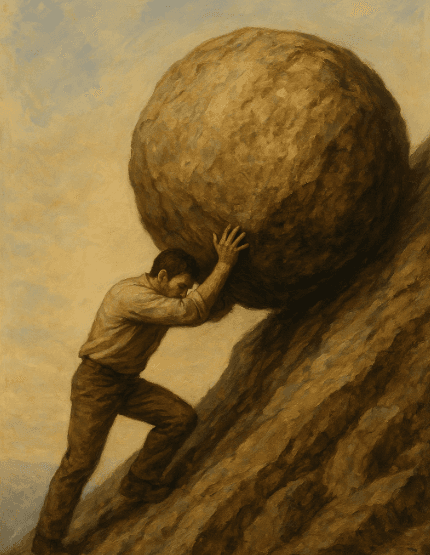
Ahmet’s Anxiety (Generated by Artificial Intelligence)
We have all experienced a similar situation. Let me ask you:
“Have you never realized, while doing a difficult task, that it was not as hard as you had imagined?”
It must have happened.
In conclusion: To accomplish a task, you must not postpone it. Yes, every task has difficulty and inertial entry. But it is we who magnify that inertia in our minds, turning it into an avalanche.
Short note: There is no inertia that sincere effort cannot overcome.