

badge icon

This article was automatically translated from the original Turkish version.

Article

Infinite Monkey Theorem

Infinite Monkey Theorem is a mathematical thought experiment proposing that, given an infinite time interval or an infinite number of monkeys, a monkey randomly typing on a typewriter will almost certainly produce a specific meaningful text such as the complete works of William Shakespeare (with probability 1). Although its origins are not precisely defined, its conceptual foundations can be traced back to Aristotle’s work Metaphysics; its modern formulation is commonly associated with Émile Borel or Thomas Henry Huxley. Mathematically, the theorem is regarded as a consequence of the Borel-Cantelli lemmas, stating that any event with a finite nonzero probability will occur with probability approaching 1 as the number of trials tends to infinity.

Mathematical Foundations and Probability Models

The theorem’s core assumption is based on a device with a keyboard of <span class="katex"><span class="katex-html" aria-hidden="true"><span class="base"><span class="strut" style="height:0.6833em;"></span><span class="mord mathnormal" style="margin-right:0.07153em;">K</span></span></span></span> keys, where each key has an equal and independent probability of being pressed. In a scenario where a single monkey makes <span class="katex"><span class="katex-html" aria-hidden="true"><span class="base"><span class="strut" style="height:0.6833em;"></span><span class="mord mathnormal" style="margin-right:0.10903em;">N</span></span></span></span> keystrokes, there are <span class="katex"><span class="katex-html" aria-hidden="true"><span class="base"><span class="strut" style="height:0.8413em;"></span><span class="mord"><span class="mord mathnormal" style="margin-right:0.07153em;">K</span><span class="msupsub"><span class="vlist-t"><span class="vlist-r"><span class="vlist" style="height:0.8413em;"><span style="top:-3.063em;margin-right:0.05em;"><span class="pstrut" style="height:2.7em;"></span><span class="sizing reset-size6 size3 mtight"><span class="mord mathnormal mtight" style="margin-right:0.10903em;">N</span></span></span></span></span></span></span></span></span></span></span> possible ordered sequences. The probability that a target text of length L appears at least once within these keystrokes is calculated using the inclusion-exclusion principle.
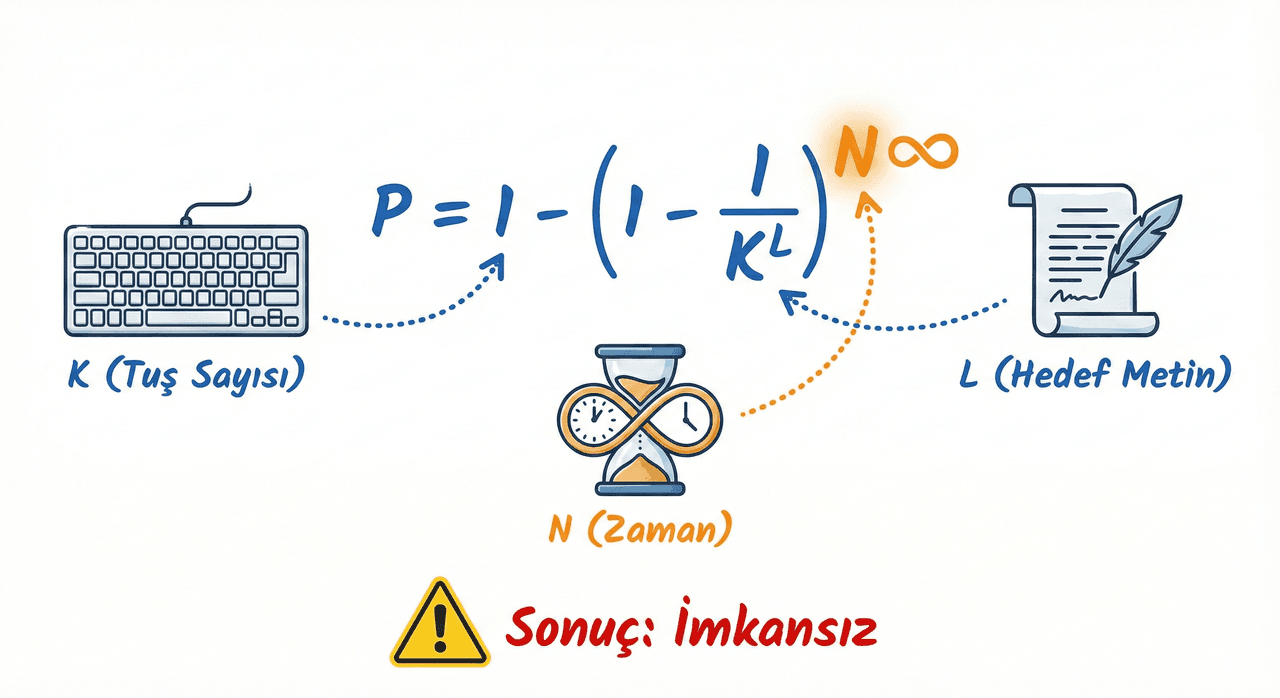

Visual Formulation of Keyboard Size, Text Length, and Time Variables Determining the Probability of a Monkey Generating the Target Text via Random Keystrokes (Generated by Artificial Intelligence)

While the “infinite” version of the theorem holds mathematical certainty, its counterpart known as the “Finite Monkey Theorem,” which respects the physical limits of the universe, yields entirely different results. Numerical assessments by Stephen Woodcock and Jay Falletta demonstrate that when accounting for the estimated lifespan of the universe (heat death) and the biological constraints of chimpanzees, the probability of generating a meaningful text is practically impossible.

Numerical Assessments and Statistical Impossibility

In the models, a chimpanzee’s working lifespan is assumed to be approximately <span class="katex"><span class="katex-html" aria-hidden="true"><span class="base"><span class="strut" style="height:0.8141em;"></span><span class="mord">1</span><span class="mord"><span class="mord">0</span><span class="msupsub"><span class="vlist-t"><span class="vlist-r"><span class="vlist" style="height:0.8141em;"><span style="top:-3.063em;margin-right:0.05em;"><span class="pstrut" style="height:2.7em;"></span><span class="sizing reset-size6 size3 mtight"><span class="mord mtight">9</span></span></span></span></span></span></span></span></span></span></span> seconds (slightly over 30 years), and the time until the universe’s heat death is assumed to be <span class="katex"><span class="katex-html" aria-hidden="true"><span class="base"><span class="strut" style="height:0.8141em;"></span><span class="mord">1</span><span class="mord"><span class="mord">0</span><span class="msupsub"><span class="vlist-t"><span class="vlist-r"><span class="vlist" style="height:0.8141em;"><span style="top:-3.063em;margin-right:0.05em;"><span class="pstrut" style="height:2.7em;"></span><span class="sizing reset-size6 size3 mtight"><span class="mord mtight"><span class="mord mtight">100</span></span></span></span></span></span></span></span></span></span></span></span> years. Even under the scenario where the current chimpanzee population (approximately 200,000) remains constant until the end of the universe, the generation of complex texts appears impossible.


Logarithmic Comparison of the Vast Time Difference Between a Chimpanzee’s Biological Lifespan and the Universe’s Heat Death, and the Probability of Randomly Typing Shakespeare’s Works (Generated by Artificial Intelligence)

The resulting data yield the following conclusions:


  • The word "Bananas": The expected number of keystrokes required to type this word randomly is 601, and the probability of a single chimpanzee producing it within its lifetime is high.


  • The sentence "I chimp, therefore I am": The expected number of keystrokes required to generate this sentence is <span class="katex"><span class="katex-html" aria-hidden="true"><span class="base"><span class="strut" style="height:0.7278em;vertical-align:-0.0833em;"></span><span class="mord">2.2</span><span class="mspace" style="margin-right:0.2222em;"></span><span class="mbin">×</span><span class="mspace" style="margin-right:0.2222em;"></span></span><span class="base"><span class="strut" style="height:0.8141em;"></span><span class="mord">1</span><span class="mord"><span class="mord">0</span><span class="msupsub"><span class="vlist-t"><span class="vlist-r"><span class="vlist" style="height:0.8141em;"><span style="top:-3.063em;margin-right:0.05em;"><span class="pstrut" style="height:2.7em;"></span><span class="sizing reset-size6 size3 mtight"><span class="mord mtight"><span class="mord mtight">30</span></span></span></span></span></span></span></span></span></span></span></span>. Even if all chimpanzees worked until the heat death of the universe, the probability of producing this sentence is approximately <span class="katex"><span class="katex-html" aria-hidden="true"><span class="base"><span class="strut" style="height:0.7278em;vertical-align:-0.0833em;"></span><span class="mord">6.4</span><span class="mspace" style="margin-right:0.2222em;"></span><span class="mbin">×</span><span class="mspace" style="margin-right:0.2222em;"></span></span><span class="base"><span class="strut" style="height:0.8141em;"></span><span class="mord">1</span><span class="mord"><span class="mord">0</span><span class="msupsub"><span class="vlist-t"><span class="vlist-r"><span class="vlist" style="height:0.8141em;"><span style="top:-3.063em;margin-right:0.05em;"><span class="pstrut" style="height:2.7em;"></span><span class="sizing reset-size6 size3 mtight"><span class="mord mtight"><span class="mord mtight">−</span><span class="mord mtight">15043</span></span></span></span></span></span></span></span></span></span></span></span>, an insignificantly small value.


  • All of Shakespeare’s Works: The number of keystrokes required to randomly generate this corpus of approximately 884,647 words is on the order of <span class="katex"><span class="katex-html" aria-hidden="true"><span class="base"><span class="strut" style="height:0.7278em;vertical-align:-0.0833em;"></span><span class="mord">6.4</span><span class="mspace" style="margin-right:0.2222em;"></span><span class="mbin">×</span><span class="mspace" style="margin-right:0.2222em;"></span></span><span class="base"><span class="strut" style="height:0.8141em;"></span><span class="mord">1</span><span class="mord"><span class="mord">0</span><span class="msupsub"><span class="vlist-t"><span class="vlist-r"><span class="vlist" style="height:0.8141em;"><span style="top:-3.063em;margin-right:0.05em;"><span class="pstrut" style="height:2.7em;"></span><span class="sizing reset-size6 size3 mtight"><span class="mord mtight"><span class="mord mtight">7448254</span></span></span></span></span></span></span></span></span></span></span></span>. This highlights the contradiction between the assumption of infinite resources and the reality of a finite universe, akin to paradoxes such as the St. Petersburg paradox or Zeno’s paradox.

Linguistics and Semantic Context

The Infinite Monkey Theorem has been used as a metaphor in linguistics and text interpretation theories to model the reader’s process of understanding a text. In David Beaver’s work, the uncertainty of “common ground” knowledge between author and reader is explained through the analogy of an infinite number of monkeys at typewriters.


Representative Illustration of the Semantic Filtering Process by Which the Reader Eliminates Possible Authorial Contexts by Tracking Presuppositions in the Text and Constructs the Correct Meaning (Generated by Artificial Intelligence)

In this model, while reading, the reader attempts to determine “which monkey” (i.e., which hypothetical author) produced the text. As the text progresses and new presuppositions emerge, monkeys (contextual possibilities) that fail to satisfy these presuppositions are eliminated. For instance, when an expression assumes information not previously mentioned, only those monkeys (contexts) assumed to possess that information remain within the probability space. This approach provides a dynamic semantic framework for analyzing how the reader’s information state is updated throughout the text and for distinguishing between the “naive reader” and the “sophisticated reader.”

Comparisons with Scientific Methodology

Biomedical research, particularly in complex fields such as pediatric HIV treatment, follows a methodology precisely opposite to the randomness proposed by the Infinite Monkey Theorem. As Fonseca and colleagues note, developing a scientific solution—such as targeting HIV reservoirs—is not equivalent to testing an infinite number of subjects with infinite random methods. Instead, research using non-human primate (NHP) models relies on systematic accumulation of knowledge regarding pathogenesis and viral persistence. In this context, the theorem serves in literature as a counter-analogy to emphasize the targeted and controlled nature of the scientific process; science does not await a masterpiece by randomly pressing keys, but advances through conscious and systematic inquiry.
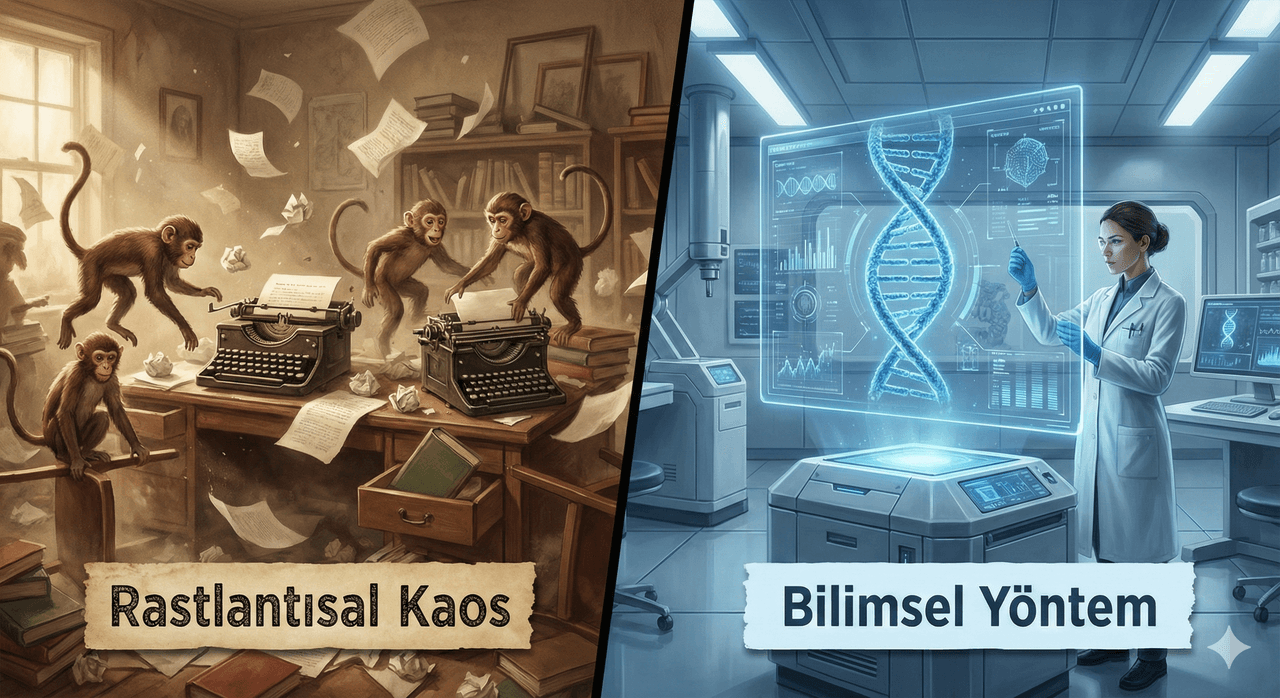

Comparative Analysis of the Random Chaos Proposed by the Infinite Monkey Theorem Versus the Targeted, Systematic, and Controlled Structure of Modern Scientific Research (Generated by Artificial Intelligence)

Cultural and Literary Reflections

The theorem is frequently referenced in popular culture and literature to discuss the limits of probability and randomness.


  • The Simpsons: In the television series, the character Charles Montgomery Burns attempts the infinite monkey experiment on an industrial scale but abandons it after producing an erroneous output such as “It was the best of times, it was the blurst of times.”


  • Science Fiction Prophecies: Author Arthur C. Clarke, in 1964, humorously predicted that advances in animal psychology and genetics might lead to monkeys being used as laborers, but that “super chimpanzees” would eventually form unions and return humanity to its starting point.

Author Information

Avatar
AuthorYunus Emre YüceDecember 6, 2025 at 6:08 AM

Tags

Discussions

No Discussion Added Yet

Start discussion for "Infinite Monkey Theorem" article

View Discussions

Contents

  • Mathematical Foundations and Probability Models

  • Numerical Assessments and Statistical Impossibility

  • Linguistics and Semantic Context

  • Comparisons with Scientific Methodology

  • Cultural and Literary Reflections

Ask to Küre