

This article was automatically translated from the original Turkish version.
+1 More
Scientific Name(s) | Bombycilla garrulus | ||||||||
|---|---|---|---|---|---|---|---|---|---|
Family | Bombycillidae | ||||||||
Conservation Status | Species Not Threatened at Global Scale | ||||||||
Feather Color | Reddish Waxy Spots on Wings Yellow Tail Tip Pastel Gray | ||||||||
Social Structure | In Flocks | ||||||||
Size / Weight | 18–23 cm / 40–68 g | ||||||||
Average Lifespan | 5 Years | ||||||||
Migration Status | Irregular Migrant | ||||||||
Distribution Area | Northern Parts of the Palearctic and Nearctic Regions | ||||||||
The Bohemian waxwing is a migratory bird species belonging to the family Bombycillidae, known for its medium size and gregarious behavior. Its scientific name is Bombycilla garrulus, and it is distributed across the Palearctic and Nearctic regions, with breeding grounds in northern latitudes. The Bohemian waxwing exhibits irregular movements and can disperse over wide areas, distinguished by its fruit-based diet, congregational presence in short-term roosting sites, and pronounced social behavior. In Türkiye it is a rare and irregularly observed species; its presence in the country is limited to winter and spring months.
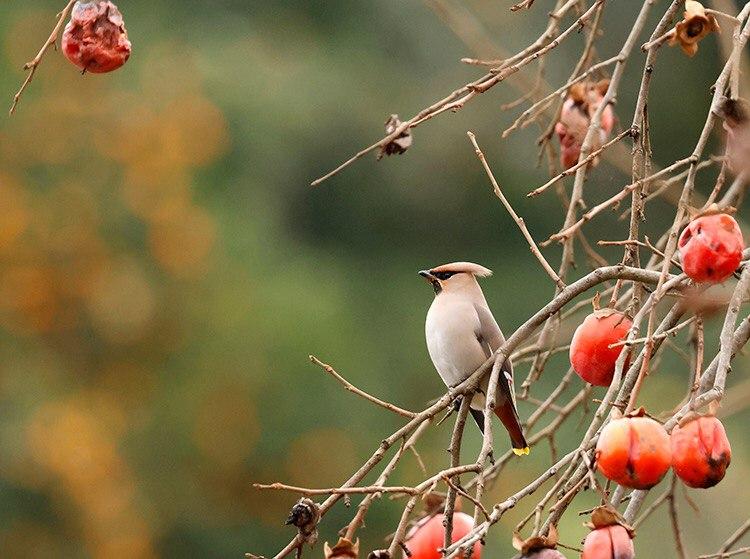
The Bohemian waxwing is a bird with a rounded body, short neck, and medium-length wings. It has a prominent crest on the back of its head. Its plumage is primarily gray and beige, with small yellow and red wing tips, and a distinct yellow band at the end of the tail. The bill is short and black, and the legs are dark. Males and females are externally very similar; juveniles have duller plumage and less prominent crests.
The species is defined by its gregarious nature and collective movement patterns. During flight it typically favors the upper canopy of tall trees. While resting, vocal communication is common, but during alarm situations, vocal activity ceases and individuals move simultaneously.【1】
The Bohemian waxwing is a widely distributed species found across the Palearctic and Nearctic regions. Major breeding areas include northern Europe, Fennoscandia, and northern Russia. It is also regularly found in northern parts of North America. Outside the breeding season, it may undertake large-scale movements southward depending on food availability.
Unlike birds with regular migratory routes, the Bohemian waxwing is characterized by irregular and mass movements. These movements are closely linked to fluctuations in the fruit production of trees and shrubs. In some years the species spreads over vast areas, while in others its range remains more restricted. This irregular mobility results in the species appearing in large flocks across different geographic regions throughout the year.
Türkiye is not part of the Bohemian waxwing’s permanent range. Its presence in the country is limited to occasional and sporadic occurrences during irregular migratory movements. The species is recorded in Türkiye during winter and spring months. It has been observed in the vicinity of Artvin (Hopa), Istanbul (Beykoz–Riva), Kırklareli (Pınarhisar–Yenice), Samsun (Asarcık and Bafra), and Van (Yüzüncü Yıl Üniversitesi Kampüsü).【2】
The Bohemian waxwing primarily feeds on fruits and forages in areas with fruit-bearing trees and shrubs. Soft fruits constitute its main food source; plant-based foods become more significant during winter and migration periods. During the breeding season, insects and other small invertebrates are also consumed, but fruits remain the primary food group for most of the year. In Türkiye, observed individuals feed on apples and rowan berries. After consuming large quantities of fruit in a short time, they move again toward new foraging areas.
During the breeding season, the Bohemian waxwing builds its nest in forested areas, particularly among coniferous trees. Nests are typically placed in the middle to upper branches, constructed from moss, fine twigs, grass stems, and feathers. The female lays four to six eggs in a single clutch; incubation lasts approximately two weeks. Hatchlings emerge naked and helpless and are fed by both parents. The nestling period lasts about two weeks, after which the young are capable of flight but continue to associate with their parents for some time.
The Bohemian waxwing is not considered threatened due to its extensive geographic range and large global population. Although short-term population fluctuations occur, the overall trend is considered stable over the long term. Since much of its habitat consists of natural forest ecosystems, it experiences only limited direct human pressure. However, local declines in forest cover and loss of fruit-bearing trees may indirectly affect food availability. In international conservation classifications, the species is categorized as low risk and is not included in any specific conservation program.
Anadolu Ajansı. "Doğu Karadeniz'de kuş gözlemcileri 'ipekkuyruk' görüntüledi." Accessed January 29, 2026. https://www.aa.com.tr/tr/yasam/dogu-karadenizde-kus-gozlemcileri-ipekkuyruk-goruntuledi/3120989
Cornell Lab of Ornithology. "Bohemian Waxwing Overview." All About Birds. Accessed January 29, 2026. https://www.allaboutbirds.org/guide/Bohemian_Waxwing/overview
Dale, Svein. “Irruptions of Bohemian Waxwings in Relation to Population Density and Food Availability.” *Journal of Ornithology* 164. (2023): 887–899. Accessed January 29, 2026. https://link.springer.com/article/10.1007/s10336-023-02083-7
Eraslan, Ali Ragıp, and Sercan Bilgin. "İpekkuyruk (Bombycilla garrulus)." Ornito.org. Accessed January 29, 2026. https://ornito.org/Bird/Detail/208
Karataş, Ahmet, Şafak Bulut, and Ayşegül Karataş. "New distribution records of Bohemian Waxwing *Bombycilla garrulus* (Linnaeus, 1758) from Turkey." *Biharean Biologist* 13, no. 1 (2019): 58–59. Accessed January 29, 2026. https://www.researchgate.net/publication/335774453_New_distribution_records_of_Bohemian_Waxwing_Bombycilla_garrulus_Linnaeus_1758_from_Turkey
Wilson, Crystal. "Bombycilla garrulus." *Animal Diversity Web*. Accessed January 29, 2026. https://animaldiversity.org/accounts/Bombycilla_garrulus/
[1]
Ahmet Karataş, Şafak Bulut ve Ayşegül Karataş. "New distribution records of Bohemian Waxwing Bombycilla garrulus (Linnaeus, 1758) from Turkey." Biharean Biologist 13, no. 1 (2019): 58. Son Erişim: 29 Ocak 2026. https://www.researchgate.net/publication/335774453_New_distribution_records_of_Bohemian_Waxwing_Bombycilla_garrulus_Linnaeus_1758_from_Turkey
[2]
Ahmet Karataş, Şafak Bulut ve Ayşegül Karataş. "New distribution records of Bohemian Waxwing Bombycilla garrulus (Linnaeus, 1758) from Turkey." Biharean Biologist 13, no. 1 (2019): 58. Son Erişim: 29 Ocak 2026. https://www.researchgate.net/publication/335774453_New_distribution_records_of_Bohemian_Waxwing_Bombycilla_garrulus_Linnaeus_1758_from_Turkey

Scientific Name(s) | Bombycilla garrulus | ||||||||
|---|---|---|---|---|---|---|---|---|---|
Family | Bombycillidae | ||||||||
Conservation Status | Species Not Threatened at Global Scale | ||||||||
Feather Color | Reddish Waxy Spots on Wings Yellow Tail Tip Pastel Gray | ||||||||
Social Structure | In Flocks | ||||||||
Size / Weight | 18–23 cm / 40–68 g | ||||||||
Average Lifespan | 5 Years | ||||||||
Migration Status | Irregular Migrant | ||||||||
Distribution Area | Northern Parts of the Palearctic and Nearctic Regions | ||||||||
Characteristics
Geographic Distribution and Migration
Diet
Breeding
Conservation Status