


This article was automatically translated from the original Turkish version.
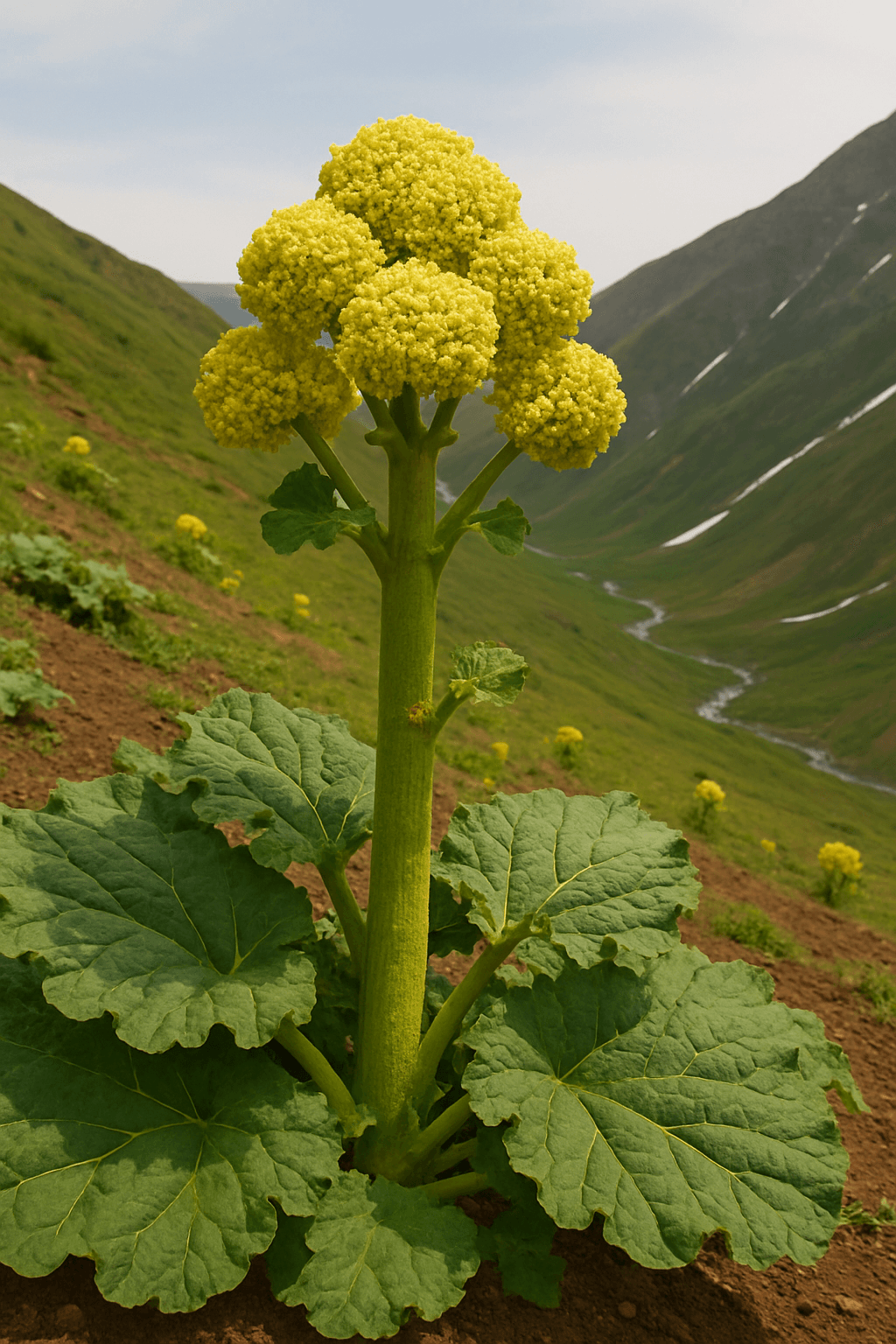
Işgın (Rheum ribes L.)
Also Known as | Işkın | ||||||||
|---|---|---|---|---|---|---|---|---|---|
Family | Polygonaceae (Kuzukulağıgiller) | ||||||||
Distribution Area | Temperate and subtropical regions of Southwest Asia, especially Türkiye's Eastern Anatolia Region | ||||||||
Growth Area | Areas at elevations of 1000–4000 m with sloping and rugged terrain | ||||||||
Height(s) | 40–150 cm | ||||||||
Structure(s) | Perennial herbaceous plant with thick rhizomes | ||||||||
Flowering | June–July (whitish to yellowish spike-like flowers) | ||||||||
Seed Maturation | July–August (triangular winged seeds) | ||||||||
Işgın is a perennial herbaceous plant species belonging to the Polygonaceae (dock family). It grows naturally at elevations between 1,000 and 4,000 meters on sloped and stony terrain. It is distributed across temperate and subtropical regions of Southwest Asia, particularly in Türkiye’s Eastern Anatolia Region. It is recognized by its thick rhizomes, reddish-green hairy stems, and whitish-yellow flowers that bloom in spike-like inflorescences during summer. Işgın is widely used in traditional medicine and pharmacology and also serves multiple functions including as a food source, dye, and erosion control agent.

Işgın (GBIF)
Rheum ribes L., a perennial herbaceous plant in the Polygonaceae family, can reach heights of 40 to 150 cm. The plant possesses underground organs supported by thick rhizomes. Its stems and leaf petioles are distinctly hairy and exhibit a reddish-green hue. Spike-like inflorescences of whitish or yellowish flowers appear at the apex in June and July. After flowering, broad-winged, triangular, reddish-brown seeds develop in July and August. These seeds measure approximately 9–15 mm in length and disperse naturally within the environment.
Rheum ribes L. thrives in sloped and rugged areas between 1,000 and 4,000 meters elevation. In Türkiye, it is naturally distributed primarily in the Eastern Anatolia Region, including the provinces of Ağrı, Muş, Bingöl, Elâzığ, Erzurum and Van. It is also found in Southwest Asian countries such as Syria, Iraq, Iran and Afghanistan. Since it has not yet been cultivated, individuals are collected entirely from natural habitats.
Işgın, with a long history of traditional use, has attracted scientific attention for its antimicrobial, antioxidant, anti-inflammatory and antidiabetic properties. It has also been reported to exhibit anti-aging, cytotoxic and protective effects against certain chronic diseases. These properties have provided the basis for its long-standing use as a traditional pharmaceutical raw material in Asia and the Middle East.
The seeds of Işgın exhibit dormancy, which prevents germination immediately after falling to the soil. Additionally, it has been observed that germination capacity declines with seed age. This characteristic is a significant factor complicating both natural dispersal and cultivation efforts.
Rheum ribes L. is valued for its rich profile of vitamins A, B1, B2, C and E, as well as various macro and microelements including phosphorus, potassium, calcium, iron, sodium, zinc and selenium. It also contains organic acids such as malic and citric acid. However, its high oxalic acid content necessitates controlled consumption.
Unregulated harvesting from natural habitats, particularly the complete removal of stems and damage to root zones, reduces the plant’s capacity for regeneration. Collecting flowers intended for seed production threatens population continuity. Therefore, it is recommended that harvesters leave at least 10 percent of individuals and avoid damaging the roots.
Field trials conducted at Muş Alparslan University have encountered difficulties in transitioning plants collected from the wild into cultivation. However, seed-based production trials are ongoing. Domesticating Işgın holds significant potential for both species conservation and economic contribution.
Thanks to its rhizome structure adapted to high-altitude environments, Işgın plays an erosion-control role by stabilizing soil in its native habitats. Excessive and unregulated harvesting diminishes this function, contributing to soil loss and degradation of the natural vegetation cover.
Natural dyes extracted from Işgın roots yield a range of colors including beige, purple, burgundy and olive green. As such, Işgın carries cultural value in traditional dyeing practices. In the Elâzığ region, its roots are also traditionally used by local communities to treat conditions such as shap disease.
GBIF. "Rheum ribes L. JPG." Global Biodiversity Information Facility. Accessed May 31, 2025. https://www.inaturalist.org/photos/489821615
GBIF. "Rheum ribes L." Global Biodiversity Information Facility. Accessed May 31, 2025. https://www.gbif.org/species/4037514
Yenikalaycı, Ahmet. "Işgın (Rheum ribes L.) Bitkisinin Önemi, Kullanım Alanları ve Sorunları." *Lokman Hekim Tıp Tarihi ve Folklorik Tıp Dergisi* 13, no. 3 (2023): 515–520. Accessed May 31, 2025. https://dergipark.org.tr/tr/pub/mutftd/issue/80056/1280588

Işgın (Rheum ribes L.)
Also Known as | Işkın | ||||||||
|---|---|---|---|---|---|---|---|---|---|
Family | Polygonaceae (Kuzukulağıgiller) | ||||||||
Distribution Area | Temperate and subtropical regions of Southwest Asia, especially Türkiye's Eastern Anatolia Region | ||||||||
Growth Area | Areas at elevations of 1000–4000 m with sloping and rugged terrain | ||||||||
Height(s) | 40–150 cm | ||||||||
Structure(s) | Perennial herbaceous plant with thick rhizomes | ||||||||
Flowering | June–July (whitish to yellowish spike-like flowers) | ||||||||
Seed Maturation | July–August (triangular winged seeds) | ||||||||
No Discussion Added Yet
Start discussion for "Işgın (Rheum ribes L.)" article
Morphological Characteristics
Distribution
Pharmacological Properties
Seed Biology and Reproductive Challenges
Nutritional and Chemical Composition
Population Pressures and Conservation Needs
Agricultural Suitability and Cultivation Studies
Ecological Functions
Use as a Dye Plant