This article was automatically translated from the original Turkish version.
Registration Number | 1481 | ||||||||
|---|---|---|---|---|---|---|---|---|---|
Registration Date | 06.10.2023 | ||||||||
Application Number | C2021/000548 | ||||||||
Application Date | 29.12.2021 | ||||||||
Name of the Geographical Indication | İskilip Çileği | ||||||||
Product / Product Group(s) | Strawberry / Processed and unprocessed fruits and vegetables and mushrooms | ||||||||
Type of Geographical Indication | Certification mark | ||||||||
Applicant/Registrant(s) | İskilip Municipality | ||||||||
Address of the Registrant | Yenicami Mah. Çorum/1 Sk. İskilip Belediyesi 2-4 İskilip 19400 ÇORUM | ||||||||
Geographical Boundary | Areas of İskilip district at elevations of 520–1650 m Çorum province | ||||||||
İskilip strawberry is a variety of the Albion type of strawberry cultivated in areas between 520 and 1650 meters elevation in the İskilip district of Çorum. This product develops large firm bright-colored and aromatic fruits due to the unique climatic conditions where continental and Black Sea climates converge and potassium-rich soil structure. İskilip strawberry is planted twice annually and maintains production efficiency for four years after which the field must be left fallow. High day-night temperature differences and low-salinity natural water sources enhance the fruit’s sweetness aroma and dry matter content. Harvested manually with intact calyx leaves this strawberry is suitable for processing and cold storage.
İskilip strawberry is a variety of Fragaria × ananassa known as Albion grown exclusively in the lands of the İskilip district of Çorum province between 520 and 1650 meters elevation. Due to the distinctive characteristics acquired by the Albion variety under İskilip’s unique geographical and climatic conditions it was officially registered as a geographical indication on 6 October 2023. The product’s recognition and its association with the region have been strengthened by a long-standing production history and its role in İskilip’s agricultural economy. Production processing and all related activities are carried out within the defined geographical boundary.
The İskilip district lies at the transition zone between the continental climate of Central Anatolia and the Black Sea climate zone. Summers are hot and dry while winters are rainy. The annual average precipitation is 503.70 kg/m² and the presence of natural water sources used for irrigation is crucial. These water sources have low salinity levels which facilitate mineral uptake by plants. Additionally the average day-night temperature difference of approximately 10 °C positively influences the development of aromatic compounds and dry matter content in the fruit. The potassium-rich nature of the region’s soils contributes to the strawberry’s sugar content color and durability.
In İskilip strawberry production Albion variety seedlings are used. Seedlings are planted in two distinct periods: the first week of November (autumn season) and the last week of April (spring season). Production areas are prepared with ridges 70 cm high 20 cm wide at the top and 80 cm wide at the base. Drip irrigation systems are installed at 25 cm intervals along the ridges and covered with mulch plastic. This covering conserves soil moisture and suppresses weed growth. Seedlings are planted in crosswise patterns in holes 15 cm in diameter spaced 25 cm apart.
Plant development is completed within approximately 30 to 45 days. The first flowers are removed to support root development. Seedlings begin fruiting 60 to 70 days after planting. Irrigation is applied via drip system every three days for two hours each time. Diseases and pests such as powdery mildew anthracnose gray mold red spider mite green grasshopper and aphids are controlled using organic (e.g. copper sulfur) and inorganic pesticides.
The production cycle of İskilip strawberry spans four years. At the end of this period the field deteriorates and must remain fallow for four years before replanting. Fruits in the first year are sparse and large while the highest yield is achieved in the second year. In the third year fruit size decreases. The fallow period occurs in July or August depending on weather conditions.
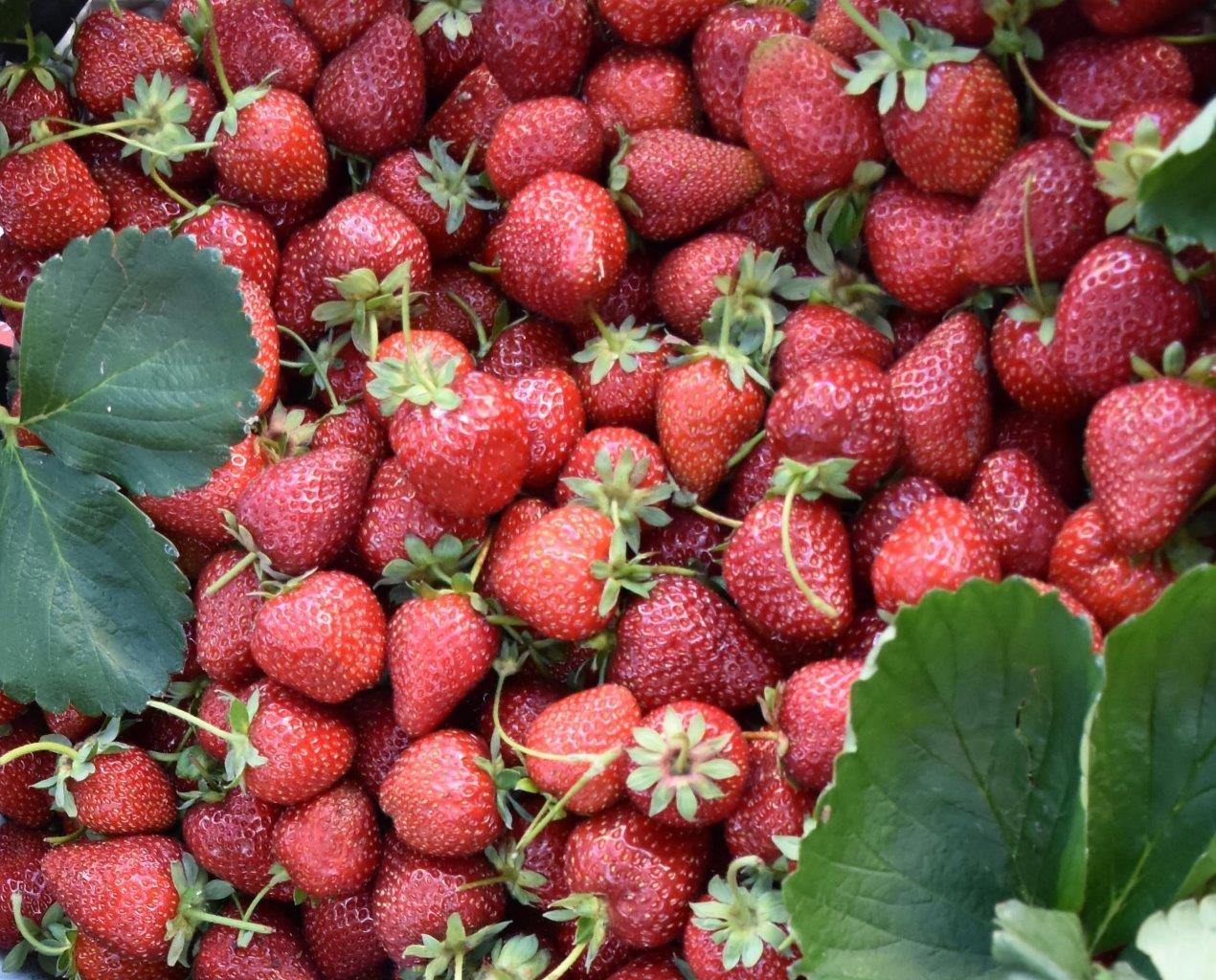
İskilip strawberry has a spherical-conical fruit shape a vivid and glossy exterior color and a firm fleshy texture. The calyx leaves adhere to the fruit and are positioned either on top or partially embedded and are resistant to detachment. Care is taken during harvest to preserve the calyx leaves.
The main physical and chemical properties of the product are as follows:
The external fruit color according to the CIELAB color space falls within the following ranges:
The internal fruit color and pulp color values are similarly determined. These values enable an objective assessment of the strawberry’s color intensity and glossiness.
Harvesting is performed manually with care to avoid damage to the calyx leaves. Harvested fruits are placed in crates of 2 to 2.5 kg without stacking. The product is marketed directly or stored at +4 °C without exposure to direct sunlight.
Although modern agricultural techniques for İskilip strawberry production began in 2011 strawberry cultivation in the region has a much longer history. The product is promoted through local festivals and competitions and has become culturally identified with İskilip. This association reinforces the link between the product and its geographical origin.
Monitoring of İskilip Strawberry is carried out by a four-member oversight body established under the coordination of İskilip Municipality comprising representatives from İskilip Municipality İskilip District Directorate of Agriculture and Forestry İskilip Chamber of Agriculture and local trade associations. Inspections are conducted regularly three times per year during spring summer and autumn. Additional inspections may be carried out upon complaint. The scope of monitoring includes compliance with the use of the Albion variety adherence to production methods conformity of product characteristics proper packaging and storage conditions and correct use of registered names and logos.
During this process the oversight body may seek expert support from public institutions or private sector specialists as needed. The İskilip Municipality the entity that registered the geographical indication is responsible for the legal protection of the mark.
Turkish Patent and Trademark Office. "İskilip Çileği Mahreç İşareti Tescil Belgesi ve Teknik Şartnamesi." Accessed July 20, 2025. https://ci.turkpatent.gov.tr/Files/GeographicalSigns/c4d88616-7afa-46c0-8928-7cadf2bf6be9.pdf.
Turkish Patent and Trademark Office. "İskilip Çileği." Accessed July 20, 2025. https://ci.turkpatent.gov.tr/cografi-isaretler/detay/5784.

Registration Number | 1481 | ||||||||
|---|---|---|---|---|---|---|---|---|---|
Registration Date | 06.10.2023 | ||||||||
Application Number | C2021/000548 | ||||||||
Application Date | 29.12.2021 | ||||||||
Name of the Geographical Indication | İskilip Çileği | ||||||||
Product / Product Group(s) | Strawberry / Processed and unprocessed fruits and vegetables and mushrooms | ||||||||
Type of Geographical Indication | Certification mark | ||||||||
Applicant/Registrant(s) | İskilip Municipality | ||||||||
Address of the Registrant | Yenicami Mah. Çorum/1 Sk. İskilip Belediyesi 2-4 İskilip 19400 ÇORUM | ||||||||
Geographical Boundary | Areas of İskilip district at elevations of 520–1650 m Çorum province | ||||||||
Geographical Boundary
Climate Soil and Ecological Characteristics
Agricultural Practices and Production Method
Physical and Chemical Properties
Harvesting Packaging and Storage
Reputation and Cultural Value
Monitoring and Protection