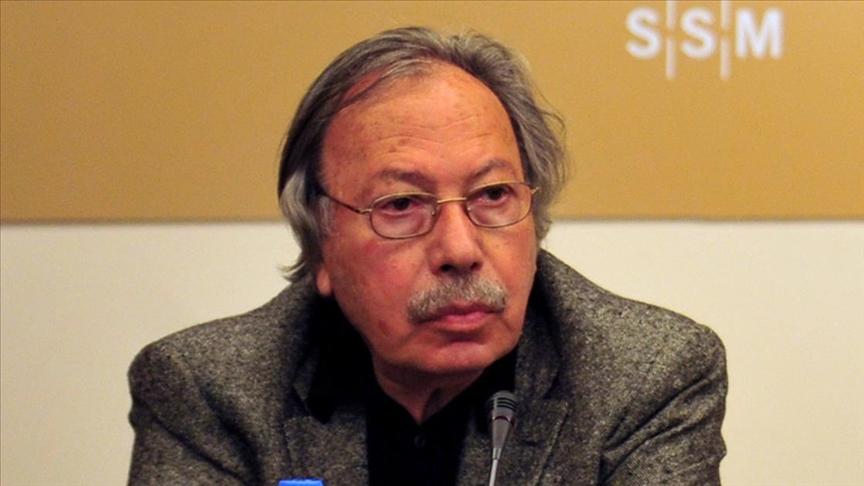



Doğum tarihi | 1936-02-24 | ||||||||
|---|---|---|---|---|---|---|---|---|---|
Eş | Filiz Bil Edgü Amelie Edgü | ||||||||
Place of Birth | Istanbul | ||||||||
Ölüm tarihi | 2024-07-22 | ||||||||
Place of Death | Trabzon | ||||||||
Occupation(s) | Writer Publisher Editor Art Critic Painter | ||||||||
Literary Genre | Poetry Essay Novel Short Story | ||||||||
Education | Paris School of Fine Arts Mimar Sinan Fine Arts Academy | ||||||||
Çocuk | Yunus Edgü Esma Edgü | ||||||||
Ferit Edgü, born on 24 February 1936, is among the leading figures of 20th-century Turkish literature. His mother is Fatma Nevber Hanım and his father is Mehmet Nuri Edgü. It is known that his maternal grandfather, the Bektashi poet Eğribozlu Mehmed Emin Sırrî, left behind a Divan from the 19th century. Edgü’s childhood unfolded under adverse political, economic and social conditions both globally and in Türkiye.
Ferit Edgü received his education in schools affiliated with the Ministry of National Education from primary school onward. During his high school years, he had the opportunity to meet Attila İlhan, Salah Birsel, and Vedat Günyol, who would later publish his earliest writings. In 1958, while studying at the Istanbul Academy of Fine Arts, he left his final year to travel to Germany where he conducted research on ceramic chemistry. At the end of that same year, he moved from Munich to Paris, where he received ceramic training for approximately six years. During this period, he attended philosophy lectures at the Sorbonne and art history courses at the Louvre Museum. He returned to Türkiye in 1964.
In 1967, Ferit Edgü fulfilled his military service as a reserve officer-teacher in the village of Pirkanis in Hakkâri and in Keskin. After his military service, he returned to Paris and, a year later, came back to Istanbul where he worked for a time as a text writer at Manajans. In 1976, he co-founded DATA Advertising Agency and Ada Publications, which he managed. He also assumed leadership of the Bedri Rahmi Art Gallery.
Ferit Edgü participated in the Mavi movement and played a decisive role in continuing the publication of the magazine under the name Son Mavi after the 24th issue of the original Mavi (1952–1954). His encounter with the short stories of Sait Faik at the age of 16 or 17 proved decisive in shaping his relationship with literature and encouraged him to write. His first short story was published in 1953 in the journal Yeni Ufuklar, though it was not included in any of his books. He began to gain recognition in literary circles through poems and stories published in journals such as Kaynak, Yeni Ufuklar, Şairler Yaprağı, the art supplement of Vatan newspaper, Mavi, Pazar Postası, and Dost. Between 1950 and 1960, he attracted attention with critical essays on art and aesthetics published in journals including Yeni Dergi, Ant, Eylem, Ataç, Papirüs, Soyut, and Yeni Ufuklar. Edgü produced works in the genres of poetry, short story, novel, drama, essay, biography, criticism, aphorism, and translation, and is regarded as one of the writers of the 1950 generation. He is particularly distinguished for his short stories. His first published poem appeared in 1952 in the journal Kaynak and was influenced by the Garip movement.
Ferit Edgü (Face-to-Face Conversations)
As a writer of the 1950 generation, Ferit Edgü operated within the framework of social realism. Drawing on existentialist approaches in Western literature, he crafted narratives that examined the individual’s position in society. Academic studies have noted that his early short stories engage with themes associated with existentialism. Employing a minimalist style, he brought to the fore issues such as despair, anxiety, nothingness, and the compulsion to narrate. He regarded the act of writing as an instrument of the individual’s intellectual and existential questioning.
His first collection of short stories, Kaçkınlar (1959), explores the transition between the individual’s inner world and external reality. In these stories, the narrative voice varies according to the psychological state of the characters. The work Bozgun (1962) addresses the sense of groundlessness experienced by the individual as he attempts to make sense of his own existence. In Bir Gemide (1978), the lack of communication between the individual and society is highlighted, and the characters’ aimlessness underscores the meaninglessness of existence.
The work Binbir Hece (1991) is noted in Turkish literature for its examples of micro-fiction and embraces a minimalist style that prioritizes semantic density. In Doğu Öyküleri (1995), the existential conditions of individuals living in the Eastern regions of Türkiye are depicted in terms of their social, economic, and physical circumstances. In these texts, the narrator adopts an observational stance rather than a critical one toward the characters.
Edgü’s novel Kimse (1976), although set in a village environment, moves beyond traditional village novel conventions to foreground individual introspection. O/Hakkari’de Bir Mevsim (1977) is regarded as a novel in which internal observations are transposed into a social framework. Its film adaptation won awards at international film festivals. In the novel Eylülün Gölgesinde Bir Yazdı (1988), sections composed of visual representations of an individual’s life are presented alongside sections depicting characters struggling to sustain their existence within a corrupted order.
In his essay series Ders Notları (1978–2000), Edgü approaches subjects such as art, morality, life, and creativity with a critical and questioning perspective. In Yazmak Eylemi (1980), he experiments with different modes and forms of expression in writing. Şimdi Saat Kaç (1979) is a selection of writings on art history and literature. İnsanlık Halleri (2003) consists of aphorisms that philosophically reflect on concepts such as time, space, life, and death, and question the individual’s place in the universe.
Edgü has also translated works by Samuel Beckett, Albert Camus, Jean Wahl, Allen Ginsberg, Lawrence Ferlinghetti, and Antonio Gramsci into Turkish. His writings are influenced by movements such as existentialism, impressionism, surrealism, and minimalism. Edgü’s narratives draw attention through their efforts to expand the layers of meaning in language. He conceptualizes writing as a mode of thought that seeks to pose questions rather than provide fixed answers. In this regard, Edgü stands out among writers of modern Turkish literature for his individual and intellectual depth.
Anadolu Ajansı. "Yazar Ferit Edgü vefat etti." Anadolu Ajansı, July 22, 2024. Accessed June 30, 2025. https://www.aa.com.tr/tr/kultur/yazar-ferit-edgu-vefat-etti/3282171
Deveci, Mutlu - TEİS (Türk Edebiyatı İsimler Sözlüğü). "Edgü, Ferit." *teis.yesevi.edu.tr*. Accessed June 30, 2025. https://teis.yesevi.edu.tr/madde-detay/edgu-ferit
Erdal, Cihan. "Ferit Edgü Öykücülüğü: Suskunluk ve Yazmak Arasında." *MSGSÜ Sosyal Bilimler* 13 (2016): 70–77. Accessed June 30, 2025. https://dergipark.org.tr/tr/download/article-file/757858
YouTube. "Ferit EDGÜ: Yazmak, Yalnızlığa Karşı Tepkidir…" Yüz Yüze Konuşmalar. Accessed June 30, 2025. https://www.youtube.com/watch?v=Zy4WUE7JQR4

Doğum tarihi | 1936-02-24 | ||||||||
|---|---|---|---|---|---|---|---|---|---|
Eş | Filiz Bil Edgü Amelie Edgü | ||||||||
Place of Birth | Istanbul | ||||||||
Ölüm tarihi | 2024-07-22 | ||||||||
Place of Death | Trabzon | ||||||||
Occupation(s) | Writer Publisher Editor Art Critic Painter | ||||||||
Literary Genre | Poetry Essay Novel Short Story | ||||||||
Education | Paris School of Fine Arts Mimar Sinan Fine Arts Academy | ||||||||
Çocuk | Yunus Edgü Esma Edgü | ||||||||
Education and Youth Years
Professional Life and Literary Beginnings
Key Works and Contributions