

This article was automatically translated from the original Turkish version.
+1 More
Type of Geographical İndication | Place of Origin | ||||||||
|---|---|---|---|---|---|---|---|---|---|
Application Date | 01.06.2020 | ||||||||
Registration Number | 1431 | ||||||||
Registration Date | 02.08.2023 | ||||||||
Product / Product Group(s) | Processed and unprocessed fruits vegetables and mushrooms | ||||||||
Province(s) | Isparta | ||||||||
Applicant/Registrant(s) | Isparta Chamber of Commerce | ||||||||
Isparta apple is a variety of apple (Malus domestica Borkh) cultivated in the Isparta province of Türkiye. Recognized for its unique characteristics shaped by the geographical climatic and ecological conditions of Isparta it was officially registered as a geographical indication on 02.08.2023 under Law No. 6769 on Industrial Property effective from 01.06.2020. The registration was carried out by the Isparta Chamber of Commerce and the geographical boundary for its cultivation is limited to Isparta province.

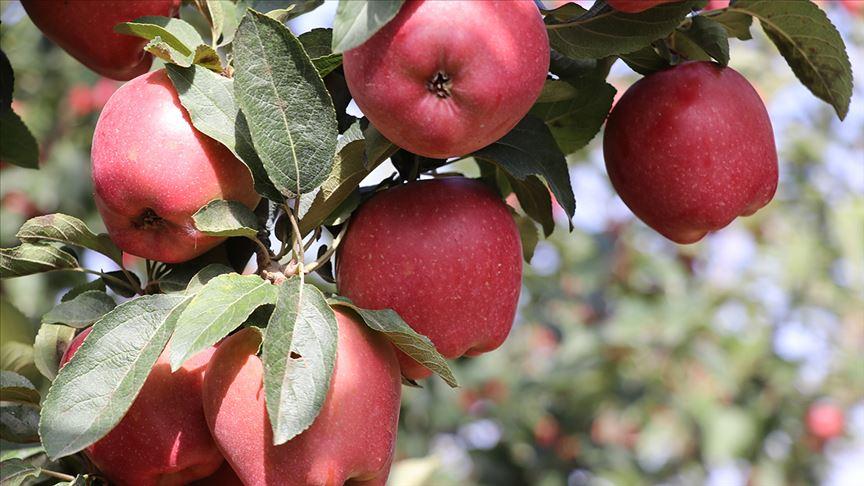
Isparta Apple (AA)
The Isparta apple attracts attention through its shape size and other pomological features. The fruit has a structure that tapers from the stem end toward the calyx cavity and is commercially classified as a “long” type. Five prominent protrusions located in the calyx cavity known as the “five-pointed star” are a distinguishing feature of the Isparta apple. This trait results from the region’s climatic conditions particularly the significant day-night temperature differences. During April the highest temperature reaches 29.5°C while the lowest drops to -7.7°C with an average temperature difference of 15-20°C. This variation influences cell division after flowering promoting the elongated fruit form. Low temperatures stimulate cytokinin synthesis increasing cell number while high temperatures support gibberellin synthesis affecting cell size.
The areas where Isparta apples are grown are concentrated around Lake Eğirdir Lake Beyşehir and Lake Burdur. The average relative humidity of 57.8% in these regions and the moderating effect of Lake Eğirdir reduce the risk of late spring frosts positively influencing apple production. The province’s semi-arid humid climate with an annual average rainfall of 568.4 mm supports apple development. Additionally light a critical factor in fruit size is provided by an annual average of 2858 hours of sunlight in Isparta apple orchards. Pruning training and thinning operations are carefully performed to ensure maximum exposure of fruits to sunlight.
Isparta apples are produced using grafted seedling rootstocks or clonal rootstocks (MM.106 MM.111 M.9). The rootstocks scions and seedlings are sourced from the Eğirdir Fruit Growing Research Institute. The main cultivars grown in orchards are Starking Delicious Golden Delicious Granny Smith Scarlet Spur Starkrimson Delicious and Red Chief. For pollination Starkspur Golden Delicious Golden Delicious and Starkrimson Delicious are used. Orchard sites are generally established on southern slopes and sloping terrains around the lakes of Eğirdir Beyşehir and Burdur. This positioning protects the apples from late spring frosts and severe winter cold. Seedling planting is carried out between November and March.
Modern agricultural techniques are employed in cultivation. Fertilization is performed using the fertigation method based on soil and leaf analysis. Irrigation is conducted via drip or sprinkler systems in 90% of the orchards with irrigation timing determined by the Forecasting and Early Warning Center under the Isparta Provincial Directorate of Agriculture and Forestry. This center analyzes data such as temperature humidity leaf wetness and rainfall from 35 agricultural meteorological stations to guide pest and disease control programs. Pruning operations are applied after leaf fall and continue until the end of March in the form of yield and shape pruning.

Isparta Apple (AA)
The harvest time of Isparta apples varies by cultivar and is determined according to the following criteria:
Fruits are tested with iodine solution. For red varieties a minimum of 50% whitening starting from the core cavity indicates readiness for harvest. For white varieties uniform whitening of at least 50% is required.
Flesh firmness measured by penetrometer must range between 6.94 and 9.55 kg/cm².
The value measured by refractometer must fall between 12.20% and 16.40%.
Harvested apples are placed in plastic or wooden crates and stored under controlled conditions of 0-4°C temperature and 90-95% relative humidity before being marketed.
The production and use of the geographical indication for Isparta apple are monitored by a three-member oversight body coordinated by the Isparta Chamber of Commerce and comprising one expert each from the Faculty of Agriculture of Isparta Applied Sciences University the Isparta Provincial Directorate of Agriculture and Forestry and the Isparta Chamber of Commerce. Regular inspections are conducted annually with additional inspections carried out upon complaint or necessity. During inspections the suitability of apple varieties cultivation methods phenological and pomological characteristics and compliance with geographical boundaries are verified. The designation “Isparta Apple” and its geographical indication emblem are used on the product or packaging. Where this is not feasible they must be displayed in a clearly visible location at the production facility.
Anadolu Ajansı. “Isparta elması dalında satılması ve verimiyle yüz güldürüyor.” Anadolu Ajansı, October 1, 2020. Accessed August 16, 2025. https://www.aa.com.tr/tr/ekonomi/isparta-elmasi-dalinda-satilmasi-ve-verimiyle-yuz-gulduruyor-/1991829.
Isparta Chamber of Commerce. "No: 1431 – Origin Name Isparta Apple." Turkish Patent and Trademark Office, Accessed August 16, 2025. https://ci.turkpatent.gov.tr/Files/GeographicalSigns/c96b0e32-0b1f-4e8c-b365-efcfbc2a7935.pdf.
Isparta Chamber of Commerce. "No: 1431 – Origin Name Isparta Apple." Turkish Patent and Trademark Office, Accessed August 16, 2025. https://ci.turkpatent.gov.tr/cografi-isaretler/detay/8842.

Type of Geographical İndication | Place of Origin | ||||||||
|---|---|---|---|---|---|---|---|---|---|
Application Date | 01.06.2020 | ||||||||
Registration Number | 1431 | ||||||||
Registration Date | 02.08.2023 | ||||||||
Product / Product Group(s) | Processed and unprocessed fruits vegetables and mushrooms | ||||||||
Province(s) | Isparta | ||||||||
Applicant/Registrant(s) | Isparta Chamber of Commerce | ||||||||
Characteristics
Phenological Characteristics
Pomological Characteristics
Cultivation and Production Methods
Harvest and Storage
Period from Full Bloom to Harvest
Starch Test
Firmness
Soluble Solids Content (SSC)
Monitoring and Geographical Indication Use