


This article was automatically translated from the original Turkish version.
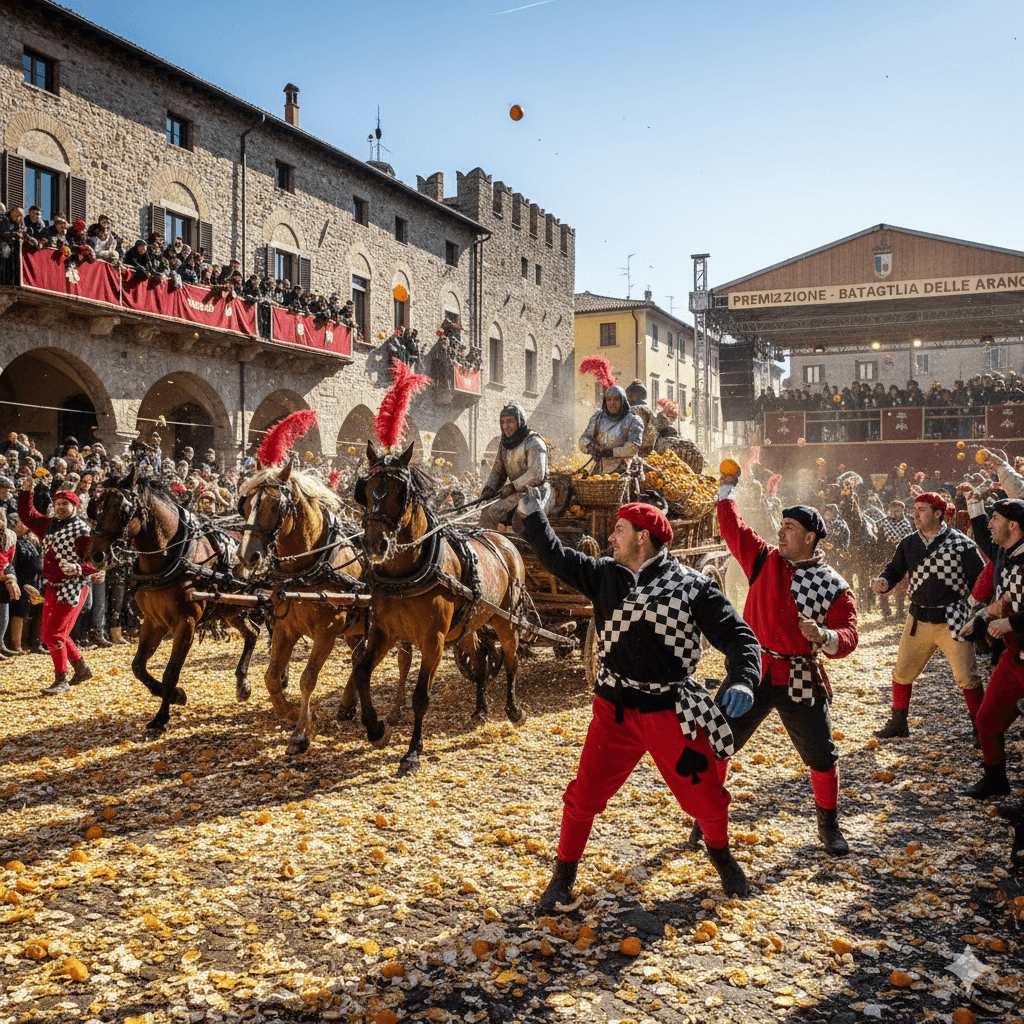
Ivrea Carnival (Generated by Artificial Intelligence.)
Type of Carnival | Historical Reenactment and Civil Festival | ||||||||
|---|---|---|---|---|---|---|---|---|---|
Location | Ivrea Italy Piedmont | ||||||||
Start Date | January 6 (Epiphany) | ||||||||
End Date | Ash Wednesday | ||||||||
Main Symbol | Red Phrygian Cap (Berretto Frigio) | ||||||||
Important Event(s) | Orange Battle (Battaglia delle Arance) | ||||||||
The Ivrea Carnival is a civilian folk festival held in the city of Ivrea, located in Italy’s Piedmont region, featuring historical reenactment elements and symbolic significance. With origins traced back approximately eight centuries, the event celebrates the people’s liberation from medieval tyranny and their right to determine their own destiny. The historical basis of the carnival lies in a popular uprising against the Marquis of Monferrato, whose rule had brought famine to the city. According to legend, this tyranny was ended by Violetta, the miller’s daughter, who rebelled against his droit du seigneur (right of the first night) and killed him with her own sword.
About the Ivrea Carnival (Youtube-Urban Pictures)
The parade features figures such as the Miller’s Daughter (Violetta/Mugnaia) and her husband Toniotto, the honorary attendant, the general and staff composed of officers and Vivandieres, the assistant grand chancellor, the chief judge who secured the city’s freedom (Magnifico Podestà), lieutenants carrying the banners of the five districts, priests (Abbá), and flute and drum players (Pifferi e Tamburi).
The name of the Miller’s Daughter is announced from the balcony of the town hall on Saturday night. During the full parade on Sunday afternoon, Mugnaia sits in a golden carriage drawn by three white horses, accompanied by her attendants, immediately behind the band playing the carnival song. As the parade passes through the squares where the Orange Battle takes place, Mugnaia throws sweets, chocolate, mimosa flowers, and wedding blossoms to the crowd.
The general, a character dating back to 1808, assumes authority on Fat Thursday (the last Thursday before the Christian Lenten period) from the mayor. The chief judge (Podestà), accompanied by the Credendari, performs the Preda in Dora ritual, symbolizing hatred toward the Marquis of Monferrato by throwing a stone from Castellazzo into the river. Then, on Epiphany, they mark the official opening of the festival with Pifferat music.

Ivrea Carnival – The Parade (Generated by Artificial Intelligence)
The Orange Battle is a reenactment representing the townspeople’s revolt against tyranny during the historical Ivrea Carnival. Lasting three days from Sunday to Shrove Tuesday (the last day before the start of the Christian Lenten period), the battle occurs between nine infantry teams representing the rebellious populace and Aranceri (orange throwers) on horse-drawn carts symbolizing feudal armies.
Each infantry team has a designated location within the city; for example, the oldest team, established in 1947, is the Asso di Picche. The Aranceri on horse-drawn carts are divided into two groups: two-horse teams (Spans) and four-horse squads (Four Horse).
On Shrove Tuesday (the last day before the start of the Christian Lenten period), an award ceremony is held in Piazza Città for both infantry teams and cart teams. Infantry rankings are determined by the number of throws, physical attributes, and accuracy rates, while cart teams are ranked based on their horses, crew coordination, and control.
During the days of the Orange Battle, wearing a Phrygian cap is mandatory to avoid being targeted.

Ivrea Historical Carnival – The Orange Battle (Generated by Artificial Intelligence)
The carnival officially begins on Epiphany, January 6, with the general’s inauguration ceremony and the first parade of the flute and drum players. Additionally, on Epiphany, the Church Candle Ceremony takes place, during which the chief judge (Podestà), accompanied by his retinue, presents a church candle to the bishop and prays to the Virgin Mary for the city’s protection.
On the Sundays preceding the carnival, traditional Fagiolate (Bean Feasts) are held in various neighborhoods of the city, and the Alzata degli Abbá ceremony takes place, during which the Abbá (chief priests) are displayed to the public from balconies in their respective districts. On Fat Thursday (the last Thursday before the Christian Lenten period), symbolic transfer of authority occurs from the mayor to the general, and the historical parade marches through the town.
The carnival’s rituals occur on Sunday night, centered on the burning of the Scarlo, a pole made of juniper and fir. As the Miller’s Daughter witnesses the burning, the Abbá ignite the fire and hold aloft the sword, symbolizing liberation from tyranny, until its flag turns to ash.
The carnival ends on Ash Wednesday (the first day of Lent in Christianity), when the people eat the traditional dish of polenta and morina fish, distributed by the Croatian committee.
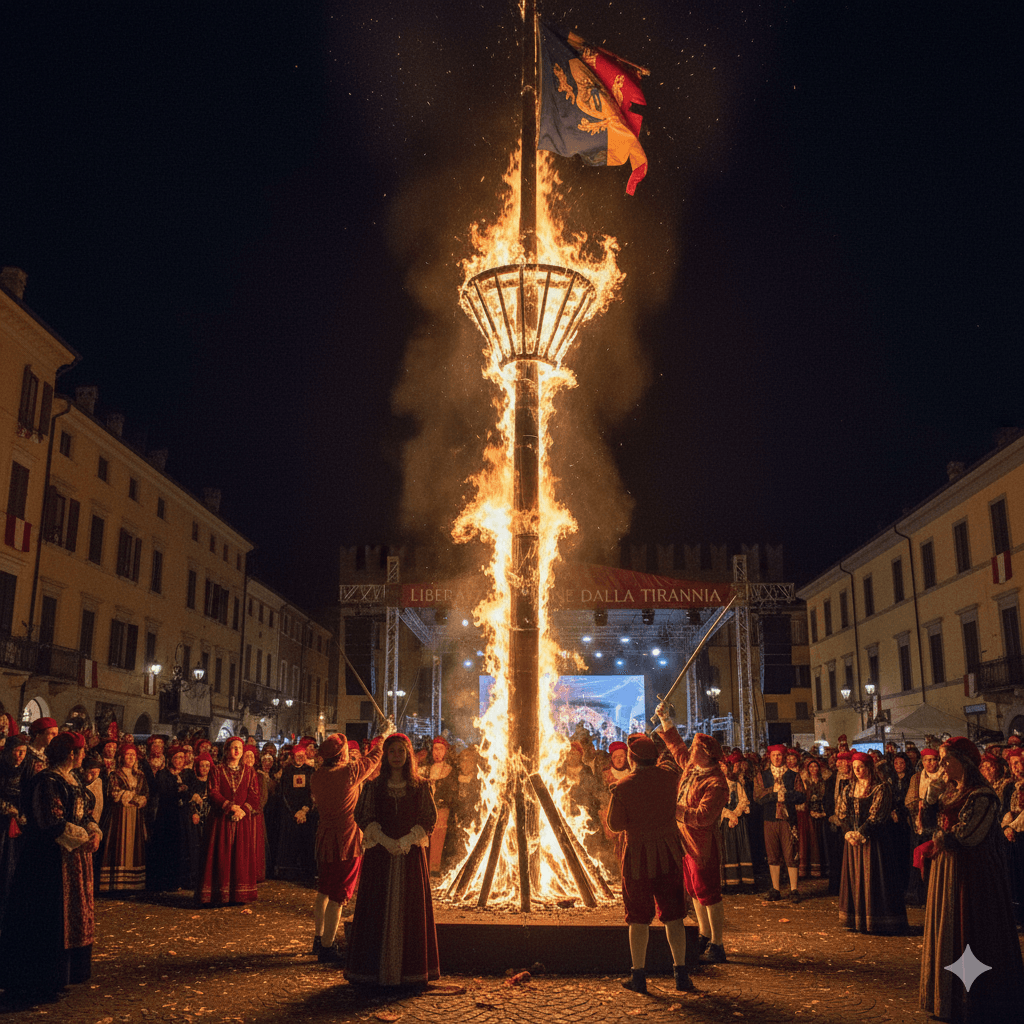
Ivrea Carnival – The Scarlo Burning Ritual (Generated by Artificial Intelligence)
The Ivrea Carnival is also distinguished by its gastronomic traditions. One such tradition is the Fagiolate (Bean Feasts), which are held on Sundays before the carnival and other key celebration days in various districts of the city. This custom originates from the Middle Ages, when beans were distributed by the people of Ivrea to the poor. Today, the traditional dish served at Fagiolate is called faseuj otu, prepared in large copper cauldrons with beans, pork skin (preive), cotechino sausages, pork hocks, bones, lard, and onions. The oldest Fagiolata is the Fagiolata del Castellazzo.
The carnival concludes with the traditional dish of Polenta e Merluzzo (Polenta and Morina Fish) on Ash Wednesday, the first day of Lent. On this day, the people of Ivrea gather at Piazza La Marmora to taste this traditional meal prepared by the Croatian committee, during which large quantities of polenta, morina fish, and onions are cooked.
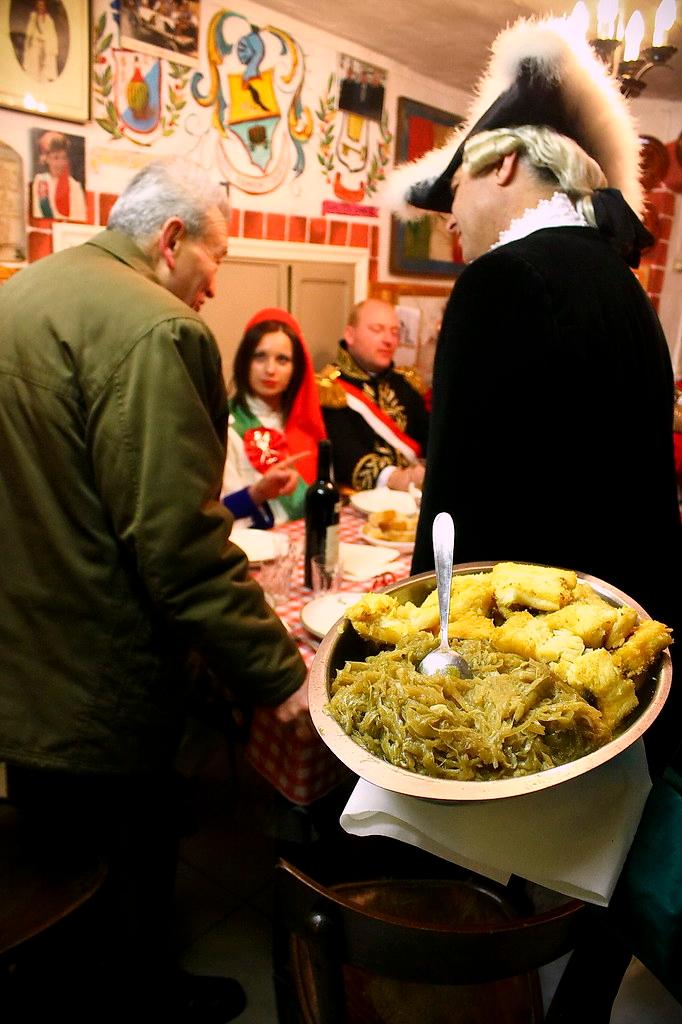
Traditional Dishes Consumed at the End of the Carnival (Flickr)
Fondazione dello Storico Carnevale di Ivrea. “Battle of the Oranges | EN”. Fondazione dello Storico Carnevale di Ivrea. Accessed October 28, 2025. https://www.storicocarnevaleivrea.it/en/chi-siamo/il-carnevale/battaglia-delle-arance/
Fondazione dello Storico Carnevale di Ivrea. “Gastronomic traditions | EN”. Accessed October 28, 2025. https://www.storicocarnevaleivrea.it/en/chi-siamo/il-carnevale/tadizioni-gastronomiche/
Fondazione dello Storico Carnevale di Ivrea. “Historical Parade | EN”. Fondazione dello Storico Carnevale di Ivrea. Accessed October 28, 2025. https://www.storicocarnevaleivrea.it/en/chi-siamo/il-carnevale/corteo-storico/
Fondazione dello Storico Carnevale di Ivrea. “History | EN”. Fondazione dello Storico Carnevale di Ivrea. Accessed October 28, 2025. https://www.storicocarnevaleivrea.it/en/chi-siamo/il-carnevale/498/
Fondazione dello Storico Carnevale di Ivrea. “Momenti | EN”. Fondazione dello Storico Carnevale di Ivrea. Accessed October 28, 2025. https://www.storicocarnevaleivrea.it/en/chi-siamo/il-carnevale/momenti/
Urban Pictures. "FOOD FIGHT: Thousands gather in Ivrea, Italy to pummel each other with 1.1 million pounds of oranges." YouTube. Accessed October 28, 2025. https://www.youtube.com/watch?v=5BhRe00O-sQ
bass_nroll. “Ivrea's Carnival in a Nutshell.” Flickr. Accessed October 28, 2025. https://www.flickr.com/photos/bass_nroll/3312010068/
Ivrea Carnival (Generated by Artificial Intelligence.)
Type of Carnival | Historical Reenactment and Civil Festival | ||||||||
|---|---|---|---|---|---|---|---|---|---|
Location | Ivrea Italy Piedmont | ||||||||
Start Date | January 6 (Epiphany) | ||||||||
End Date | Ash Wednesday | ||||||||
Main Symbol | Red Phrygian Cap (Berretto Frigio) | ||||||||
Important Event(s) | Orange Battle (Battaglia delle Arance) | ||||||||
Historical Parade and Main Characters
Orange Battle (Battaglia delle Arance)
Key Events and Activities
Gastronomic Traditions