


This article was automatically translated from the original Turkish version.
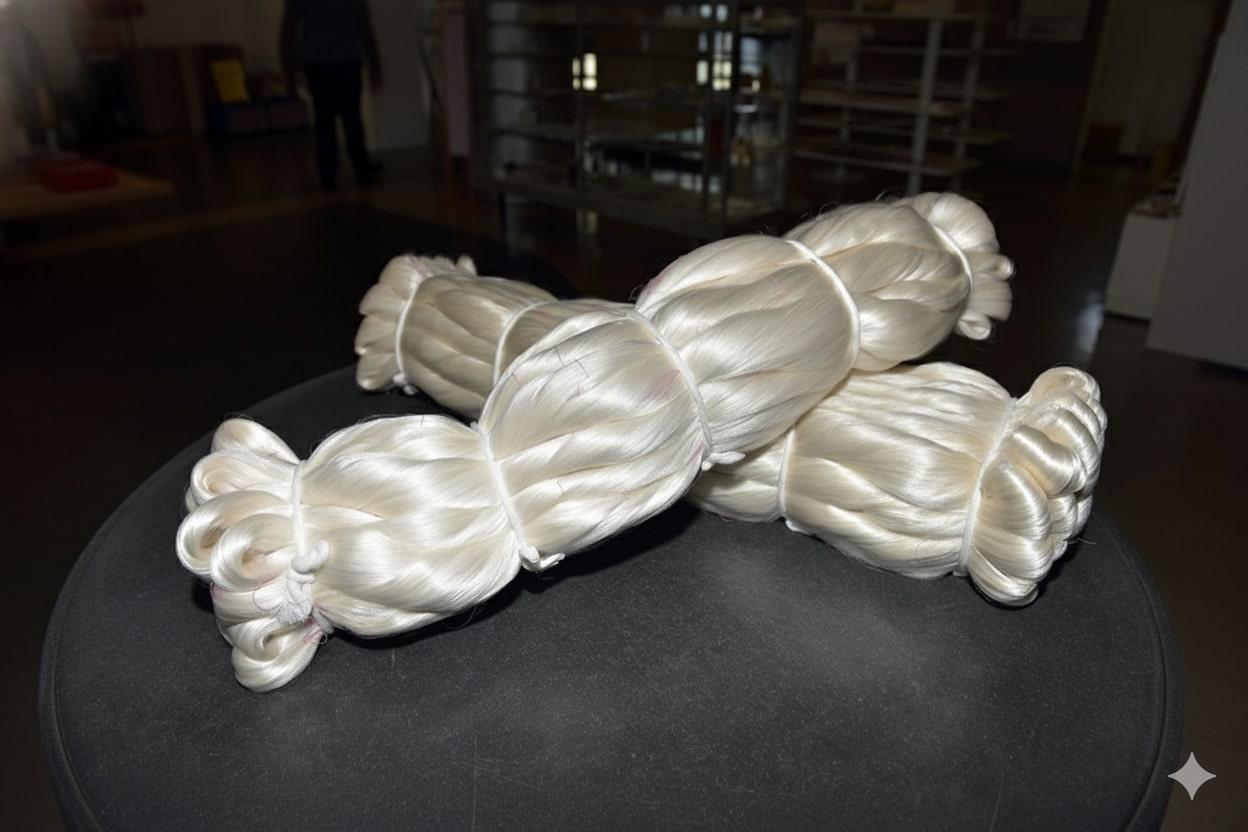
Iyo Ham İpeği (Yapay Zeka ile Oluşturulmuştur.)
Iyo Raw Silk (original name: Iyoito) is a traditional geographical indication silk product produced in Seiyo City, Ehime Prefecture, Japan. It is distinguished by its luminosity resembling the white camellia flower, a soft and lofty texture, and a voluminous structure compared to ordinary raw silks.
The production area of Iyo Raw Silk is Seiyo City in Ehime Prefecture. Thanks to the region’s favorable geographical and climatic conditions, the sericulture industry began in the early Meiji period (around 1900). The industry reached its peak during the early Shōwa period (1930s–1940s). However, this traditional industry gradually disappeared due to declining domestic demand for kimono and the widespread availability of cheaper imported silk. Today, the traditional production method, culture, and manufacture of Iyo Raw Silk are preserved and exhibited solely at the Nomura Silk Museum, which also serves as the official applicant for the geographical indication.
About Iyo Raw Silk (Geographical Indication Product Information Website)
Iyo Raw Silk possesses superior qualities compared to other raw silks due to its unique production methods. The silk exhibits a luminosity akin to the white camellia, a soft and lofty texture, and a voluminous structure. When woven into fabric, it imparts a soft and warm feel. It is particularly noted for its resistance to stretching when used as a kimono and its tendency to tighten when used as an obi (sash).
The fundamental and distinguishing feature of Iyo Raw Silk production is the use of raw cocoons instead of heated and dried ones. In typical domestic silk production, cocoons are heated and dried to prevent the silkworm pupa from emerging as a moth and to inhibit mold growth; this method is suitable for long-term storage of large harvests. However, Iyo Raw Silk producers believe that silk obtained from raw cocoons yields superior quality. Therefore, the cocoons are stored unheated in refrigerators and processed using traditional methods. Since the cocoon is composed of a protein secreted by the silkworm, even minimal heat hardens it. Using raw cocoons preserves the natural waviness of the silk filaments, which are extruded in an S-shape by the silkworms, resulting in a voluminous structure unmatched by raw silks from other production regions. The reeling process is carried out using water sourced from the Shikoku cordillera and traditional manual machinery.
Geographical Indication Product Information Website. "10 Iyoito." YouTube. Accessed October 24, 2025. https://www.youtube.com/watch?v=MtQ35huGqD4
Information Website on Japan Geographical Indication Products. “Kumamoto Kensan Igusa Tatami-omote for Rear Side.” Accessed October 24, 2025. https://pd.jgic.jp/en/register/entry/10.html
Ministry of Agriculture, Forestry and Fisheries (MAFF). “Product Summary (Registration No. 10).” MAFF. Accessed October 24, 2025. https://www.maff.go.jp/e/policies/intel/gi_act/register/s10.html

Iyo Ham İpeği (Yapay Zeka ile Oluşturulmuştur.)
Production Area and History
Characteristics and Quality
Production Method