


This article was automatically translated from the original Turkish version.
+1 More
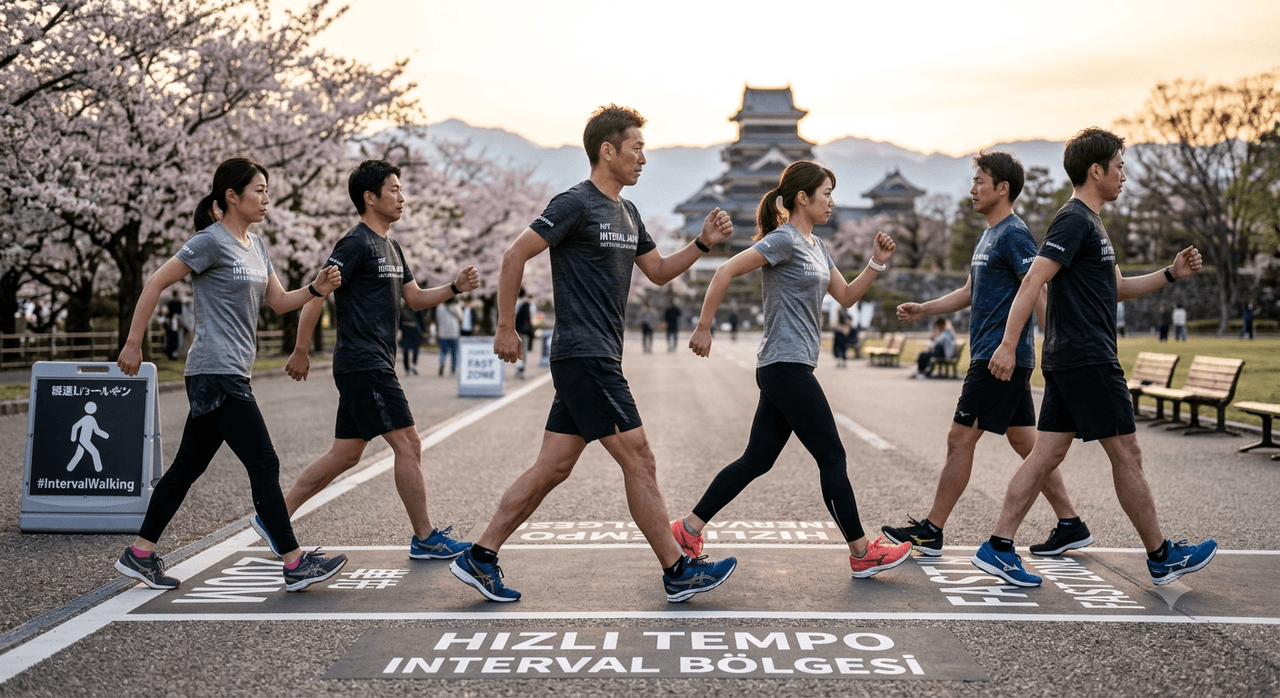
Japanese Walk (Generated with Artificial Intelligence.)
Type | Interval exercise / Fitness routine | ||||||||
|---|---|---|---|---|---|---|---|---|---|
Year Developed | 2007 | ||||||||
Developers | Prof. Hiroshi Nose Prof. Shizue Masuki | ||||||||
Developing Institution | Shinshu University (Japan) | ||||||||
Year of Global Popularization | 2026 | ||||||||
Person Who Made It Known | Eugene Teo | ||||||||
Application Protocol | For 30 minutes; 3 minutes fast/tempo followed by 3 minutes slow/resting walk transition | ||||||||
Year of Popularization | 2026 | ||||||||
Japanese Walking is an interval exercise method (Interval Walking Training - IWT) based on alternating periods of high and low intensity walking. The method was scientifically defined by Japanese researchers in 2007 and was initially recommended to improve physical fitness in middle-aged and older adults. In subsequent years it began to be applied across different age groups and gained international recognition on social media platforms in the mid-2020s.
Japanese Walking was developed as a result of exercise physiology research conducted by Shinshu University researchers Hiroshi Nose and Shizue Masuki. The researchers aimed to create an applicable low-cost and sustainable exercise model to counteract issues such as muscle strength loss and reduced cardiovascular capacity associated with aging.【1】 The first clinical study published in 2007 examined the method’s effects on physical fitness; subsequent research evaluated its long-term health outcomes.【2】
For approximately twenty years the method remained known primarily within academic circles until 2026 when social media content creators introduced it as “Japanese Walking” or “Japanese Walking Method” triggering renewed global interest.
The core principle of the method is based on the overload principle in exercise physiology and requires no specialized sports equipment or gym membership. The standard program consists of repeating alternating cycles of three minutes of brisk brisk walking and three minutes of slow walking at a pace that allows conversation, for a total duration of 30 minutes.
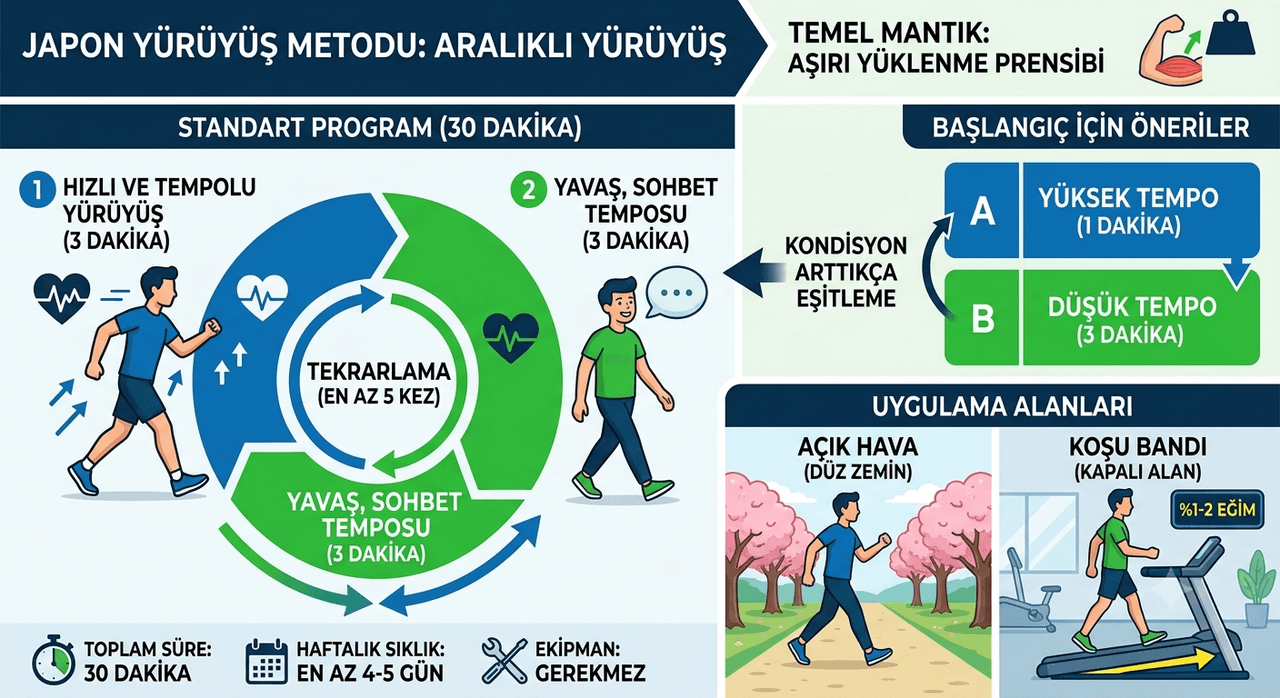
Japon Yürüşünün Uygulama Metodunu İfade Eden Bir Görsel (Yapay Zeka ile Oluşturulmuştur)
Participants are advised to complete at least five cycles per session and follow the routine at least four or five days per week. For beginners the durations can initially be adjusted to one minute of high tempo and three minutes of low tempo, gradually equalizing to three minutes each as fitness improves.
The training can be performed outdoors on flat terrain or, when outdoor conditions are unsuitable, on a treadmill with an incline of 1 to 2 percent.
Scientific studies have demonstrated that interval walking produces greater improvements in physical fitness compared to steady-state walking.【3】 Individuals who followed this program for five months showed improvements in thigh and leg muscle strength, flexibility of lower limb joints (knee extension and flexion), and VO2 max values indicating enhanced oxygen consumption capacity.【4】
This cyclical training also benefits the cardiovascular system by lowering systolic blood pressure, improving circulation, increasing insulin sensitivity, and reducing the risk of stroke and heart disease.【5】 It has also been found to improve markers of lifestyle-related conditions such as diabetes and obesity by an average of 10 to 20 percent and to help maintain bone density.【6】
In addition to physical benefits, interval walking has positive effects on cognitive function and mental health. The continuous variation in pace during exercise compels individuals to focus on the present moment and their movements, creating a mindfulness effect.【7】
Longitudinal studies have shown that this method alleviates depression symptoms associated with aging and lifestyle, improves sleep quality, and reduces anxiety symptoms particularly in individuals with low baseline anxiety levels.【8】 By increasing blood and oxygen flow to the brain, the activity supports memory and triggers endorphin release, enhancing overall psychological well-being.
Japanese Walking gained global recognition following the release of short promotional videos on social media platforms in 2026. Thanks to content viewed extensively on TikTok, Instagram, and YouTube, the method reached broad audiences.【9】 A short video by fitness instructor Eugene Teo introducing the method as “Japanese Walking” garnered millions of views on social media, after which numerous users shared their own experiences with the practice.【10】
Brown Health University. "Interval Walking: Health Benefits of the "Japanese Walking Method"." Accessed July 17, 2026.https://www.brownhealth.org/be-well/interval-walking-health-benefits-japanese-walking-method
CNN. "‘Japanese’ interval walking is an easy way to become fit, experts say". Accessed July 17, 2026.
NHK World Japan. "How a Japanese exercise routine became a global sensation". Accessed July 17, 2026.https://www3.nhk.or.jp/nhkworld/en/news/backstories/4530/
euronews. "'Japon yürüyüşü': Uzmanlara göre güç, zindelik ve kalp sağlığına katkı sağlıyor." Accessed July 17, 2026.https://tr.euronews.com/saglik/2025/07/30/japon-yuruyusu-uzmanlara-gore-guc-zindelik-ve-kalp-sagligina-katki-sagliyor
[1]
Euronews. "'Japon yürüyüşü': Uzmanlara göre güç, zindelik ve kalp sağlığına katkı sağlıyor." Accessed July 17, 2026.https://tr.euronews.com/saglik/2025/07/30/japon-yuruyusu-uzmanlara-gore-guc-zindelik-ve-kalp-sagligina-katki-sagliyor.
[2]
Euronews, "'Japanese walking': According to experts, it contributes to strength, endurance, and heart health"
[3]
Euronews, "'Japanese walking': According to experts, it contributes to strength, endurance, and heart health"
[4]
CNN, "‘Japanese’ interval walking is an easy way to become fit, experts say", erişim 17 Temmuz 2026, https://edition.cnn.com/2025/10/17/health/japanese-walking-interval-training-wellness.
[5]
Euronews, "'Japanese walking': According to experts, it contributes to strength, endurance, and heart health"
[6]
CNN, "‘Japanese’ interval walking is an easy way to become fit, experts say"
[7]
Euronews, "'Japanese walking': According to experts, it contributes to strength, endurance, and heart health"
[8]
Euronews, "'Japanese walking': According to experts, it contributes to strength, endurance, and heart health"
[9]
NHK World Japan, "How a Japanese exercise routine became a global sensation", erişim 17 Temmuz 2026, https://www3.nhk.or.jp/nhkworld/en/news/backstories/4530/.
[10]
NHK World Japan, "How a Japanese exercise routine became a global sensation"


Japanese Walk (Generated with Artificial Intelligence.)
Type | Interval exercise / Fitness routine | ||||||||
|---|---|---|---|---|---|---|---|---|---|
Year Developed | 2007 | ||||||||
Developers | Prof. Hiroshi Nose Prof. Shizue Masuki | ||||||||
Developing Institution | Shinshu University (Japan) | ||||||||
Year of Global Popularization | 2026 | ||||||||
Person Who Made It Known | Eugene Teo | ||||||||
Application Protocol | For 30 minutes; 3 minutes fast/tempo followed by 3 minutes slow/resting walk transition | ||||||||
Year of Popularization | 2026 | ||||||||
History
Application Method
Effects on Physical Health
Mental and Psychological Benefits
Social Media Impact and Global Popularity