


This article was automatically translated from the original Turkish version.
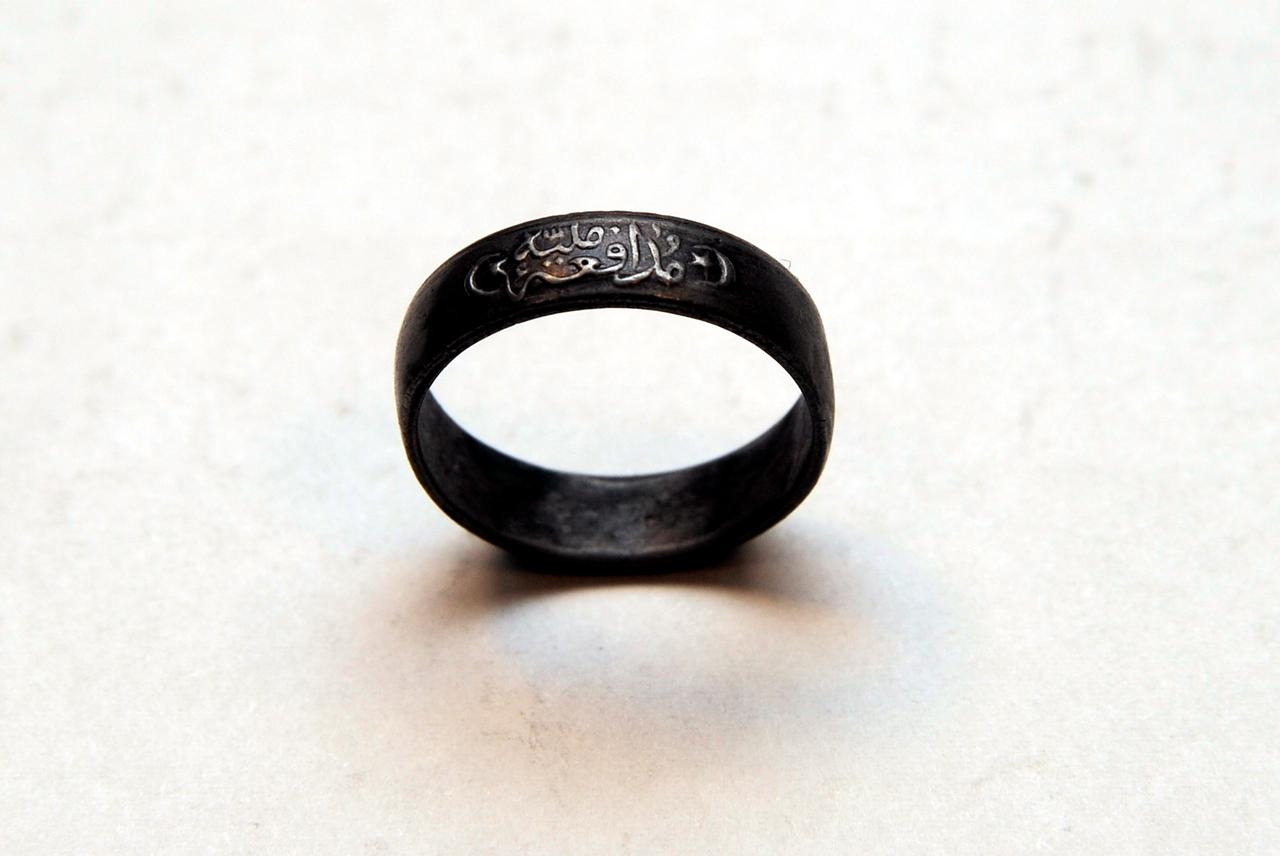
Cihadiye Ring
Production Date | 1914 | ||||||||
|---|---|---|---|---|---|---|---|---|---|
Project Owner | Mudâfaa-i Millîye Cemiyeti | ||||||||
Material(s) | Scrap and cast materials | ||||||||
Cost Per Ring | 20 Para | ||||||||
Sales Per Ring | 200 Para | ||||||||
Technical | Relief | ||||||||
Cihadiye rings were symbolic accessories produced during World War I in the Ottoman State, particularly during the Çanakkale Front campaign, to mobilize public material and spiritual support for the war effort. These rings became one of the most significant symbols of social solidarity during the conflict and evolved into a powerful tool of propaganda and wartime mobilization.

Cihadiye Ring (AA)
Following the Ottoman State’s entry into the war in 1914, Sultan and Caliph Mehmed Reşad proclaimed the Cihâd-ı Ekber (Great Jihad), which mobilized the Muslim population both at the front lines and on the home front. In this context, the Müdâfaa-i Millîye Cemiyeti launched the Cihadiye Rings project to alleviate the financial burden of war and garner public support.
Cihadiye rings were manufactured from scrap and cast materials, with an initial production target of 50,000 units. The cost of each ring was set at 20 para, while the selling price was fixed at 5 kuruş (200 para). The projected revenue of 250,000 kuruş from sales was allocated such that 225,000 kuruş would be directly directed toward aid activities.
One side of the Cihadiye rings bears the inscription "Cihâdîye" beneath which the Hijri date 1332 is engraved; the other side displays the text "Müdâfaʻa-i Millîye" between two crescent and star motifs. The inscriptions were executed in relief technique, and original rings contain no cut lettering. Today, authentic examples of these rings are extremely rare, while commercially produced counterfeit versions do not correspond to historical reality.
To promote and popularize the rings, officials of the Society presented them to Sultan Mehmed Reşad and Crown Prince Yusuf İzzeddin Efendi. The Sultan publicly wore his ring, setting an example for the public and donating 100 Ottoman gold liras. This gesture encouraged widespread public participation, and within a short time the rings were made available for sale at Müdâfaa-i Millîye Cemiyeti branches and various shops.
Women made significant contributions to the sales and promotion of the rings. In particular, the Hilâl-i Ahmer Cemiyeti Hanımlar Merkezi and the women’s branches of the Müdâfaa-i Millîye Cemiyeti went door to door to encourage public donations. Revenue generated from ring sales funded numerous services, including the treatment of wounded soldiers and assistance to families of servicemen.
Due to their non-durable materials, only a small number of original Cihadiye rings have survived to the present day. Their rarity has enhanced their historical value. Meanwhile, many products currently sold on the market under the name "Cihadiye Ring" are commercial imitations that do not align with historical authenticity.
Anadolu Ajansı. “Cihadiye Yüzüğü Değer Bulduğu Topraklarda.” Accessed June 8, 2025. https://www.aa.com.tr/tr/vg/video-galeri/cihadiye-yuzugu-deger-buldugu-topraklarda/2
Atabay, Mithat. 2022. “Cihadiye Yüzükleri.” *Çanakkale Savaşları Ansiklopedisi*. Istanbul: Çanakkale Savaşları Enstitüsü Yayını. Accessed June 8, 2025. https://canakkalesavaslariansiklopedisi.com/wp-content/uploads/2022/10/cihadiye-yuzukleri-csa.pdf
Erdemir, Lokman. 2012. “Çanakkale Muharebeleri Sırasında İstanbul’da Yardım Faaliyetleri.” *Çanakkale Araştırmaları Türk Yıllığı* 10, no. 12: 35–60. Accessed June 8, 2025. https://dergipark.org.tr/tr/download/article-file/45147
Yazıcı, Nevin. 2011. “Çanakkale Savaşı’nda Türk Kadınının Rolü / The Role of Turkish Women During the Gallipoli Campaign.” *Akademik Bakış* 5, no. 9: 245–251. Accessed June 8, 2025. https://dergipark.org.tr/tr/download/article-file/73937

Cihadiye Ring
Production Date | 1914 | ||||||||
|---|---|---|---|---|---|---|---|---|---|
Project Owner | Mudâfaa-i Millîye Cemiyeti | ||||||||
Material(s) | Scrap and cast materials | ||||||||
Cost Per Ring | 20 Para | ||||||||
Sales Per Ring | 200 Para | ||||||||
Technical | Relief | ||||||||
Historical Background and Purpose
Production and Financial Model
Design Features
Political and Social Impact
Public Participation and the Role of Women
Current Status