


This article was automatically translated from the original Turkish version.
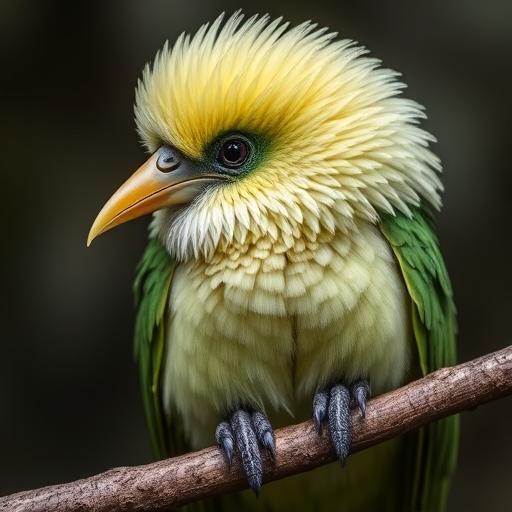
Kakapo
Scientific Name(s) | Strigops habroptilus | ||||||||
|---|---|---|---|---|---|---|---|---|---|
Team(s) | Psittaciformes | ||||||||
Family | Strigopidae | ||||||||
Habitat | New Zealand | ||||||||
Length(s) | Approximately 60 cm | ||||||||
Weight(s) | 2–4 kg | ||||||||
Diet(s) | Herbivorous (plants fruits) seeds | ||||||||
Reproduction Method | Leek system, females take care of the young | ||||||||
Conservation Status | Critically Endangered (IUCN CR) | ||||||||
Distinguishing Feature | Flightless, nocturnal, and heavy-bodied parrot | ||||||||
The kakapo (Strigops habroptilus) is a flightless, nocturnal parrot species endemic to New Zealand. It belongs to the family Strigopidae within the order Psittaciformes. This species is taxonomically unique and the only member of the genus Strigops. It is also an evolutionarily ancient and highly isolated species.
The kakapo is approximately 60 cm in length and weighs between 2 and 4 kg. Its feathers are greenish-yellow with black markings, providing camouflage against the forest floor. Its wings are short and weak, rendering it incapable of flight. However, it can climb trees and make gliding leaps over short distances.
Its facial structure resembles that of an owl, leading some sources to refer to it as the “owl parrot.” This morphology has evolved to support nocturnal vision.

Generated by artificial intelligence
The kakapo is a herbivorous species active at night. Its diet consists primarily of native plants, fruits, seeds, and leaves. The fruit of the rimu tree is a critical food source during the breeding season.
The kakapo communicates through vocal calls. During the breeding season, males attract females with deep, resonant calls known as “booming.” These calls can be heard several kilometers away.
The kakapo reproduces via a lek mating system, in which males gather in specific areas to compete for females. Females alone build nests and care for the young. Breeding intervals are irregular and typically coincide with years of abundant rimu fruit production. The incubation period lasts approximately 30 days.
The International Union for Conservation of Nature (IUCN) classifies the kakapo as Critically Endangered. As of 2025, the total population of living individuals is below 250. The species’ risk of extinction has increased due to habitat destruction and invasive predatory species introduced by humans, particularly cats and stoats.
Conservation efforts are carried out on various isolated islands in New Zealand. Under the Kakapo Recovery program, individuals are monitored, genetic diversity is preserved, and artificial insemination techniques are being developed.
BirdLife International. "Species factsheet: Strigops habroptilus." BirdLife DataZone. Accessed May 3, 2025. .
Department of Conservation (NZ). "Kakapo Recovery." New Zealand Department of Conservation. Accessed May 2, 2025.
Eason, Charles T. et al. "The history, ecology and management of the Kakapo (Strigops habroptilus)." Notornis 51.1 (2004): 3–17. Accessed May 2, 2025.
White, David J., et al. "Evolution of lekking behavior in the Kakapo: Evidence from conservation studies." *Biological Conservation* 126.1 (2005): 113–124.

Kakapo
Scientific Name(s) | Strigops habroptilus | ||||||||
|---|---|---|---|---|---|---|---|---|---|
Team(s) | Psittaciformes | ||||||||
Family | Strigopidae | ||||||||
Habitat | New Zealand | ||||||||
Length(s) | Approximately 60 cm | ||||||||
Weight(s) | 2–4 kg | ||||||||
Diet(s) | Herbivorous (plants fruits) seeds | ||||||||
Reproduction Method | Leek system, females take care of the young | ||||||||
Conservation Status | Critically Endangered (IUCN CR) | ||||||||
Distinguishing Feature | Flightless, nocturnal, and heavy-bodied parrot | ||||||||
No Discussion Added Yet
Start discussion for "Kakapo (Strigops habroptilus)" article
Morphology and Physical Characteristics
Behavior and Ecology
Reproductive Biology
Conservation Status