This article was automatically translated from the original Turkish version.
Registration Number | 129 | ||||||||
|---|---|---|---|---|---|---|---|---|---|
Registration Date | 06.01.2011 | ||||||||
Application Number | C2008/049 | ||||||||
Application Date | 18.12.2008 | ||||||||
Name of the Geographical Indication | Kale Pepper | ||||||||
Product Name | Pepper | ||||||||
Type of Geographical Indication | Place of origin | ||||||||
Applicant/Registrant(s) | Kale Municipal Mayorship | ||||||||
Address of the Registrant | Cevherpaşa Neighborhood, Atatürk Street No:19, Kale, DENİZLİ | ||||||||
Geographical Boundary | Kale district of Denizli Province (villages of Alanyurt Özlüce) and villages Habibler Gökçeören Demirciler | ||||||||
Kale pepper is a local variety of pepper belonging to the species Capsicum annuum of the Solanaceae family, unique to the Kale district of Denizli Province. This pepper is cultivated primarily in the Akçay Basin, encompassing the villages of Alanyurt, Demirciler, Gökçeören, Habibler, and Özlüce, where its distinctive morphological and chemical properties develop due to the region’s unique microclimate conditions. The fruits are large, thick-fleshed, three-lobed, and exhibit a bright orange-red color; their taste profile varies between mild pungency and a slightly sweet note.
Kale pepper is a local variety of Capsicum annuum within the Solanaceae (nightshade) family, specifically cultivated in the Kale district of Denizli Province. Distinguished by its unique morphological and chemical characteristics, this pepper variety is utilized in various forms, from fresh consumption to drying and production of pepper flakes. During the registration process, the product is protected under a geographical indication labeled as “origin name.”
The cultivation area of Kale pepper is confined to the Akçay Basin, which includes the villages of Alanyurt, Demirciler, Gökçeören, Habibler, and Özlüce under the Kale district of Denizli Province. Experiments conducted outside this microclimate zone have failed to preserve the desired quality and distinguishing characteristics of the product. Consequently, the production area is strictly limited to the boundaries specified in the registration certificate.
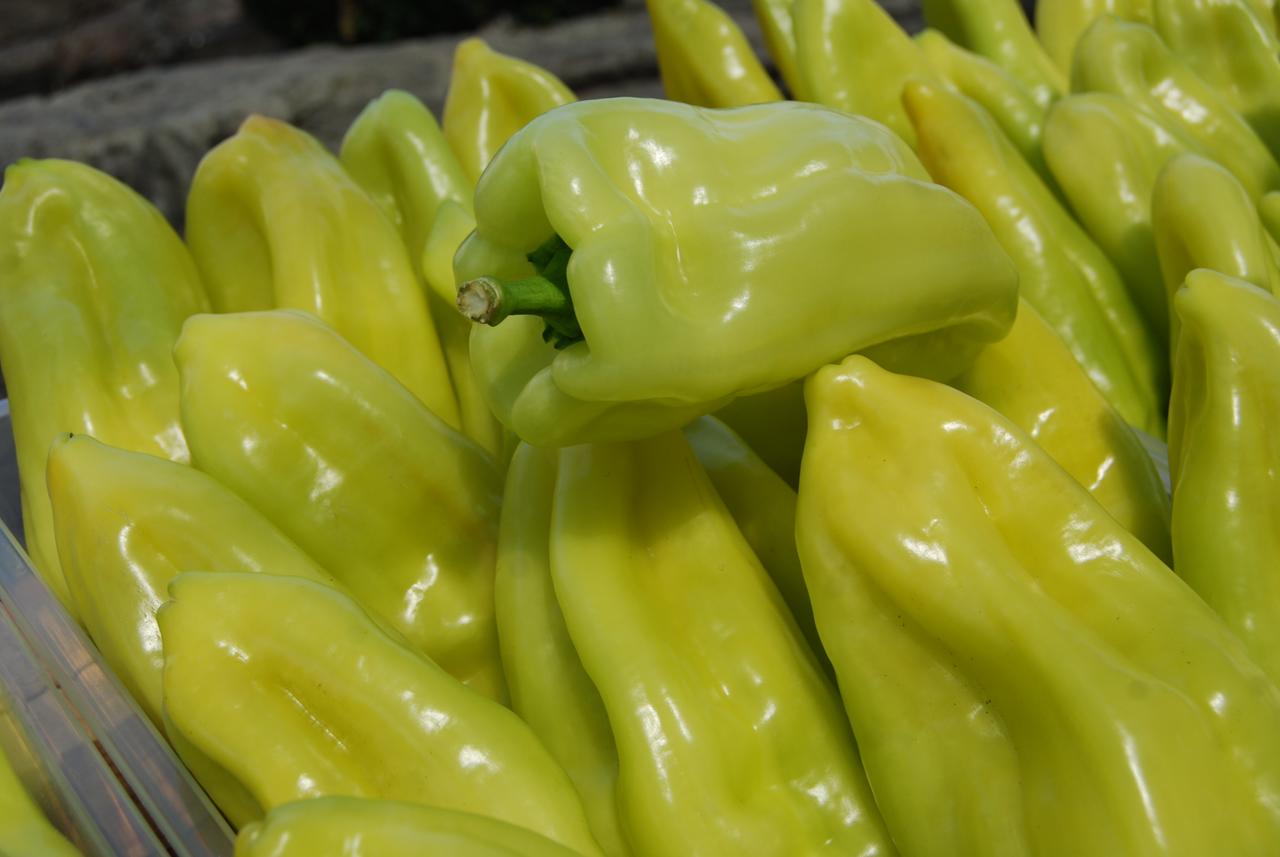
The Kale pepper plant exhibits a semi-upright growth habit and can reach a height of 50–60 cm. Moderate anthocyanin development is observed on the stems and node regions. The leaves are green, broad, and elongated, with a slightly wavy and weakly convex structure. The fruits are typically three-lobed and three-seeded, with a triangular cross-section, medium-thick flesh, and a smooth surface.
Before ripening, the fruit is yellowish-green; upon full maturity, it turns bright orange-red. The fruit flesh is fleshy and exhibits strong gloss. The average fruit weight ranges from 125 to 150 grams, with a diameter of 50–60 mm and a length of approximately 15–20 cm. The taste profile is mildly pungent, with a prevalent sensation of sweet-spicy flavor. The plant is self-pollinating, but cross-pollination may occur depending on environmental conditions.
Chemical analyses conducted on the 2009 harvest revealed significant differences between fresh and dried forms of Kale pepper. In fresh pepper, the moisture content was 93.34%, fat 0.17%, protein 1.12%, and carbohydrates 4.48%. In dried pepper, these values were 3.58% moisture, 11.53% fat, 30.15% protein, and 84.1% carbohydrates. Additionally, vitamin C content was measured at 823.3 mg/kg in fresh produce and dropped to 23.8 mg/kg in the dried form. Nitrate levels were determined at 604.15 ppm in fresh pepper and 57.80 ppm in dried pepper.
Successful cultivation of Kale pepper requires warm and temperate climatic conditions. This plant is highly sensitive to frost and must be transplanted into the field only after the danger of spring frost has passed. Preferred soil types are loamy, rich in organic matter, and with high water retention capacity.
The production cycle begins in February–March with sowing seeds on heated seedbeds. Seedlings are transplanted into the field using the transplanting method during April–May, when they reach sufficient size. Row spacing is typically maintained at 60–80 cm, and intra-row spacing at 15–25 cm. After transplanting, seedlings receive a thorough watering.
It is recommended to apply 3 tons/ha of composted animal manure in autumn. At planting, half of the nitrogen fertilizer (15 kg/ha) and 10 kg/ha of phosphorus fertilizer are applied; the remaining nitrogen is applied before the first irrigation. Irrigation frequency is set at every 7–10 days until fruit set, then reduced to every 2–3 days thereafter. Irrigation is discontinued by late September to early October. Use of drip irrigation has been observed to increase yield and improve plant uniformity.
Harvesting begins at the end of July and continues until mid-October. A total of six to ten harvests can be carried out. Under conventional farming conditions, yield averages approximately 4 tons per hectare; with improved management practices, this can reach 8–10 tons per hectare.
Monitoring of Kale pepper is conducted by a commission established under the chairmanship of the Kale District Governorship, comprising representatives from the Kale Municipality, the District Directorate of Agriculture, and the Kale Chamber of Agriculture. Inspections are carried out at least twice annually, particularly during July–August, on both fields and harvested products to verify adherence to the distinctive characteristics of Kale pepper. Additional inspections are conducted in response to complaints. An annual competition is held to incentivize producers to maintain high quality standards.
Turk Patent and Trademark Office. "Kale Biberi." *Coğrafi İşaret ve Geleneksel Ürün Adı Bülteni*. Accessed July 20, 2025. https://ci.turkpatent.gov.tr/cografi-isaretler/detay/38005.
Türk Patent ve Marka Kurumu. *Kale Biberi Coğrafi İşaret Tescil Belgesi ve Teknik Şartnamesi*. Ankara: Türk Patent ve Marka Kurumu, 2011. https://ci.turkpatent.gov.tr/Files/GeographicalSigns/2307335e-5e68-4450-82d7-5d034cbc36c8.pdf.

Registration Number | 129 | ||||||||
|---|---|---|---|---|---|---|---|---|---|
Registration Date | 06.01.2011 | ||||||||
Application Number | C2008/049 | ||||||||
Application Date | 18.12.2008 | ||||||||
Name of the Geographical Indication | Kale Pepper | ||||||||
Product Name | Pepper | ||||||||
Type of Geographical Indication | Place of origin | ||||||||
Applicant/Registrant(s) | Kale Municipal Mayorship | ||||||||
Address of the Registrant | Cevherpaşa Neighborhood, Atatürk Street No:19, Kale, DENİZLİ | ||||||||
Geographical Boundary | Kale district of Denizli Province (villages of Alanyurt Özlüce) and villages Habibler Gökçeören Demirciler | ||||||||
Classification
Geographical Distribution and Production Area
Botanical and Morphological Characteristics
Chemical Composition
Growing Conditions and Production Method
Fertilization and Irrigation
Harvest and Yield
Monitoring and Control Mechanism