This article was automatically translated from the original Turkish version.
+2 More
Location | Kuşadası / Aydın Türkiye | ||||||||
|---|---|---|---|---|---|---|---|---|---|
Construction Date(s) | Early 17th century (before 1617) | ||||||||
Founder(s) | Grand Vizier and Damat Konevî Öküz Mehmet Pasha | ||||||||
Architectural Style(s) | Ottoman classical style 19th century Baroque influences | ||||||||
Material(s) | Cut stone wood marble brick broken stone | ||||||||
Kaleiçi Camii is located at Yedi Eylül Street No: 8 in the Camikebir Neighborhood of Kuşadası district, Aydın Province, at the heart of the historic urban fabric enclosed by ancient walls. The building, also known as Öküz Mehmet Paşa Camii, is the oldest mosque in Kuşadası and is situated within the Kaleiçi quarter, which forms the core of the town’s original settlement.
Although the mosque’s foundation inscription has not survived, archival records from the General Directorate of Foundations dating to before 1617 indicate that it was commissioned by Grand Vizier and Damat Konevî Öküz Mehmet Paşa. Öküz Mehmet Paşa served as vizier and governor of Egypt in 1607, as Kapudan Pasha in 1611, as Second Vizier in 1612, and as Grand Vizier twice in 1614 and 1619; he died in 1622. The foundation deeds refer to “a fine mosque in the place named Kuşadası” and state that the mosque was constructed in the 17th century alongside the Öküz Mehmet Paşa Caravanserai.
In 1830, a three-arched western prayer hall was added to the northern facade of the mosque; during this renovation, certain elements such as the mihrab were redesigned in the Baroque style. Repairs were carried out on the minaret in 1712, and further additions to the mihrab and interior arrangements were made in 1982.
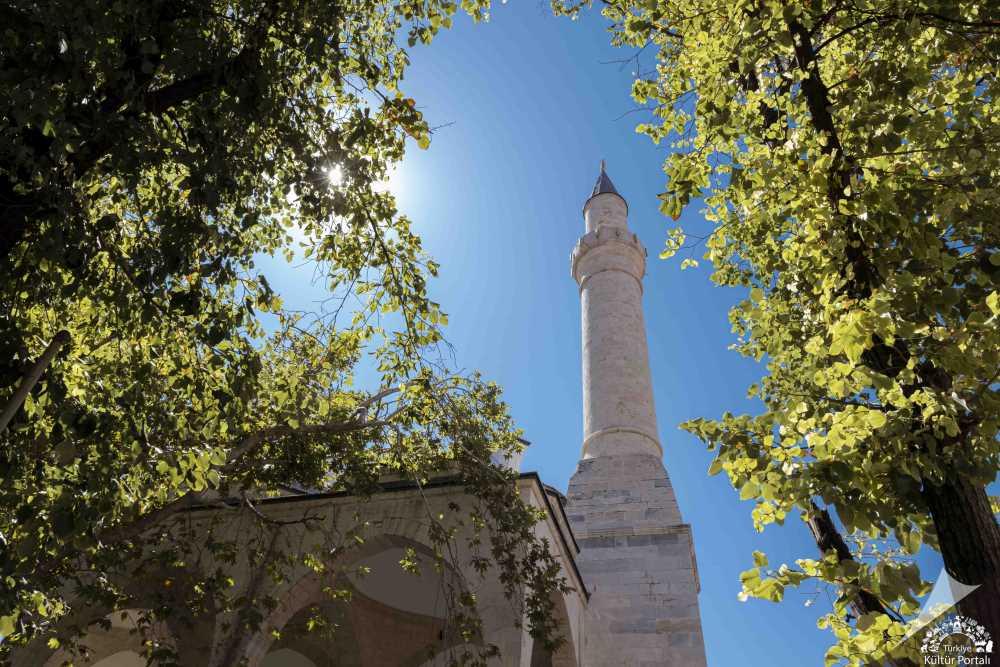
The octagonal-based minaret features a round-arched niche on each face. The transition from the base to the cylindrical shaft is achieved through triangular elements. The shaft, base, and the area beneath the balcony are encircled by bands. The bricks of the balcony are arranged in a triangular tooth pattern. The balcony railings and honeycomb section have been renewed with brick, and the finial is covered with sheet metal. A four-line inscription above the door leading to the dome base indicates that the minaret was repaired in 1712.
Located in the northeast corner of the mosque, to the left of the entrance, the library was built in 1812 by İlyas Ağa, the governor of the Sığla Sanjak. The library has a near-square rectangular plan, consists of a single space, and is covered by an oval dome. It is connected to the mosque via an adjacent window. Its foundation inscription, dated using the abjad system to Hijri 1227 (Gregorian 1812), confirms this date. Today, it serves as the Kuşadası District Muftiate Family and Guidance Center.
The mosque is situated within a garden covering 1800 m². In the past, the garden housed a Quranic instruction class and a foundation library. The ablution areas are spacious and shaded. Due to its location within the marketplace, access is possible through three separate entrances.
The mosque has a capacity of approximately 550 worshippers and is suitable for congregational prayers. It is currently active and open for worship, serving as a destination for both local and foreign visitors.
Kaleiçi Camii incorporates elements of Ottoman classical style alongside Baroque details added in the 19th century. The wooden kündekârî door with mother-of-pearl inlays, the plaster mihrab decorations, and the painted column motifs on the drum windows enhance the architectural and artistic value of the structure.
The mosque has undergone various restorations since the 17th century and is currently well preserved. Periodic renewal works have been carried out on the minaret and interior spaces.
Turkish Ministry of Culture and Tourism. “Kaleiçi Camii – Aydın.” *Kültür Portalı*. Accessed August 16, 2025. https://www.kulturportali.gov.tr/turkiye/aydin/gezilecekyer/kaleici-camii-
Turkish Ministry of Culture and Tourism. “Kaleiçi Camii – Aydın.” *Kültür Portalı*. Accessed August 16, 2025. https://www.kulturportali.gov.tr/turkiye/aydin/gezilecekyer/kaleici-camii-
“Kale İçi Cami.” *Tarihi Mekanlar Kişisel Ansiklopedi – Türkiye’nin Tarihi Eserleri*. Accessed August 16, 2025. https://turkiyenintarihieserleri.com/?oku=1794
Location | Kuşadası / Aydın Türkiye | ||||||||
|---|---|---|---|---|---|---|---|---|---|
Construction Date(s) | Early 17th century (before 1617) | ||||||||
Founder(s) | Grand Vizier and Damat Konevî Öküz Mehmet Pasha | ||||||||
Architectural Style(s) | Ottoman classical style 19th century Baroque influences | ||||||||
Material(s) | Cut stone wood marble brick broken stone | ||||||||
History
Architectural Features
Minaret
Ilyas Ağa Library
Garden and Surrounding Layout
Capacity and Usage
Artistic and Stylistic Features
Conservation Status